Medieval Hanseatic square
Town Hall Square Audio Guide (Raekoja plats)
The old market of Hanseatic Tallinn, from which every street in the city starts its numbering: a cobbled space that was a court, a festival hall and the place where the name Tallinn was first written down, under the gaze of a copper soldier.
- 45 min audio
- Hanseatic Gothic
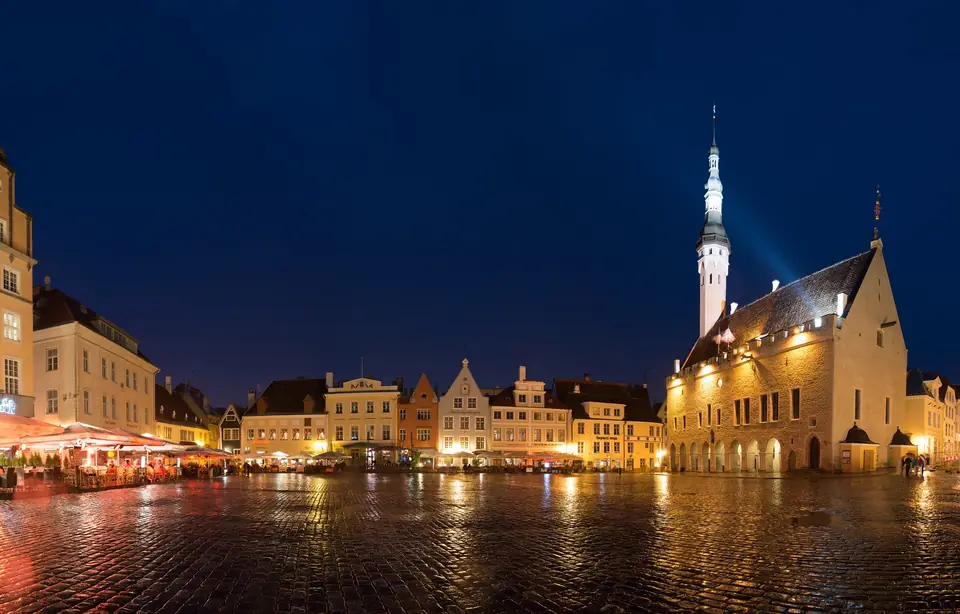
The square appears in documents in 1313 as forum, in 1371 as market and by 1442 as the Old Market; the name Raekoja plats, “Town Hall Square”, was not made official until 1923. Its south side is taken up by a long Gothic block of grey limestone, with a crenellated parapet and dragon gargoyles, which the city’s official website presents as the only surviving Gothic town hall in northern Europe. Rebuilt between 1402 and 1404 by the stonemason Ghercke, it holds inside three walls and seven windows of the 1322 building, the oldest civil architecture in Tallinn.
Across from that solemn façade, on one corner of the square, a pharmacy documented since 1422 is still open in the same premises. Its 1695 price list named more than 3,200 remedies, among them mummy powder, burnt hedgehogs and human fat, and also the clarea, the spiced wine it has made since 1467 and which councillors came to drink to hear the news and close deals. It still sells a marzipan that local tradition recommends for heartbreak.
Highlights
- Vana Toomas, the copper soldier-weathervane who has watched over the 64-metre tower since 1530, now in his third version, from 1996
- A Gothic arcade of nine arches, walled up in 1650 and reopened in 1959, with the iron ring of the old pillory
- Raeapteek, a pharmacy documented since 1422 in the same premises and run for ten generations by a Johann Burchart
- Two L-shaped stones in the cobbles, protected as antiquities, tied to an execution wrapped in legend
- Zero point of Tallinn’s street addresses and setting of the Brotherhood of Blackheads’ Christmas tree in 1441
The history of Raekoja plats is that of a market that never stopped being the centre of the city. Documents call it forum in 1313, market in 1371 and Old Market (Vana turg) in 1442; the Great Market was held in front of the town hall until 1896, and only in 1923 did it officially receive its present name. It is also Tallinn’s zero point: the house numbers of every street are counted from the side of the square.
The architecture of Raekoja plats revolves around its south side. There stands the Gothic town hall, already mentioned in 1322 with a large meeting hall and a huge storeroom, rebuilt between 1402 and 1404 in two storeys with a tower and arcade, and crowned since 1530 by the weathervane of Vana Toomas. Around it are merchants’ houses from the 14th to the 20th century, many protected as cultural monuments and now occupied by café terraces and restaurants.
Beneath those terraces peek out traces of everything the square has been: market, pillory, tournament ground, setting for Christmas festivities and place of oaths. The audio guide walks the perimeter from the centre to the 1422 pharmacy, with documented narration, checked against historical sources, that saves for each point the detail you cannot see at a glance.
About 230 metres away, St Nicholas’ Church holds the last fragment of a medieval Dance of Death, and to the north, less than half a kilometre off, rises the spire of St Olaf’s Church.
The zero point and the five spires
Raekoja plats
Summary of this stop
The tour starts in the middle of the esplanade of uneven cobbles, the place from which streets such as Kullassepa, Dunkri, Kinga, Saiakang and Vanaturu kael begin, and from which Tallinn counts numbers 1 and 2 on each of them. Near the centre, a round stone is engraved with a windrose, and the custom is to stand on it and turn: it is said that from that spot the tips of the city’s five most famous spires, among them St Olaf, St Nicholas and the Holy Spirit, show above the rooftops all at once.
This ground also keeps a singular festival. In 1441 the members of the Brotherhood of Blackheads set up a Christmas tree here, danced and played around it and finally set it on fire; in 1584 the chronicler Balthasar Russow still described the custom of the burned fir in the market. In Estonia it is argued that it was the first public tree in the world, although Riga claims that primacy with a description from 1510 and some consider the Baltic origin of the tradition a myth. What remains today of that burning fir is what the narration reveals in the middle of the square.
The house that is no longer there
Site of the old weigh house
Summary of this stop
On the northwest corner, by the mouth of Kullassepa street, there is a gap with a history. Here in 1554–1555 stood the weigh house, the vaekoda, the first Renaissance building of the Lower Town, which from 1583 also served as the municipal wine cellar. It burned in the Soviet bombing of March 1944 and its ruins were demolished in 1946.
A few years before it was built, in 1536, the square lived through one of its noisiest days: the reception of the new Livonian master of the Teutonic Order, Hermann von Brüggenei. A gold thaler was minted, there was a banquet for 700 people in the town hall and a tournament in the square that ended in a bloody brawl between nobles and burghers. That same year the Estonians of Tallinn swore fidelity to him here, and the secretary Johann Sulstorp noted in the text two words with an unexpected weight for the city. Which they are, and why they matter, is told on this empty corner.
Walled-up arches and the punishment ring
Tallinna raekoda
Summary of this stop
Under the town hall’s nine-arch arcade, the cold stone and the echo change the scale of the square. The back wall is the 14th-century façade, with some old windows still visible, wrapped by the work directed by the stonemason Ghercke between 1402 and 1404. The documents of that reconstruction preserve the material hauled in: 600 logs, 581 beams, 46 pairs of main rafters and 107 cartloads of Lasnamäe limestone.
The arcade was not always open. In 1650–1652, when the main entrance was moved to the centre of the façade, it was walled up, and it stayed that way until 1959–1960. And one of its pillars had a less noble use: it served as a pillory, with an iron collar for the neck and shackles for the wrists. The iron ring, the kaelaraud, still hangs on the wall, beside the copper dragon-headed gargoyles that jut from the façade. What it meant to be tied up there, in full view of the whole market, is one of the episodes the audio guide reserves for this point.
The third Vana Toomas
Town Hall tower with Vana Toomas
Summary of this stop
At the top of the 64-metre octagonal tower, on a Renaissance spire with open galleries, a tiny silhouette turns: Vana Toomas, “Old Thomas”, a copper warrior who has crowned the tower since 1530. The council’s account book records that the painter Joachim was paid that year for gilding him. The original figure watched over the square until the spire burned in the Soviet bombing of 9 March 1944; in 1952 a copy was put up and the one seen today is the third, from 1996, with that date on its flag. Where the original ended up is disputed: the City Council’s official website places it in the building’s cellar, and other sources point to the City Museum.
His name might come from the town hall itself. The city council only admitted merchants of spotless reputation, with a lifetime post, and its elections were generally fixed for St Thomas’s Day, 20 December. When the 1952 spire was taken down in 1996, that 44-year-old Vana Toomas had lost his sword and his anchors were almost loose.
Legend has it that the model was a peasant boy who slipped into the crossbow contest of Tallinn’s rich youths, who shot at a wooden parrot on top of a pole. He won, but his origins denied him the prize, and the city gave him another destiny in return. How he ended up as the watchful grandfather of the whole city is revealed by looking at the tower while the narration plays.
The pharmacy of the Johanns and the L in the cobbles
Raeapteek
Summary of this stop
The tour ends in front of the Raeapteek, the Town Hall Pharmacy, on the corner with Apteegi street, under its hanging sign. Its first documentary mention is from 8 April 1422, although earlier openings are considered, and it has operated in the same premises ever since. The Burchart family ran it for ten generations, from about 1582 to 1911, always with an eldest son named Johann; inside, a small museum keeps their stone coat of arms of 1635. It is also said that one of them was called in 1725 to the deathbed of Peter the Great.
In the corner of the square nearest the pharmacy, two long cobbles form an L that café terraces usually cover in summer. Tradition ties them to the beheading of a clergyman at the end of the 17th century, although versions disagree on the motive for the crime: one speaks of an omelette, another of a jug of lukewarm beer. What is on record is that an early 20th-century plan in the National Archives of Estonia shows the placing of these two granite stones, entered in the state register of protected antiquities. The square stopped being the Great Market in 1896, but every year it fills with Old Town Days in June, Medieval Days in July and the Christmas market, and from the town hall the mayor proclaims the Christmas peace. What exactly happened on that L is the last story the audio guide tells in front of the pharmacy.