Gothic church
St Olaf’s Church Audio Guide (Oleviste kirik)
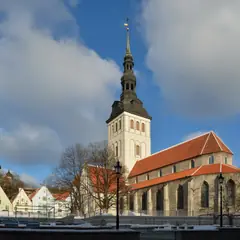
A 123.7-metre spire that guided ships towards Tallinn, that lightning set on fire again and again and that the KGB used as an antenna: the church of the Scandinavian merchants keeps the legend, the scars and the best view of the port.
- 45 min audio
- Gothic architecture
The church is dedicated to the Norwegian king St Olaf because it was born in the market square of the Scandinavian settlers, outside the oldest core of the city, and its first written mention dates from 1267. After the great fire of 1433, the three-aisled Gothic basilica seen today was raised between 1436 and 1450 under the master Andreas Kulpesu, with a central nave 31 metres high, the tallest in Estonia, and a stone tower of 57 metres.
For centuries that tower beside the port was a signal for ships, and also a magnet for lightning: in 1625 the spire burned and the bells melted, and in 1820 the spire collapsed in four hours while the authorities evacuated the neighbouring houses. Only Oleviste’s library survived that fire, hidden under the vaults of the sacristy. More than a century later, from 1944 to 1991, the same spire served the KGB as a radio antenna and lookout post.
Highlights
- A copper spire of 123.7 metres, rebuilt after the fire of 1820, which the KGB used as an antenna between 1944 and 1991
- The cenotaph of Hans Pawels, 1513: an empty tomb with a skeleton, a toad on its chest and a snake beside the skull
- Arent Passer’s sundial of 1602, the oldest surviving in Estonia
- A 31-metre central nave with star vaults, the tallest in Estonia
- A viewing platform at 60 metres after 258 steps of a historic spiral staircase, open from April to October
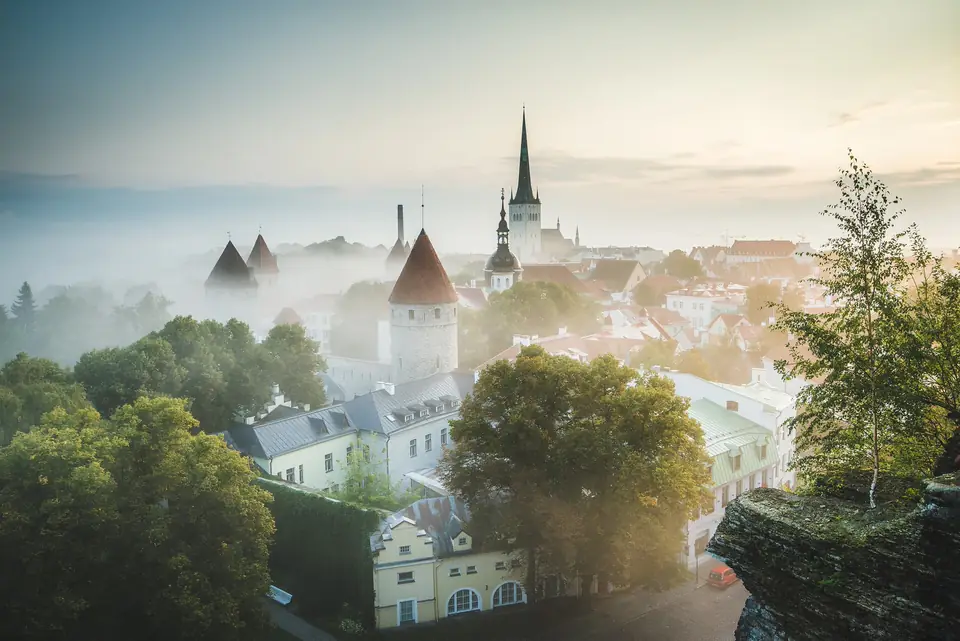
At the northern end of Tallinn’s old town, St Olaf’s Church (Oleviste kirik) raises a copper spire of 123.7 metres that can be seen from the sea. The history of Oleviste kirik begins in 1267, when the Danish queen Margaret Sambiria ceded its patronage to the Cistercian convent of St Michael; the historian Paul Johansen argued in 1951 that a church of St Olaf already existed before the Danish conquest of 1219, a hypothesis that neither archaeology nor documents have confirmed.
The architecture of Oleviste kirik is that of a three-aisled Gothic basilica raised between 1436 and 1450 on the ruins of a fire, with star vaults, a late Gothic chapel that never received its statues and a tower that lightning has struck so many times that even the sources do not agree on the count: some speak of eight strikes, others of a dozen. Through its nave passed Lutheran iconoclasm, a count who promoted the first Bible in Estonian, the rallies of 1917 and the congregations that Soviet power gathered here in 1950.
The audio guide walks the church from Lai street to the viewing platform at 60 metres, with documented narration, checked against historical sources, that reserves for each point its most surprising episode, from the legend of the builder who fell from the cross to the day the tower seemed to burn without fire.
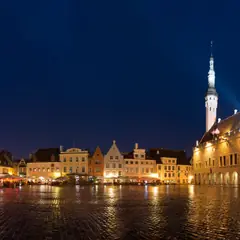
About 450 metres to the south, Town Hall Square marks the centre of the Lower Town, close to the other great merchants’ church, St Nicholas’ Church; one of the best-known views of this spire over the rooftops is the one from the Kohtuotsa Viewing Platform, on Toompea.
A merchants’ lighthouse on Lai street
Oleviste kirik
Summary of this stop
The tour starts on Lai street, in front of the west tower: 57 metres of stone, four corner turrets and, at the top, the copper spire with a sphere 114 centimetres across and the cross. Below opens the Gothic portal with moulded archivolts and, above it, a pointed five-light window reaching 27.5 metres. Dedicated to a Norwegian saint-king, Olav II Haraldsson, who died in 1030, the church was born among merchants, and around 1500 its Gothic spire of timber clad in tin measured some 115 to 125 metres: a tower like that, beside the port, served as a navigation signal.
Hence its fame as the tallest building in the world between 1549 and 1625, a record that is shaky. It comes from a document found in the tower in 1778 that gave the spire before the 1625 fire a height of 84 fathoms, and everything depends on which fathom is used: 134 metres with Tallinn’s, 159 with the Rhenish, 161 with the Hamburg or 179 with the Russian. The congregation and official Estonian tourism maintain 159 metres; other scholars consider it an error by early modern authors. Nor does the municipal rule exist, by the way, that is often said to forbid buildings taller than Oleviste in Tallinn.
Looking at the cross, the city’s most told legend makes sense, recorded in 91 versions by 45 parishes of Estonia: that of a foreign builder who asked for ten barrels of gold, unless the city guessed his name. A lullaby sung by his wife and a shout from the street were enough to change everything. How the story of Olev ends, and which animals appear in it, is revealed by listening to it right there, with the spire overhead.
A stone toad on an empty tomb
Cenotaph of Hans Pawels
Summary of this stop
Beside the chancel, on the Pikk street side, stands the Chapel of St Mary (1513–1523), with buttresses topped by pinnacles and empty niches: the Reformation came before the statues and the chapel was left unfinished. On its east outer wall waits the cenotaph of 1513 of the merchant Hans Pawels, promoter of the chapel. It is an empty tomb: below, a skeleton with a toad on its chest and a snake beside the skull; above, eight reliefs of the Passion, a shield with the family mark and an inscription in Low German comparing human life to smoke. Since 2021 it has been lit and sits under a new canopy.
On the south wall of the same chapel the sundial that the Tallinn stonemason Arent Passer carved in 1602 still tells the hours, the oldest surviving in Estonia, visible from the church garden.
The toad and the snake admit two readings. For Christian tradition they symbolise the double nature of the human heart and the corruption of thought, with a final message of hope in the reliefs of the Passion. For popular belief, they are the signature of Olev’s fall. Which of the two stories weighs more in front of the empty tomb is one of the questions the narration leaves open at this point.
A nave that burned down to the walls
Central nave and star vaults
Summary of this stop
Inside, the central nave rises 31 metres on square pillars, covered by eight-ribbed star vaults: the tallest in Estonia. It was born of a fire, that of 11 May 1433, which left the church half in ruins and forced the demolition of the old nave. At the back, the altar by Friedrich von Maydell and Johann Exner (1835) frames a painting by Wilhelm von Kügelgen (1834), part of the neo-Gothic furnishings that came after another catastrophe.
For this nave survived two more fires that left only the walls. In 1625 lightning set the tower on fire, melted the bells and finished off all the furnishings; the church reopened in 1628, but the new octagonal tower was not finished until 1651. The exact date of that night is still disputed: some sources place it on the night of St Peter and St Paul, others at the end of May.
On the night of 16 June 1820 another bolt ignited one of the turrets. Twenty or thirty young men were ready to climb up and put it out, but the authorities, remembering 1625, preferred to evacuate the neighbouring houses. In four hours the spire collapsed and the whole interior burned. The only thing that was saved, and where it was hidden, is the outcome the audio guide keeps for the centre of the nave.
A pulpit for the whole city
Walcker organ
Summary of this stop
On 15 September 1524 Lutheran iconoclasm swept through an interior that had come to have 25 altars. The building remained standing and, after the Reformation, Oleviste became Tallinn’s main church, ahead of St Nicholas’. Two centuries later, on 23 September 1736, Count Nikolaus Ludwig von Zinzendorf, head of the Moravian Brethren, preached here, and that visit came to be linked to the printing, in 1739, of 6,015 copies of the first complete Bible in Estonian, the basis of the common written language.
Facing the nave stands the neo-Gothic façade of the Walcker organ Op. 34 of 1842, with 65 stops and three manuals, the largest in Estonia until 1914, when war interrupted its enlargement. It has a trick: the pipes seen on the façade are mute cardboard replicas covered in silver paper.
The nave also heard other sermons. In 1917 the church became the “Olevi People’s House”, where revolutionaries such as Viktor Kingissepp spoke, and in 1950 the Soviet representative for Religious Affairs, Aleksander Veiderpass, forced eight free congregations of Tallinn to share the church: at the two opening services on 17 September some 3,000 and 2,700 people gathered, and since then the Oleviste Baptist congregation has used it. How a passing count turned a manuscript with no money into a printed book is the story told in front of the organ.
The view the KGB kept watch over
Tower viewing platform
Summary of this stop
The finale demands effort: 258 steps of a historic spiral staircase up to 60 metres, at the base of the spire, where since 2002 a viewing platform has operated, open from 1 April to 31 October. Since 2019 its walkway has been a stainless-steel grating, and the view takes in the old town, Toompea and the port that this tower pointed out to ships. Above stands the copper spire rebuilt after 1820, in a reconstruction that lasted twenty years, cost more than 500,000 roubles, had the support of the tsars Alexander I and Nicholas I and ended with the reopening of 16 June 1840.
Below, a few steps from the church, stands the large grey building at Pikk 59, with its basement windows bricked up: the headquarters of the Estonian branch of the KGB, which from 1944 to 1991 used this same spire as a radio antenna and lookout post.
The tower never stopped attracting the sky either: between 1693 and 1757 lightning caused it damage and small fires at least seven times. But the most unusual episode occurred in the summer of 1740, when something like the smoke of a fire was seen at the top. What that smoke really was is the finale with which the audio guide closes the tour, 60 metres above Tallinn.