Gothic church and museum
St Nicholas’ Church Audio Guide (Niguliste kirik)
The Lower Town merchants’ church outwitted the iconoclastic mob with molten lead, fell under the bombs of 1944 and was reborn as a museum: inside hangs the last fragment of a medieval Dance of Death painted on canvas.
- 60 min audio
- Hanseatic Gothic art
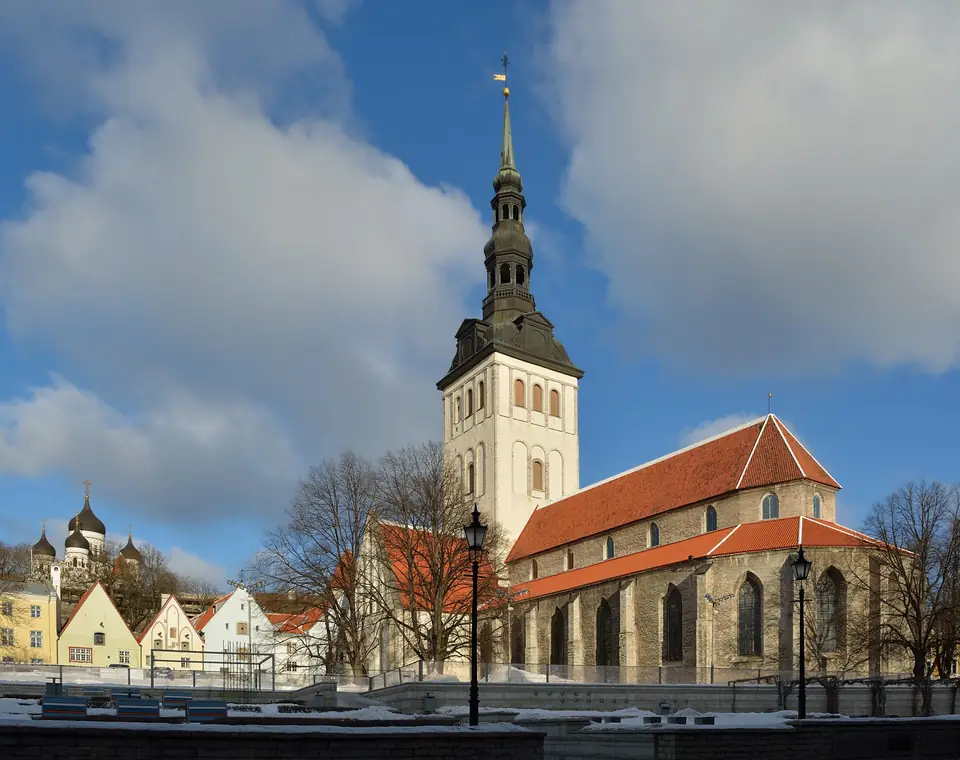
Westphalian merchants arriving from Gotland built this church of St Nicholas, patron of merchants and sailors, in the 13th century, when Tallinn still had no walls: that is why it was born with heavy bars to close the entrances, arrow slits and refuges. The wall enclosed it in 1310 and between 1405 and 1420 it was almost entirely rebuilt, with a polygonal choir with ambulatory and a central nave raised above the side aisles, basilica-style, which has kept its appearance ever since.
Its treasures survived a mob, the bombs and two fires. In 1944 the pulpit, organ and stalls burned, but the great altarpiece and the Dance of Death had been hidden far from the city for a year. In the late 1940s the ruin came close to being demolished; it was restored from 1953 to 1984, and in 1982, with the work almost finished, a fire that nobody could explain destroyed the spire.
Highlights
- The Dance of Death from Bernt Notke’s workshop: 7.5 metres of canvas with thirteen figures, the only medieval one on canvas in existence
- Hermen Rode’s altarpiece (1478–1481), over 6 metres wide when open, which cost as much as two or three stone houses
- A four-metre seven-branched brass candelabrum, donated in 1519, with a double-faced Virgin and Child
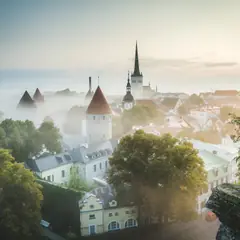
- A 105-metre Baroque spire rebuilt in 1983 and a platform at 50 metres with a glass lift
- Nearly a hundred gravestones of the 14th–17th centuries, with full-length effigies in armour
The history of St Nicholas’ Church, Niguliste kirik in Estonian, is that of a church that has refused to disappear. It was founded by Westphalian merchants arriving from Gotland in Tallinn’s Lower Town; tradition fixes the date at 1230, although Estonian historiography rejects that year and places the foundation around the middle of the 13th century. Since 1984, with no congregation of its own, it has operated as the Niguliste Museum of the Art Museum of Estonia and as an organ concert hall, and most of its works, made for this very building, are back in their old places.
Its Gothic architecture tells several lives at once: a church with arrow slits from when the city had no walls, a basilica rebuilt in the early 15th century, Baroque funerary chapels attached beside Rüütli street and a spire of 1983 that repeats the form of 1695. Inside, nearly a hundred gravestones and the heraldic epitaphs on the walls recall the rich citizens, nobles and pastors buried under its floor; in 1926, when the heating was installed, thirty barrels of bones were taken out of the subsoil.
Not everything that passed through here stayed. The tower monstrance that the goldsmith Hans Ryssenberg made in 1477 for the church was given away in 1710 to Prince Menshikov and is now in the Hermitage in St Petersburg. And for almost two centuries a side chapel displayed as an attraction the mummified body of Duke Charles Eugène de Croÿ, a prisoner of Charles XII after the battle of Narva, who died in 1702 with nobody paying for his funeral, until the authorities buried him in 1897.
The audio guide walks the church in five stops, from the tower to the centre of the nave, passing by the high altar and the St Anthony’s Chapel, with documented narration, checked against historical sources, that keeps for each point its most surprising episode.
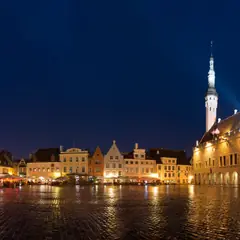
About 230 metres away, Town Hall Square was the Lower Town’s market; to the north of the old town stands the other great merchants’ church, St Olaf’s Church, and at the foot of Toompea, about 160 metres away, the artillery tower Kiek in de Kök.
Bars, arrow slits and a spire with no culprit
Niguliste kirik
Summary of this stop
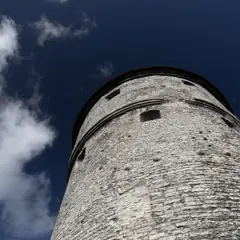
Beneath the tower it is hard to imagine that such an elegant church began as a refuge. With Tallinn still without walls, the merchants’ church had heavy bars to close the entrances, arrow slits and spaces to shelter in, and only lost that defensive role in 1310, when the wall left it inside the city.
The Baroque spire that crowns the tower, 105 metres tall, is much younger than it looks. On the night of 12 to 13 October 1982, with the restoration almost finished, a fire with eight seats burned the tower and destroyed the spire; the investigation never found the cause. It was rebuilt in 1983 and keeps at the top the weathervane of 1695, under a gilded cross added after the fire.
None of Niguliste’s five bells survived. Today the tower holds an exhibition of medieval, Baroque and Orthodox bells that were left without a church of their own, and a glass lift rises to a platform at 50 metres with a view over the old town and the bay. What is known, and what is not, about that night in 1982 is left for the narration at the foot of the tower.
The void left by the fire
Open nave without pews
Summary of this stop
From the back of the nave, what strikes you is what is missing: there are no pews, no galleries, no pulpit. It is the mark of the Soviet bombing of 9 March 1944, which left the church in ruins. Roofs and spire burned, the pulpit donated in 1624, the organ, the galleries and the Renaissance council stalls of 1556–1558; only the interior of St Anthony’s Chapel was saved, and the tower went on smouldering for nearly a month.
The paradox is that, four centuries earlier, the church had dodged another destruction. In the iconoclastic wave of the Reformation, in 1523 according to most sources (others say 1524), Niguliste was the only Lower Town church whose furnishings remained intact: molten lead was poured into the locks and the mob could not get in. Some sources attribute the gesture to the head of the congregation and others to the parish council; afterwards it became a Lutheran parish.
After the war, the ruin came close to being demolished in the late 1940s. It was decided to restore it in a project from 1953 to 1984, completed under the direction of the restorer Villem Raam, who rebuilt pillars, upper walls, vaults and roofs, and in the 1960s reopened the south portal walled up in the 15th century. How one decides to save a building that already seemed lost is part of what is told at this point.
Guild gold before the altar
Hermen Rode altarpiece
Summary of this stop
Before the high altar the pride of Hanseatic money unfolds. The altarpiece came from the workshop of the Lübeck master Hermen Rode between 1478 and 1481: open, it measures more than 6 metres wide and almost 3.5 high, gathers more than forty saints and cost 1,250 Riga marks, the price of two or three stone houses. It was paid for mainly by the Great Guild and the Brotherhood of Blackheads, and their emblems are still painted on the wings, beside scenes of St Nicholas and St Victor.
Beside it stands another gift from the merchant elite: the seven-branched brass candelabrum, four metres tall, cast in Lübeck and donated in 1519 by the wealthy Tallinn merchant Hans Bouwer. At the top of the central branch, a double-faced Virgin and Child looks both ways at once.
The altarpiece changes face with the calendar. Only twice a year, on the two feasts of St Nicholas, does it open fully in its most festive position: 6 December, the day of the saint’s death, and 9 May, the day his relics were moved from Myra to Bari. Which figures appear then, and what they say about those who paid for the work, is revealed by listening to the narration before the altar.
The last dance on canvas
Bernt Notke’s Dance of Death
Summary of this stop
In St Anthony’s Chapel hangs the museum’s most famous work. Of the Dance of Death painted in the late 15th century only the beginning survives: a frieze 7.5 metres long and 1.57 high with thirteen figures, in which dancing skeletons lead the pope, the emperor, the empress, a cardinal and a king, with Low German verses beneath. The Art Museum of Estonia attributes it to Bernt Notke’s workshop; other references give it to Notke himself, and there is no agreement either on its original size, estimated at between about 20 and about 30 metres.
It repeats the dance that Notke painted in 1463 for St Mary’s Church in Lübeck. That one deteriorated, and Anton Wortmann’s 1701 copy burned in 1942, while the Tallinn canvas spent the war rolled up in the Järlepa manor, evacuated in 1943 together with Rode’s altarpiece, which took refuge in Järvamaa. So it remained the only medieval Dance of Death painted on canvas in existence; it was restored in Moscow between 1962 and 1964.
A cloud of mystery hangs over it. Nobody knows for certain whether it was in St Nicholas’ from the start or what became of the rest: it does not appear in the church’s accounts until 1520, the first written mention is from 1603 and the name of whoever commissioned it has not survived. And although it is called the Tallinn Dance, behind the skeletons an autumn landscape appears with some buildings of Lübeck. What those details suggest about its origin is the great enigma the audio guide keeps for this chapel.
Half an hour of organ in a church without worship
Niguliste organ
Summary of this stop
In the centre of the nave one understands why these ruins ended up as a concert hall. The basilica form the church received between 1405 and 1420, with the central nave raised and windows above the aisles, is the same one seen today: the choir and the nave have kept their appearance since then.
Since 1984, with no congregation of its own, the church has operated as the Niguliste Museum of the Art Museum of Estonia and as an organ concert hall, and most of its works come from the building itself and hang again in their old places.
Every Saturday and Sunday at 16:00 the old church holds its half hour of organ: the museum’s organists, Andres Uibo and Tiit Kiik, take turns with programmes of classical and modern music, from Bach to Buxtehude. How a church that lost its worshippers sounds again is the idea with which the tour closes.