Maritime museum
Seaplane Harbour Audio Guide (Lennusadam)
Three concrete domes only a few centimetres thick, raised for the tsar’s seaplanes in the middle of a war, now shelter a submarine paid for by public subscription, while a quayside icebreaker that sailed under four flags waits outside.
- 120 min audio
- 1916 seaplane hangar
Construction of the seaplane harbour of Peter the Great’s Naval Fortress, between the Noblessner shipyard and the Patarei fortress, began on 5 July 1916 under the architect and lieutenant colonel Aleksander Jaron. The design, by the Danish firm Christiani & Nielsen, brought together three square hangars 36.4 metres on a side under reinforced-concrete domes 5 to 8 centimetres thick: a hall of 35 by 110 usable metres without a single intermediate support, designed to handle seaplanes with wingspans of up to 30 metres.
That hangar, which the British magazine The Builder compared to Hagia Sophia, ended up as a Soviet store for mines and torpedoes and reached 2009 on the brink of collapse. Restored by KOKO Architects, it opened as a museum on 12 May 2012 and the following year won the Europa Nostra Grand Prix. Inside, hanging beneath a dome, floats a wooden seaplane; in the centre, in dry dock, rests the submarine Lembit.
Highlights
- Three reinforced-concrete domes of 5 to 8 cm covering a columnless hall of 35 x 110 m
- The submarine Lembit of 1936, paid for by public subscription and lifted out of the water in 2011 after almost 75 years afloat
- The icebreaker Suur Tõll of 1914: five names, four flags and a swap for 300 tonnes of scrap
- A full-size replica of a Short 184 seaplane, the only one in the world, hanging about 10 m beneath the dome
- The 2013 Europa Nostra Grand Prix for KOKO Architects’ restoration
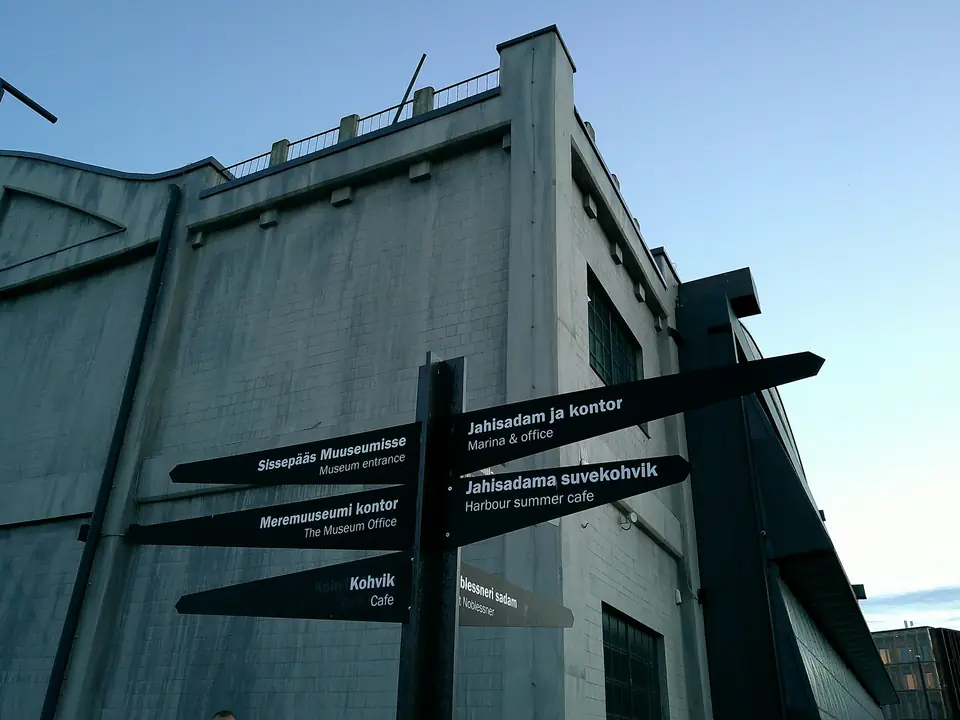
From outside, Tallinn’s Seaplane Harbour, Lennusadam in Estonian, is barely noticeable: three low domes in a chain, with corner towers, on the edge of the bay. The history of Lennusadam starts in the middle of the First World War, when the Russian Empire needed a hangar for the seaplanes defending Peter the Great’s Naval Fortress. Work began on 5 July 1916, although the 2013 Europa Nostra jury’s ruling speaks of a start in 1912, and the date still does not quite fit among the sources.
The architecture of Lennusadam is the reason for its fame. Its reinforced-concrete domes are between 5 and 8 centimetres thick and cover a columnless hall 110 metres long. The Estonian monuments register entered it in 1996 as the world’s first thin-shell concrete structure; other sources are more cautious and place it “among the first”. What nobody disputes is what came after: Estonian naval aviation, a Soviet minesweeper base, a store for mines and torpedoes, a lawsuit over a contract that the Ministry of Justice considered forged and, finally, an award-winning restoration in Europe.
What to see at Lennusadam has two settings. On the quay, the icebreaker Suur Tõll and a fleet of retired patrol boats and coastguard vessels; inside the hangar, the submarine Lembit in dry dock, the replica of a Short 184 seaplane hanging beneath the vault, steel walkways at different heights and the Maasilinna wreck, the oldest found in Estonia. The audio guide walks the harbour from outside in, in five stops, with documented narration that follows how each of these survivors returned to Estonian hands by almost unbelievable paths.
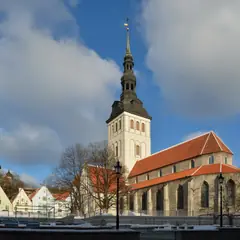
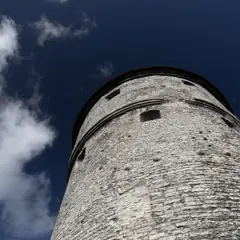
Towards the old town, a little over a kilometre to the south, St Olaf’s Church raises the spire that served as a reference for ships, and Tallinn’s military history begins centuries before the seaplanes, in the cannon of the tower Kiek in de Kök.
A concrete shell in the middle of a war
Lennusadam
Summary of this stop
The tour starts in front of the three domes. Under the direction of the architect and lieutenant colonel Aleksander Jaron, and with the design of the Danish engineering firm Christiani & Nielsen, three square hangars of 36.4 by 36.4 metres were raised here, between the Noblessner shipyard and the Patarei fortress. Together they form a single hall of 35 by 110 usable metres, with no intermediate supports, able to handle seaplanes with wingspans of up to 30 metres.
The disconcerting fact is the thickness: the shell that covers everything measures between 5 and 8 centimetres. When the hangars were built, the British architecture magazine The Builder compared them to Hagia Sophia in Istanbul, a bold comparison for a military building raised in a hurry. How such a thin sheet holds up such a span, and why that discreet silhouette so impressed its contemporaries, is what the narration reveals in front of the domes.
The ship of five names
Suur Tõll
Summary of this stop
On the outer quay, moored and open to visitors, waits the icebreaker Suur Tõll: 75.4 metres of steam, with bridge, saloon and engine room. It was built in 1914 by AG Vulcan in Stettin as Tsar Mikhail Feodorovich, changed names five times and sailed under the flags of the Russian Empire, the Soviet Union, Finland and Estonia. On 29 March 1918, when it was called Volynets, 53 Finns disguised as workers boarded it with a forged order from Captain Theodor Segersven and took it over.
Its darkest chapter came in August 1941. According to the ship’s history, during the Soviet evacuation of Tallinn it sailed in the combat group of the cruiser Kirov with 980 passengers aboard; more than half of the 67 civilian ships sank and some 6,000 people died, but the icebreaker reached Kronstadt intact.
Slated for scrapping in 1987, the Soviet Navy command handed it over to the Estonian Maritime Museum in exchange for 300 tonnes of scrap. It arrived under tow in Tallinn on 13 October 1988 and regained its name on 21 November that year. What the ship lacked on entering port, and what had replaced it the night before, is one of the details told beside its hull.
Seaplanes for a newborn country
Short 184 seaplane replica
Summary of this stop
Once inside, the suspended walkways lead to a floatplane biplane hanging about ten metres beneath one of the domes. It is the full-size replica of a Short 184, the only one in the world, built from February 2010 at the Nurmsi aeroclub in Türi, mainly by the cabinetmaker Urmas Haug. Interwar Estonian aviation bought eight of these British seaplanes and used them mostly for training and for carrying mail to Helsinki.
The hangar was never finished as planned. On 26 August 1917 the order came to stop work: the second hangar was left as foundations and the first with a plank floor, openings blocked with boards and no heating. In December 1918 a half-company of Estonian airmen took it over from the German troops and found only four wrecked fuselages with no engines. On 13 March 1919 the Merelennurühm, the first unit of Estonian naval aviation, was born here under Ensign Arnold-Gustav Under, and it was independent Estonia that finished the works in the early 1920s.
It is also said that in 1933 a famous guest landed on the water in this harbour: Charles Lindbergh, the first man to fly the Atlantic solo, arriving from Moscow with his wife Anne aboard a red and black Lockheed Sirius. The name of that aircraft and the meaning of the journey are revealed beneath the hanging seaplane.
A submarine paid for by a whole country
Submarine Lembit
Summary of this stop
In the centre of the hall rests, in dry dock, the 59.5-metre hull of the Lembit, which can be visited inside. It and its twin Kalev were launched together on 7 July 1936 at the Vickers-Armstrongs shipyard in Barrow-in-Furness and were paid for by one of the largest public collections of the Republic of Estonia. Under the Estonian flag, between 1937 and 1940, it made only one practice torpedo attack. Already in the Soviet fleet, on 14 September 1942 it attacked a convoy near Utö, took some 50 depth charges, suffered a battery fire and spent 10 hours on the bottom before returning to the surface: hence its nickname of “immortal submarine”. Its real war record is still debated, and some consider its merits inflated by post-war propaganda.
In the early hours of 27 April 1992, amid rumours that the Soviet fleet would take it away to Russia, a group of armed Estonian soldiers occupied it in the port of Pirita on the Government’s orders, and in 1994 it was entered as ship number one of the Estonian Navy. On 21 May 2011, after almost 75 years afloat, it was lifted out of the water up the quay’s great ramp on air-filled rubber pontoons, hauled by a rescue tank built on a T-54; according to some sources, until then it was the oldest submarine afloat in the world.
Beside the conning tower is kept the most personal episode: the plaque with the submarine’s motto, “Be worthy of your name”. Who unscrewed it in August 1940 and where it spent the next half century is revealed at the foot of the conning tower.
A century written in concrete
Dome skylights
Summary of this stop
The last stop looks upward, at the twelve-sided skylights that open the apex of each dome and which originally had ordinary windows with wooden frames. The exposed, rough concrete keeps the traces of an eventful century. After 1940 the place was renamed the Hydroport, served as a base for Baltic Fleet minesweepers and the hangar was for a long time a store of mine and torpedo armament base 2754.
In 1990 a company took over the buildings by buying them from the Soviet army with a contract that the Estonian Ministry of Justice considered forged. A court recognised the state as owner in 2005 and the Maritime Museum began works in 2007. When restoration started, in 2009, the building was on the brink of collapse.
The works of 2010 to 2012, designed by KOKO Architects and 70% financed by the European Regional Development Fund, gave the hangar new life: the museum opened on 12 May 2012 and in 2013 received the Grand Prix of the Europa Nostra awards. How such a thin shell was saved and what each scar in the concrete tells is the finale the audio guide reserves for this point.