Artillery tower
Kiek in de Kök Audio Guide
Tallinn’s great artillery tower still carries in its wall the stone cannonballs Ivan the Terrible fired at it in 1577, and beneath the bastion that half buried it open the Swedish tunnels that ended up sheltering anyone who needed to hide.
- 75 min audio
- Medieval fortifications
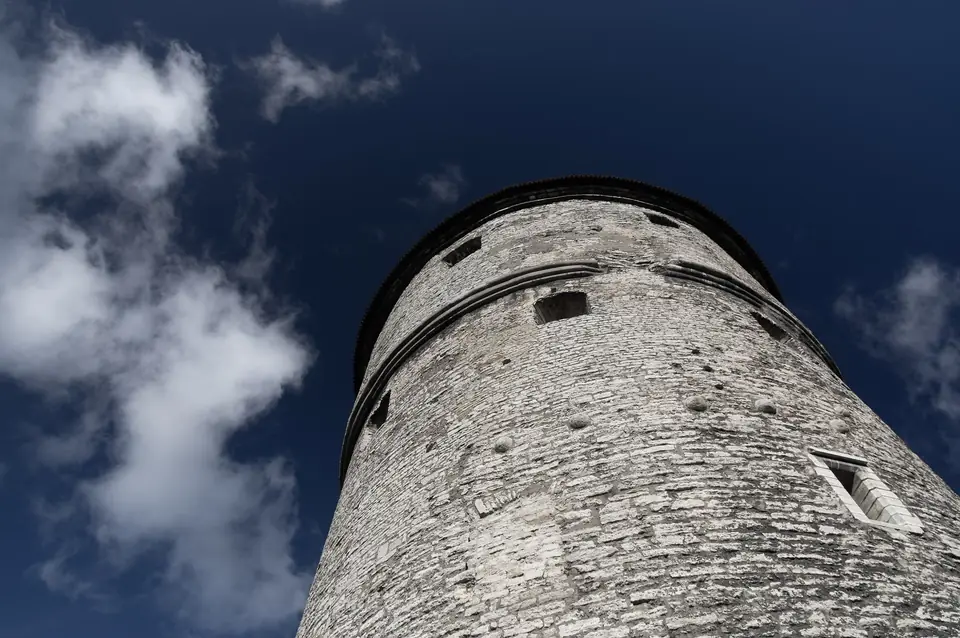
It was built between 1475 and 1483 on an earlier, smaller tower, and in its day it did not even have a name of its own: it was “the new tower behind Boleman’s sauna”. Clad in new layers of wall up to 17.3 metres in diameter and about 4 metres of wall thickness, with 27 gun ports for cannon and 30 for hand weapons, it outgunned any other tower on the Reval wall. Today it stands about 38 metres high.
Its Low German name, “peep into the kitchen”, boasts that from the top you could see what was cooking in the neighbouring houses. But the tower seen today is only half: at the end of the 17th century the Swedish Ingria bastion buried its two lower floors, and beneath that earth run galleries that were an air-raid shelter, a Soviet nuclear bunker, a punks’ hideout and a home for homeless people.
Highlights
- Stone cannonballs from the Russian siege of 1577 still embedded in the south façade
- A tower about 38 metres tall, with 4-metre walls, 27 gun ports for cannon and 30 for hand weapons
- Replicas of the cannon Lion (1559) and Bitter Death (1560), whose originals were taken to St Petersburg
- Arent Passer’s verse plaque for the famine and plague of 1602–1603
- Tunnels of the Swedish bastions: air-raid shelter, Soviet nuclear bunker and punks’ hideout
The history of Kiek in de Kök begins with a tower without a name. The Council of Reval, as Tallinn was then called, had it built between 1475 and 1483 on top of a smaller one, and the documents of the time merely located it as “the new tower behind Boleman’s sauna”. The nickname that made it famous does not appear in writing until 1577, in the chronicle of the city’s second siege, and its present spelling was not fixed until 1696. Sources do not entirely agree on its figures either: the City Museum speaks of about 38 metres in height and walls of 4 metres, while other overviews give about 35 metres and walls somewhat thicker at the bottom than at the top.
What is not disputed is its job. It was Tallinn’s first great artillery tower, the best armed on the whole wall, and the one that took Ivan the Terrible’s cannon head-on. After that, every century found it a new job: storehouse, archive, housing, workshops, a weightlifting hall and, finally, home of the Tallinn City Museum, which dates its opening to 1958, although other sources push it back to 1968, after the reconstruction that added the present entrance. Since 2010 it has been part of a fortifications museum over 500 metres long that links it to the bastion passages and to other medieval towers. The audio guide’s route goes from outside to inside and from the top to the underground, with documented narration, checked against historical sources.
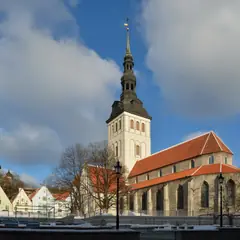
About 150 metres away, on top of Toompea, Alexander Nevsky Cathedral plants its domes opposite the castle; at a similar distance, already in the Lower Town, lies St Nicholas’ Church, and the city’s military history continues in the 20th century by the sea, at the Seaplane Harbour.
Ivan’s cannonballs are still in the wall
Kiek in de Kök
Summary of this stop
Facing the south façade, the first impression is the mass: a stone drum more than 17 metres across topped by a projecting crown and a conical roof. That body did not come out like this all at once. At the end of the 15th century it was clad in new layers of wall until reaching 4 metres thick, and with 27 gun ports for cannon and 30 for hand weapons it came to have more firepower than any other tower on the wall.
That power was put to the test between January and March 1577, when Ivan the Terrible’s artillery blew holes in this very side. When repairing them, the builders made a curious decision: they left the stone cannonballs lodged in the wall, as a reminder. They are still there, in view from the street. What those balls say about the city that kept them is revealed by listening to the narration right there.
A kitchen for a mocking name
Kitchen with spit
Summary of this stop
Between the modern staircase and the stone one hides a small reconstructed old kitchen, with its spit over the fire. It is no gratuitous set piece: the tower’s name, first written in 1577 as “Kyck in de Kaeken” and fixed in 1696 as “Kiek in de Kök”, means “peep into the kitchen” in Low German. The most widespread explanation is that from the top you could see what the neighbours were cooking, although it is not the only one: some link it to the wide chimneys of the Lower Town, and the museum itself reinterprets it as watching what the enemy was “cooking”.
The nickname was not exclusive to Tallinn, either. With the expansion of the Hanseatic League and the Teutonic Order, the same name travelled around the Baltic: Gdańsk has another Kiek in de Kök and Magdeburg a “Kiek in de Köken”. And in this tower cooking fire was very real: each defence floor had its own hearth so as to have fire to hand when shooting, while ammunition was hauled up by a pulley from the ground-floor store through openings in the vaults.
Lion, Bitter Death and the famine stone
Cannon Lion and Bitter Death
Summary of this stop
On the third floor wait two cannon with names of their own. Lion was cast by Karsten Middeldorp in 1559 and Bitter Death by Kort Hartmann in 1560, both local masters; the first bears a lion, the arms of Reval held by griffins and an inscription in verse. What you see are replicas: the originals were taken to St Petersburg in the 19th century and never returned.
On the side of a nearby gun port waits the tower’s most disturbing piece. The plaque that Arent Passer carved for the famine and plague of 1602–1603 does not mince words: its verses speak of war, hunger and plague unleashed on Livonia, of cats and dogs devoured and of a lord who ate his brother. According to the tradition recorded in the German oval that accompanies it, the stone was lost and reappeared in 1697, when a new famine was again killing thousands and Christoffer Schwabe, administrator of the poorhouse, dug it up so that it would be remembered for ever. The carved wooden frame with a small skeleton is from that same year.
The tower the bastion buried
Gun ports on the top floor
Summary of this stop
Before the funnel-shaped gun ports of the top floor, with their floors levelled in the 17th century and the vents to let out the gunpowder smoke, you grasp something that cannot be seen from outside: the present entrance lies halfway up the original tower. Between 1693 and 1697, when the Ingria bastion was built, the earth heaped at its foot buried the two lower floors. The old door was abandoned, another was opened from the bastion and the top received a limestone vault several metres thick.
That bastion was part of the grand plan of the Swedish engineer Erik Dahlberg, begun in 1686 with 11 or 12 bastions. When Peter the Great besieged and conquered Reval in 1710 only three were finished, and they never came to defend the city. Obsolete as a fortress, the tower passed to the state in 1760 as a storehouse, dwelling and archive; in 1864 Alexander II gave it to the Toompea Kaarli congregation, and it filled with craftsmen’s workshops, flats and a weightlifting hall where the first Estonian strongmen trained. There was even a plan by President Konstantin Päts, in 1938, to turn it into a museum of independence. How that plan ended is part of the story heard at the top.
Swedish tunnels that never saw war
Vaulted galleries of the bastions
Summary of this stop
Beneath several metres of earth run the bastion passages, from the late 17th and early 18th centuries: limestone galleries with barrel vaults, 1.5 to 2.5 metres wide and up to 3 high, ventilated by vents instead of gun ports. About 1.3 kilometres are known, of which 470 metres have been renovated. Built for war, they never saw it, but found other uses: in 1936 a part became an air-raid and gas shelter, used in the bombings of the Second World War, and in the 1950s the Soviets turned it into a nuclear shelter with its own electricity and ventilation, telephone, toilets and three-tier metal bunks.
Once the bunker was abandoned in the second half of the 1970s, the labyrinth came to hide punks hounded by the militia, and between 1991 and 2004 homeless people lived in it, some for more than a decade, until the City Council began to renovate it. Long before, after 1857, the tunnels already fed the city’s stories: adventurers and curious kids slipped in through any opening, and when some galleries served as storage, the sculptures of the Art Foundation had to be moved out because intruders kept getting in. Who else passed through this underground is told in the last stretch of the tour.