Diplomatic history
American Legation Audio Guide (Tangier American Legation Museum)
A Moorish palace-house that leaps over a medina alley: the first US property abroad, which housed lions, spies and Confederate prisoners and today teaches the neighbourhood’s women to read.
- 60 min of audio
- Neo-Moorish architecture
- Museum and National Historic Landmark
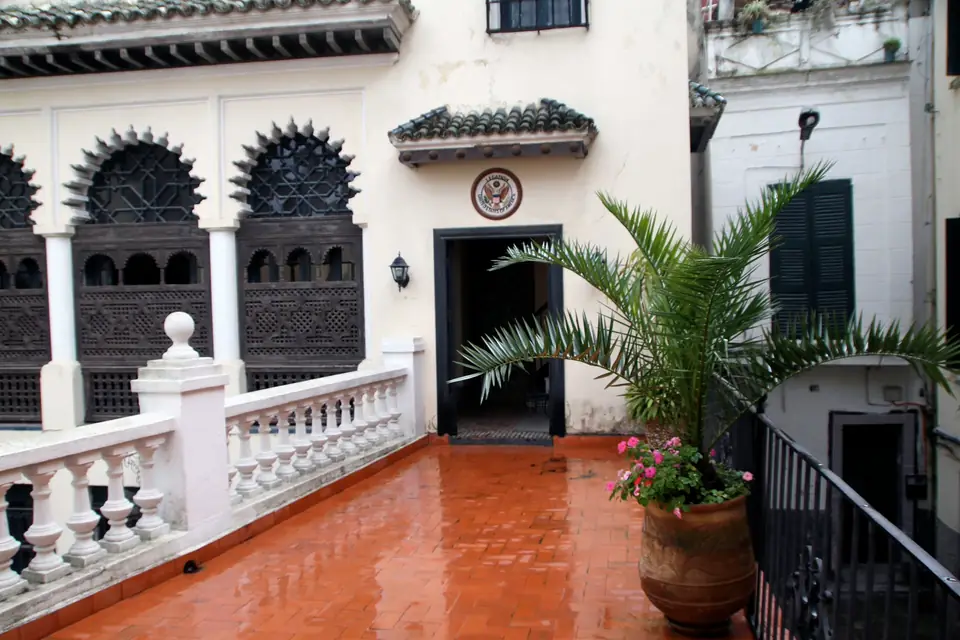
From 1821 to 1961, this house in the Tangier medina was the seat of the United States in Morocco. The original building, a gift from the sultan, grew by annexing neighbouring houses until it occupied both sides of the Rue d’Amérique and the air space above it. Its neo-Moorish architecture, with a fountain courtyard and orange trees, carved wooden lattices and a pavilion decorated by craftsmen from Fez and Marrakech, blends phases running from the mid-19th century to the 1930s.
Behind its calm lie episodes worthy of a novel: a pair of lions lodged in a room of the consulate, two Confederates shackled in the building in the middle of the Civil War, a tiny closet from which the 1942 Allied landing was followed and, according to what is told, a cistern under the kitchen where Peace Corps volunteers set up a disco and left their painted handprints on the walls.
Highlights
- Bridge over the Rue d’Amérique — the building occupies both pavements and leaps over the alley
- Maxwell Blake’s Arab Pavilion — antique doors and tiles from all over Morocco, built between 1927 and 1931
- Listening room — the closet from which Operation Torch was followed in 1942
- Zohra — James McBey’s 1952 oil that visitors call the Moroccan Mona Lisa
- Paul Bowles Wing — three rooms devoted to the writer and composer, who donated some 72 hours of Moroccan music recorded in the 1950s
In 1821 the sultan gave the United States a building in the heart of the Tangier medina. Most official sources attribute the gesture to Moulay Suliman, although the American National Museum of Diplomacy credits Mohammed ben Abdallah, the sultan who recognised the young republic in the late 18th century. Over its whitewashed walls, consul John Mullowny raised the 23-star flag: it was the first property the US government had acquired outside its territory. For between 140 and 150 years, depending on the source, consuls, ministers and ambassadors worked here, and the house kept gaining rooms by annexing the neighbouring dwellings.
The history of the American Legation is that of a very old diplomatic friendship told through objects: a seal with the eagle over an arch of the alley, a pavilion that holds all of Morocco, a photograph of Roosevelt and Churchill beside Sultan Mohammed V, a portrait that seems to follow the viewer with its gaze. In 1981 it entered the National Register of Historic Places and in 1982 it was declared a National Historic Landmark. The visit, organised in five stops, walks through this building made of patches with a documented narration, checked against historical sources, heard in each room.
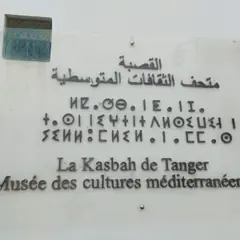
A few steps away, the Petit Socco keeps the memory of the city’s foreign post offices and consulates; the Grand Socco, beside the Mendoubia, completes that diplomatic history, and at the top of the medina the Kasbah Museum occupies the palace from which the sultans ruled.
A medina street called America
Tangier American Legation Museum
Summary of this stop
The visit starts outside, on the narrow Rue d’Amérique in the Ben Idder quarter. There the complex is seen in all its oddness: a stretch of the building leaps over the alley and joins the two halves of the Legation, which occupies both pavements. Over an arch shines the circular emblem with the American eagle, and both the street and the quarter’s gate, Bab d’Amérique, bear the name of America.
What is seen today is not exactly what the sultan gave. In 1848 the new consul found the house almost in ruins, possibly because of the French bombardment of Tangier in 1844, and undertook its reconstruction. The real extent of that damage remains disputed: some consider the original building destroyed and others describe an 18th-century stone construction integrated into the complex. Most of the present building dates from the mid-19th century to the 1930s, and the narration explains how a distant power put down roots here, house by house.
Lions, shackles and seven warships
Neo-Moorish central courtyard
Summary of this stop
The heart of the complex is a neo-Moorish courtyard with a fountain, lemon and orange trees, surrounded by carved wooden lattices. Its calm is deceptive. In 1839 Sultan Abd al-Rahman ibn Hisham sent the consulate a lion and a lioness as a gift for President Martin Van Buren. Consul Thomas Carr tried to refuse them, but ended up giving one of his rooms to the beasts, which were auctioned at the Philadelphia naval yard in August 1840 for 375 dollars.
In February 1862, in the middle of the Civil War, consul James DeLong had the Confederates Thomas Tate Tunstall and Henry Myers arrested and locked them up in chains in the building. Myers jumped from a second-floor window and was recaptured, while between 200 and 400 Europeans surrounded the house to demand their release. Lincoln ended up removing DeLong from his post.
According to a documented tradition, the loudest episode came in 1904 with the kidnapping of Ion Perdicaris at the hands of the chieftain Ahmed al-Raisuni. Theodore Roosevelt sent seven warships and at the Republican convention the phrase “we want Perdicaris alive or Raisuli dead” rang out, while consul general Samuel Gummeré negotiated discreetly from this house. The outcome, which in 1905 turned the consulate into a Legation, holds a twist about the kidnapped man’s nationality that the narration reveals beside the fountain.
Maxwell Blake’s dreamed-of Morocco
Maxwell Blake’s Arab Pavilion
Summary of this stop
Between 1927 and 1931 Maxwell Blake, the American envoy who served longest in Tangier, raised a Moorish pavilion before a new courtyard. He decorated it with antique doors and tiles brought from different regions of Morocco, and the floors, ceilings and walls were worked by craftsmen from Fez and Marrakech. Today it houses the exhibition “Americans in Morocco”. The dates of his stay vary by source, but the result is the same: a foreign diplomat who wanted to sum up a whole country in one room.
The Legation also displays the toy-soldier dioramas of the Battle of the Three Kings (1578) and the Battle of Songhai (1591), a gift from the family of Malcolm Forbes. And in the painting collection hangs “Zohra”, a 1952 oil by the Scot James McBey: the portrait of a young Tangier woman whom visitors call the Moroccan Mona Lisa. By custom, whoever moves before the painting checks whether her eyes follow. The story of the model and that of the painter, buried in Tangier, are told in front of the canvas.
A closet for listening to the war
Listening room
Summary of this stop
On 8 November 1942, during Operation Torch, diplomats, military attachés and OSS agents followed the Allied landing crammed into a narrow closet, the “listening room”. The Legation was then the largest American mission in North Africa and the only one outside Vichy territory. That tiny room is part of the permanent exhibition “The Legation, Morocco and World War II”, opened in November 2022.
Nearby hangs the museum’s most famous photograph: Sultan Mohammed V, Franklin D. Roosevelt and Winston Churchill at the Anfa conference in Casablanca in January 1943, with Roosevelt’s reply to Churchill about the dinner in the sultan’s honour: “because this country is his”. And in the same house, as a documented tradition records, is the portrait of chargé d’affaires J. Rives Childs beside a 1945 letter crediting him with 1,200 lives saved. How they came to be saved, and with which signatures, is one of the stories of this stop.
Scaffolding, classrooms and a view of the Strait
Upper terrace
Summary of this stop
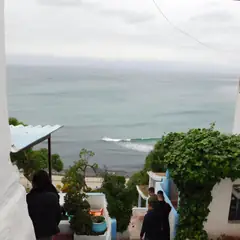
The visit ends on the upper terrace, with the port and the medina at its feet and the ocean beyond. From there one understands how close this house came to being lost. After the consulate general moved in 1961 it was an Arabic school for diplomats and a Peace Corps training centre; in 1975 it fell out of use and was nearly sold, until in 1976 a group of private citizens founded the society that rents it from the US government as a museum and cultural centre.
Its fragility is still visible. On 1 May 2024 it entered the National Trust for Historic Preservation’s list of America’s 11 Most Endangered Historic Places, after the demolition of a neighbouring building forced the research library to close, now propped up with scaffolding and without its books. Meanwhile, the house remains open to its neighbours: the programme for medina women, founded in 1994, teaches Arabic literacy, sewing and cooking, and its acronym, TALIM, matches the Arabic word meaning “education”. The close of the route explains why that detail sums up the whole history of the building.