Palace and museum
Kasbah Museum Audio Guide (Musée de la Kasbah des Cultures Méditerranéennes)
At the highest point of Tangier, a sultans’ palace raised over a blown-up English castle now holds a Venus mosaic brought from Volubilis, a prison turned into an art gallery and an orange-tree garden.
- 75 min of audio
- Sultans’ palace
The former Dar el Makhzen, the palace of power in the kasbah, was built in the 18th century on the site once held by the Portuguese governor’s residence and the English “upper castle”. Its history, its architecture of arcaded courtyards and wooden ceilings, and its conversion into a museum in 1922 make it the best way in to understand how each power in Tangier built on the ruins of the one before.
The palace prison served as a civil jail until the early 1970s; around 1900 a British woman traveller described prisoners chained by the leg and a man tied to a pillar with an iron collar. Since 2021, those same cells have displayed contemporary Moroccan art.
Highlights
- Voyage of Venus mosaic — a Roman piece from Volubilis with the Three Graces at the oars
- Former prison — a jail until the 1970s, now more than 1,225 m² of contemporary art
- Arcaded courtyard — reused Roman columns and a white marble fountain
- World map of 1154 — a giant copy with north at the bottom
- Andalusian garden — the largest traditional garden open to the public in the medina
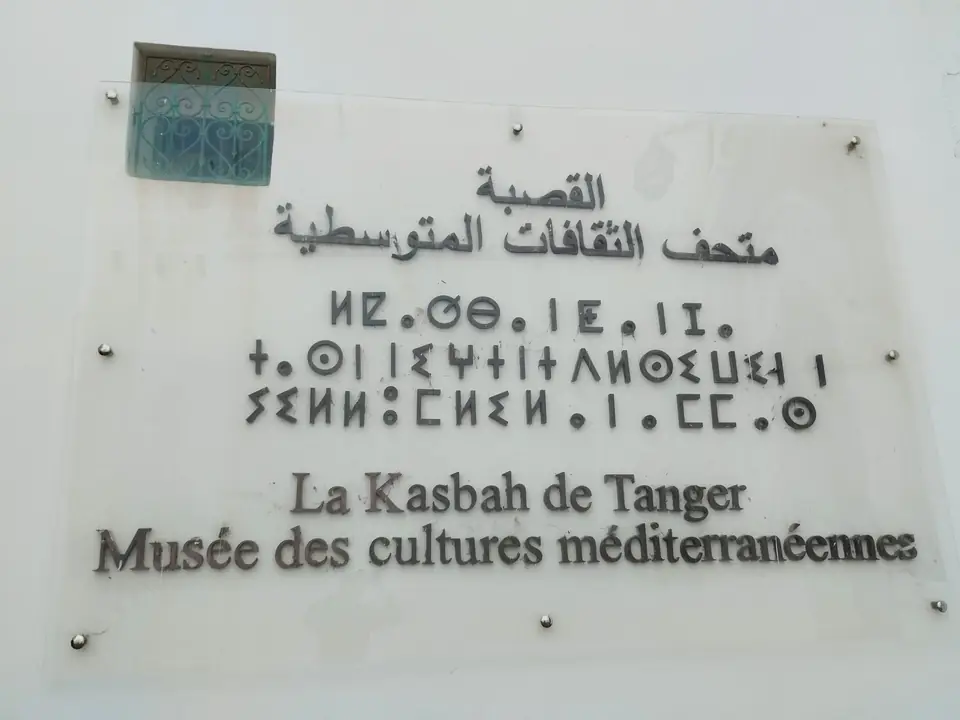
In 1684, as they evacuated Tangier, the English blew up their fortifications. Over those ruins, and over those of the Portuguese governor’s residence that had occupied the same site between 1471 and 1661, the Morocco of Moulay Ismail raised a walled kasbah with everything needed to govern: palace, treasury, court, prisons, stables, barracks, mosque and a great square, the mechouar. The heart of that compound is Dar el Makhzen, today the Kasbah Museum of Mediterranean Cultures.
The history of the Kasbah Museum is a chain of reuses. Residence and seat of government of the Alaouite sultans, renovated at the start of the 19th century and again in 1889, the palace became a museum in 1922 at the initiative of the French scholar Édouard Michaux-Bellaire. It reopened on 29 July 2016, after a year of restoration faithful to the original, with a chronological route devoted to the Tingitan peninsula as a meeting point between shores, with pieces going back to 5000 BC. And in 2021 even its prison changed function.
What to see at the Kasbah Museum runs from the square of power to the courtyard of columns, from the rooms of the Venus mosaic to the Andalusian garden. The audio guide, documented and checked against historical sources, walks through that palace in five stops and arranges centuries of overlapping layers into a single walk.
Down the slope, in the medina, the American Legation occupies the palace-house that the sultan gave to the United States in 1821, and a walk to the west, in the Marshan, the Café Hafa serves tea on terraces hanging over the Strait.
The square where the treasury was kept
Place de la Kasbah
Summary of this stop
The visit starts in the mechouar, the kasbah’s square, before a white crenellated façade. Facing it are lined up the buildings that made the power rebuilt after the English departure work: the former Bayt al-mal or treasury, created in the late 18th century, the former court and the prisons. Today it is a bright, quiet space; for generations it was the city’s engine room.
In March 1833 the painter David Roberts was here drawing the citadel. According to the account of Thomas Roscoe, who published those drawings in 1838, they entered a castle no European had drawn before by buying their way in with gold, and an officer who was left without his share nearly ruined everything. The outcome of that episode, and what they managed to draw inside, is left for the narration on the square itself.
A prison turned into an art museum
Former Kasbah prison
Summary of this stop
On one side of the square opens the kasbah’s former prison, built from the 17th century as part of the palace. Its thick walls served as a civil prison until the early 1970s, barely half a century ago. Around 1900 foreigners could no longer enter, but the British traveller Isabel Savory looked through a small grille in the door and wrote down what she saw: a courtyard open to the sky, prisoners huddled in rags, chains on their legs at night and food that only arrived if their families brought it.
The turn came in December 2021. After a renovation costing 13 million dirhams, the former prison opened as the Kasbah’s contemporary art museum, with more than 1,225 m² and an inaugural exhibition, “The School of the North”, which brought together more than 70 works by artists such as Mohamed Melehi and Mohamed Chabâa. The contrast between what these walls once held and what hangs on them now is the heart of the stop.
Roman columns in a pasha’s courtyard
Main arcaded courtyard
Summary of this stop
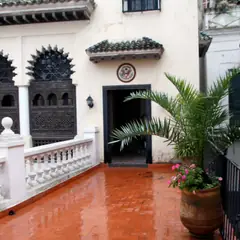
Inside, the visitor finds a large arcaded courtyard with a white marble fountain at its centre and decorated wooden ceilings in the halls around it. The palace is attributed to Pasha Ahmad ben Ali al-Rifi, general of the Jaysh al-Rifi and semi-autonomous governor of Tangier, in the time of Sultan Moulay Ismail; an inscription found in Dar al-Bukhari, a side building, dates the work to 1157 AH / 1738. The exact dating and authorship remain disputed: some sources place it in the early 18th century, others give 1737, and the pasha is often confused with his ancestor Ali Errifi, the caid who recovered the city.
The courtyard is a palimpsest in stone. Some of its columns are reused Roman pieces, and the marble capitals were probably imported from Italy in the mid-18th century. Beneath the floor lie, unseen, the English castle and the Portuguese residence. The narration beside the fountain explains how that overlapping of eras is read in a single space.
Venus sailing and a map upside down
Voyage of Venus mosaic
Summary of this stop
The museum’s rooms tell the story of the Tingitan peninsula as a crossroads. The star piece is the Roman mosaic of the Voyage of Venus, the Navigium Veneris, from the House of the Voyage of Venus in Volubilis: the goddess in a boat, the Three Graces at the oars and Eros tending the sails.
Very close by hangs the giant copy of a map of the known world dated 1154 and oriented with north at the bottom, next to another large chart of Mediterranean trade routes. That same year al-Idrisi finished for Roger II of Sicily his atlas with south at the top; the museum describes its map as made in Tangier, although al-Idrisi’s atlas was finished at the court of Palermo, and the relationship between the two remains open. Why a mosaic and a map sum up the thread of the whole museum is what this room reveals.
The garden that gave the palace its name
Andalusian garden
Summary of this stop
The route ends in the Andalusian garden, with its pergola, columns, banana plants, fig trees, loquats and orange trees, among tortoises and cats. It is the largest traditional garden open to the public in the historic centre of Tangier, and it explains a nickname documented in the early 20th century: with the palace already empty, it was called in Arabic by a name meaning “the little garden”.
That name sums up a long journey: from residence of the sultans, where Hassan I stayed in 1889, to a building out of use, and from there to the museum that Michaux-Bellaire promoted in 1922. On the way out appears the octagonal minaret clad in zellige of the Kasbah mosque, a rarity in Tangier. The audio guide’s close, in the shade of the pergola, ties the trees to the power that once inhabited these rooms.