Listed monument since 2016
Café Hafa Audio Guide
A neighbourhood café opened in 1921 that steps down the Marshan cliff in five terraces: a glass of tea, the Strait ahead and the Spanish coast across the water.
- 45 min of audio
- Views of the Strait
The Café Hafa opened in 1921 at the top of the Marshan, the Tangier quarter overlooking the sea. It was founded by Ba Mohamed, a local also registered as Mhamed Alouch, so that the neighbourhood’s people had somewhere to meet, and he named it after the cliff itself: “Hafa”, the edge. With no architect’s design, its form was dictated by the rock: five stepped terraces, joined by two flights of steps, with concrete and iron tables, whitewashed walls tinted with indigo, and nothing between the tables and the Strait of Gibraltar.
This humble café, with no menu and with tea, bissara and bread as almost its whole offer, has been on Morocco’s list of monuments since 2016. At its tables Juan Goytisolo, Mohamed Choukri and Tahar Ben Jelloun found material, and Ben Jelloun opened his novel “Leaving Tangier” on these terraces. And every evening repeats a ritual that appears in no guidebook: waiting for the lights of the Spanish coast to come on.
Highlights
- Five stepped terraces — on the Marshan cliff, facing the Strait
- Tea, bissara and bread — a café with no menu, opened in 1921 and almost as simple
- Writers’ tables — Goytisolo, Choukri and Tahar Ben Jelloun wrote facing this sea
- The lights of Spain — the Spanish coast lights up at dusk across the water
- The founder’s cats — heirs of the fish that Mhamed Alouch bought for them every morning
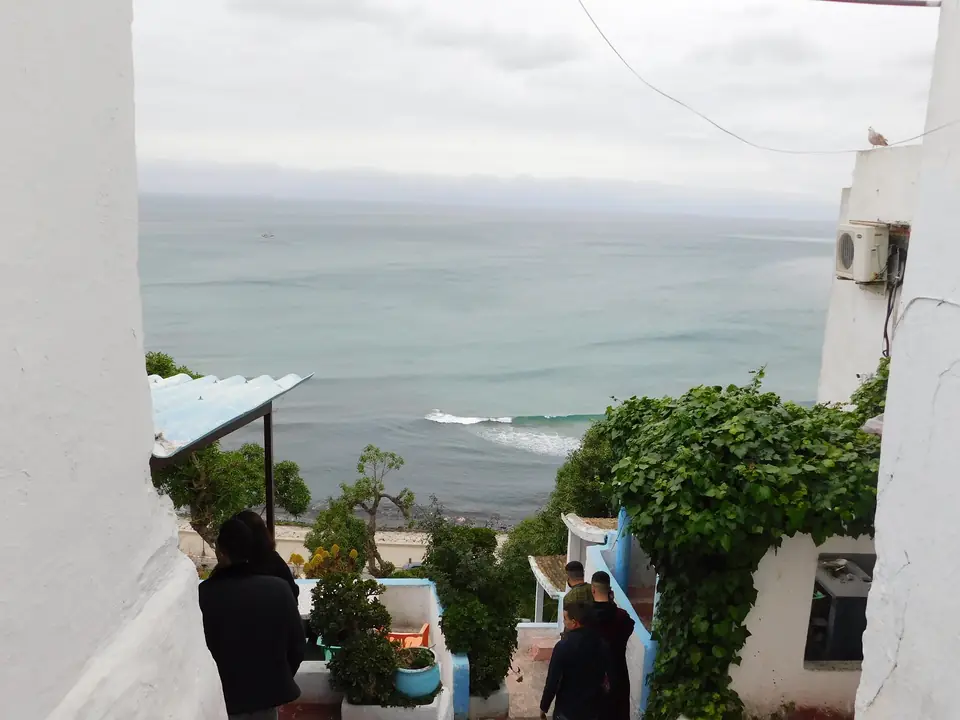
At the end of the alleys that descend from the Marshan square, an iron door and a discreet sign, “Café Hafa, fondé en 1921”, lead into one of the most famous cafés in Tangier. Behind it there are no halls or decoration: there is a cliff turned into five terraces, tables where paint mingles with rust, cats underfoot and, ahead, the Strait of Gibraltar with Tarifa and the southern coast of Spain in view. The story of the Café Hafa is that of a local man who more than a century ago tore rocks from a barren hillside to serve tea to his neighbourhood, and of how that humble corner ended up in the pages of Goytisolo, Choukri and Tahar Ben Jelloun.
What to see at the Café Hafa is not limited to the view. The café carries layers of memory: the clearing of the ground by hand, the years when customers sat on mats, the fame that television brought, its listing as a monument in 2016 and the terrace demolished in 2018. It also drags along legends best heard with caution, such as that of William Burroughs writing “Naked Lunch” here, a much-repeated image that literary history places rather in his room in the lower town. The audio guide route goes down from terrace to terrace, from the door to the edge over the sea, separating what is documented from what is only told.
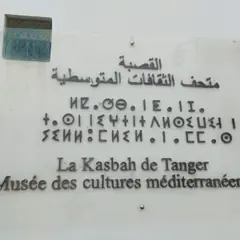
Writers’ cafés have another stage in the Petit Socco, in the heart of the medina; near the Marshan, the Kasbah Museum occupies the sultans’ palace at the top of the city, and following the coast towards the Atlantic wait the Caves of Hercules.
The door that names the edge of the Marshan
Café Hafa
Summary of this stop
The route starts before the iron door, with its sign fixing the date that almost all sources accept: 1921. That year Ba Mohamed, a Tangier man of the Marshan also registered as Mhamed Alouch (1901-1999), opened a place meant as a meeting spot for the neighbourhood’s residents. Sources do not entirely agree on his name or on how old he was then, and some wrongly bring the date forward, but the consensus and the sign itself point to the same year.
The name is no accident either. Tangier people called this cliff “Hafa”, the edge in Arabic, where the city’s young people already came to gaze at the sea. The founder saw that coming and going and decided to open his café there, which inherited the name of the place. What that gesture says about the Tangier of the time is revealed in the narration, in front of that same door.
Rocks, steps and the founder’s cats
Steps and upper terraces
Summary of this stop
The upper terraces tell the most physical part of the story of the Café Hafa. Before 1921 this was a steep, barren slope, frequented by vagrants and drunks. The founder spent months tearing out giant rocks, trees and scrub until he turned the hillside into the platforms that now step down towards the sea, five in all, joined by two flights of steps. In those years the water for the tea came up from the well on a cart that he and his brother Ba Idriss pushed, helped by a local child such as the future journalist Mohammed Mrini.
The furniture keeps that handmade air: concrete and iron tables with paint eaten by rust, tiled tables, clay pots of every size and uncomfortable chairs. Between them the cats slip through, and they have their own genealogy here: Mhamed Alouch went to the market every morning to buy them fish, and the café became their refuge. Their heirs still stroll among the tables.
Writers facing the Spanish coast
Tables of the middle terrace
Summary of this stop
The middle terrace looks straight at the Strait, and here the story of the Café Hafa turns literary. In its early days there were no tables or chairs: customers sat on mats and plain rugs to drink atay and talk, with Moroccan, Andalusian and Spanish music in the background. In 1965, on these terraces, Juan Goytisolo imagined a Moorish reconquest of Franco’s Spain, the seed of his novel “Count Julian” (1971). Mohamed Choukri, author of “For Bread Alone”, took advantage of the calm of the place to write and receive his guests, and shared a table with Tahar Ben Jelloun.
Ben Jelloun gathered fragments of “Leaving Tangier” in the café and opened the novel right here: in winter, he writes, the Café Hafa becomes an observatory of dreams and of their consequences. In its pages, men sitting on mats, backs to the wall, wait for the first lights of Spain to come on and think about crossing, knowing the journey may end in the sea. The narration lingers on that first page, with the same coast ahead.
Fame, pickaxe and the lights of Tarifa
Lower terrace over the Strait
Summary of this stop
The lowest terrace, hanging over the cliff, sums up the price of fame. In the late 1970s Goytisolo recorded a television programme from the Hafa that shot up its popularity; he later regretted having made it famous, because it attracted tourists and stripped it of identity. Tangier writers maintain that the extensions of recent decades, with the disappearance of trees and pergolas, have taken away its authenticity, while the owner defends having preserved it.
In 2016 Morocco’s Official Gazette published its listing as a monument, and since then any work requires notifying the Ministry of Culture at least six months in advance. On 4 August 2018 the authorities evicted the café, cut the electricity and demolished a terrace added without permission; the Hafa reopened on 8 August, after almost four days closed, with conflicting accounts over whether there had been prior notice.
None of that has erased the place’s oldest ritual. At dusk, families and groups of young people fill the steps and watch the water like a cinema screen, waiting for the European shore to light up some 14 kilometres away. For the visitor it is a postcard; for many Tangier people, Europe in sight and out of reach. What that waiting means is better understood by listening to the narration right there, with the glass of tea on the table.