Historic square
Grand Socco Audio Guide
A roundabout of taxis and palm trees at the gates of the medina that keeps beneath its paving a camel market, a cemetery and two speeches that changed Morocco. Its official name is a date: the day the country asked aloud for its freedom.
- 30 min of audio
- Independence history
The Grand Socco, Suq Barra in Moroccan Arabic, is the circular sloping square that opens before Bab el Fahs, the gate of the medina. Around 1905 it was Tangier’s outer souk, raised over the disused part of a Muslim cemetery, where caravans from the interior loaded and unloaded. Today it is ringed by the tiled minaret of Sidi Bou Abib, from 1917, the Cinéma Rif and the Mendoubia gardens.
Beside the square, behind a fence, stands the former German legation. There Kaiser Wilhelm II spoke in 1905 in favour of Moroccan independence and set off the First Moroccan Crisis; there a consul of Nazi Germany settled in 1941; and in its gardens, on 9 April 1947, Sultan Mohammed V demanded the independence and unity of Morocco. Because of that speech the square is now called Place du 9 Avril 1947.
Highlights
- Sidi Bou Abib Mosque — a neo-Moorish minaret of 1917 with pink, green, blue and white tiles
- Cinéma Rif — home of the Cinémathèque de Tanger, with projectors that can be turned towards the square
- Bab el Fahs — the medina gate where the old caravan market ended
- Mendoubia gardens — setting of Mohammed V’s speech of 9 April 1947
- Gravestones on the north side — the last visible remnant of the 19th-century cemeteries
At first glance, the Grand Socco of Tangier is a roundabout: taxis circling, a large marble fountain, tall palm trees, benches and flowerbeds. But its name already gives something else away. “Socco” is a Spanish corruption of the Arabic souk, market, and in Moroccan Arabic the square is still called Suq Barra. The history of the Grand Socco begins outside the walls, before the gate of Bab el Fahs, on land that was a cemetery, then a Sunday and Thursday souk and finally a political stage.
Its official name, Place du 9 Avril 1947, recalls the speech in which Sultan Mohammed V demanded the independence and unity of Morocco in the Mendoubia gardens, a few steps away. Earlier, in 1905, Kaiser Wilhelm II had spoken in that same building, and in between it served as a consulate for Nazi Germany. The route goes down from the Cinéma Rif to Bab el Fahs and ends among the gravestones of the Mendoubia: five stops, documented and checked against historical sources, best enjoyed on the spot, with the audio guide in your pocket.
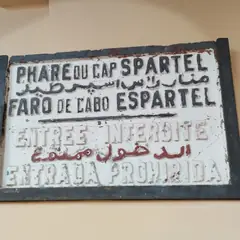
Through Bab el Fahs one enters the medina as far as the Petit Socco, the souk inside the walls, and very close by the American Legation tells another side of the Tangier of the powers. Outside the city, some 9 km away, the lighthouse of Cape Spartel adds another piece to that story: ten countries ran it by convention.
A cinema that projects onto the square
Cinémathèque de Tanger
Summary of this stop
The terrace of the Cinéma Rif offers the best view of the square: the circle at one’s feet and, from the south-west, the minaret of the Sidi Bou Abib mosque, built in 1917 in neo-Moorish style and clad in pink, green, blue and white tiles. Below, its green keyhole-shaped doors open only for the faithful.
The cinema itself is a character. It is a building from the 1940s, although sources do not agree on its exact opening date, which had 500 seats. In 2005 the French architect Jean-Marc Lalo redesigned it with two screens, of 380 and 60 seats, and with projectors that can be turned outwards for open-air screenings of up to 4,000 people in the square. The artist Yto Barrada founded the Cinémathèque de Tanger there, in 2006 according to most sources: the first arthouse cinema with a film archive in North Africa, in a venue that until then had shown Bollywood B-movies.
The square even has its own novel. In 1950 the writer Joseph Kessel was walking through the Grand Socco when he noticed a street boy leading his little gang on this very circle, and turned him into Bachir, the narrator of “Au Grand Socco”. Who that boy was and how Kessel described him is told in the narration, facing the square.
Camels and pilgrims where taxis now circle
Marble fountain of the central circle
Summary of this stop
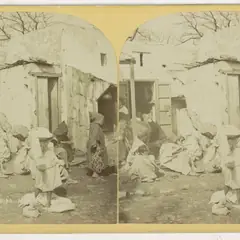
Around the marble fountain of the central circle nothing of the souk remains visible. Yet around 1905 this was the loading and unloading point of the caravans coming and going from the interior, and some forty camels gathered here, eating barley poured onto cloths laid on the ground.
A documented episode from the early 20th century completes the scene: each year, in the month after Ramadan, the market filled with low tents of pilgrims waiting for a steamer to Alexandria or Jeddah, on the way to Mecca. Some had walked a month from the interior and had never seen the sea. Among those shanties was a very particular one, and its owner’s answer is one of the moments the audio guide keeps for this stop.
Gunpowder at a gallop towards Bab el Fahs
Bab el Fahs
Summary of this stop
At the foot of the square opens Bab el Fahs, the entrance to the medina. Around 1905, on Sundays and Thursdays, Tangier’s market occupied the disused part of the Muslim cemetery before this gate, which the English had called Port St. Catherine and which was then known as “the souk gate”. Strings of donkeys and mules passed through it.
The slope also had its festival. On Mawlid, the Prophet’s birthday, the market became the setting for a gunpowder game: a dozen horsemen galloped up the slope along a lane opened through the crowd and fired their long guns.
Under an arch beside the gate, where the farriers worked, it used to be said that the structure had been built to shelter the English guard. It is a disputed story, and one detail casts doubt on it; the narration reveals it in front of the arch.
A kaiser, a Nazi consul and a sultan
Jardins de la Mendoubia
Summary of this stop
The gate of the Mendoubia gardens leads to a villa with an unusual biography. In 1872 the newly created German Empire bought the former villa of the Swedish consul, on the hill beside the medina, and remodelled and extended it to give it its present look. By the late 19th century it was the only European consulate outside the walls.
On 31 March 1905 Kaiser Wilhelm II spoke at this legation in favour of Moroccan independence and against the French advance, and his speech set off the First Moroccan Crisis. During the Spanish occupation of Tangier, on 16 March 1941 the mendub was dismissed and the next day the consul of Nazi Germany settled in the building, which remained a German consulate until 23 May 1944, when Spain expelled it under Allied pressure.
On 9 April 1947 the gardens hosted another speech: that of Sultan Mohammed V, who before representatives of the colonial authorities demanded the independence and unity of Morocco, and the next day repeated the message at the Great Mosque of Tangier. How one villa served as a loudspeaker for such opposing voices is the thread of this stop.
Gravestones that stopped a car park
Monument to the Tangier speech
Summary of this stop
In the Mendoubia park, a monument reproduces the full text of the 1947 speech. After independence in 1956, the Grand Socco was renamed Place du 9 Avril in its memory, and commemorative events are held here each anniversary. Beside the entrance grows an enormous banyan tree to which some eight hundred years are attributed, an age that is repeated without any dating to back it.
This shaded garden was a cemetery. In the 19th century two were opened on these grounds and used until 1911: a Christian and European one to the north and a larger Muslim one to the west; exactly when they disappeared is something the sources do not agree on. On the north side several Christian funerary monuments survive, and here are buried the martyrs of the independence demonstrations of 30 March 1952, alongside the graves of Germans and European doctors.
In March 2019 the gardens were fenced off to build an underground car park. An international petition and several protests defended some 15 gravestones of Tangier notables and about 30 trees; during the works human bone remains appeared and the project ended up withdrawn. With that recent history the circle of the route closes, at the place that gave the square its date-name.