Historic lighthouse
Cape Spartel Audio Guide (Cap Spartel)
At the north-western tip of Africa, a sultan raised with Moroccan money a minaret-shaped lighthouse that ten powers ran by convention, that Spain occupied in the middle of the Second World War and that ended up returning to Morocco.
- 40 min of audio
- Lighthouse with museum
The Cape Spartel lighthouse was first lit on 15 October 1864 over the Atlantic mouth of the Strait of Gibraltar. It was ordered built by Sultan Mohammed IV ben Abderrahmane, paid for by the Moroccan government, and its tower reproduces a square-plan Maghrebi minaret, with a broad base inspired by Hispano-Moorish mosques. Since 2021 the building has housed the Museum of the Lighthouses of Morocco, and in 2023 the IALA named it Heritage Lighthouse of the Year, the first Arab and African one with that title.
The history of Cap Spartel is as diplomatic as it is maritime. In 1865 Morocco and ten powers signed a convention under which all paid the same share to maintain the light, while ownership, sovereignty and the tower’s single flag remained the sultan’s. That pact promised neutrality even in wartime, until in 1941 a Spanish order set the day and hour to take over the lighthouse.
Highlights
- Minaret tower of 1864 — some 31 m of Maghrebi silhouette paid for by Sultan Mohammed IV
- Spiral staircase — 101 steps with a mahogany handrail up to the lantern and its Fresnel lens
- Upper viewpoint — a 360-degree view over the Strait of Gibraltar and its merchant ships
- Museum of the Lighthouses of Morocco — twelve rooms around a courtyard with fountains
- Sea of shipwrecks — the frigate Dona Isabel in 1860 and the steamer Delhi with a princess aboard in 1911
Cap Spartel, the Cabo Espartel of Spanish maps, is the north-western end of Africa: it is often called the continent’s northernmost point, although that title belongs to Ras ben Sakka in Tunisia. The line joining its lighthouse with that of Trafalgar marks the passage between the Atlantic and the Mediterranean, and off its rocks battles have been fought and ships sunk for centuries. The history of Cap Spartel begins in earnest in November 1860, when the Brazilian training frigate Dona Isabel was wrecked here with some 250 cadets aboard. The following year, Sultan Mohammed IV ordered a lighthouse built.
What looks like just another minaret is in fact a diplomatic experiment: a Moroccan tower, paid for by Morocco, that ten foreign powers ran, that Spain occupied between 1941 and 1945 and that returned to Moroccan hands in 1956. Why it was built remains a matter of debate: the current Moroccan version links it to the wreck of the Dona Isabel, others attribute it to a request from the European consuls, and in 1941 Spain presented it as an obligation of the 1861 treaty. The route, documented and checked against historical sources, goes from the esplanade to the foot of the tower, crosses the Lighthouse Museum and climbs the 101 steps to the viewpoint, where each piece of this story fits with the landscape ahead.
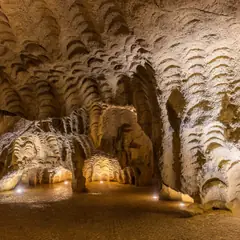
About 4 km to the south, along the coast road, the Caves of Hercules open onto the ocean their mouth shaped like a map of Africa, and back in Tangier the Café Hafa ends the day with tea facing the Strait.
A sea that sank frigates and princesses
Esplanade over the cliff
Summary of this stop
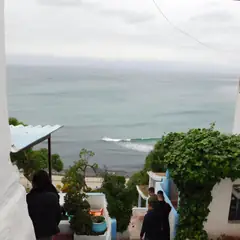
The lighthouse esplanade looks out on a postcard sea that for centuries was a trap for ships. Here the Dona Isabel was lost in 1860 with some 250 cadets of the Brazilian imperial navy, and here in December 1911 the P&O steamer Delhi ran aground with Alexander Duff, Duke of Fife, his wife Princess Louise and their daughters aboard. British and French ships rescued the passengers; three French sailors died in the attempt.
The accounts of that rescue, a well-documented tradition, add scenes hard to forget: more than nine hours aboard in nightclothes, a boat that flooded on the way to shore, a royal jewel case that vanished among the waves and a family that arrived barefoot and soaked at the Cap Spartel lighthouse itself in search of hot tea and dry clothes. What the lighthouse keeper lent the duke to continue his journey is the detail the narration saves to tell facing these same rocks.
A minaret paid for by the sultan
Minaret tower of the lighthouse
Summary of this stop
At the foot of the tower the architecture of Cap Spartel is understood: a square-plan Maghrebi minaret, some 31 m according to the IALA (other sources give different measurements), on a broad base that recalls Hispano-Moorish mosques and crowned by a crenellated gallery and the lantern. Works began in 1861 by order of Sultan Mohammed ben Abderrahmane, were paid for by the Moroccan government and finished in 1863. The official Moroccan nomination to the IALA names the French engineer L. Jacky as site director, with skilled local labour, while other sources attribute the design to the architect François Léonce Reynaud.
The light was lit on 14 Jumada al-awwal 1281 AH, 15 October 1864, with oil lamps, and reached 30 nautical miles, some 55.6 km. That same silhouette travels today across Morocco from hand to hand: the blue 200-dirham note of the 2012 series shows on its reverse a stylised view of the lighthouse beside the port of Tanger-Med. The rest of the tower’s story, stone by stone, is revealed by listening to the stop right there.
Ten powers and a single flag
Courtyard of the Lighthouse Museum
Summary of this stop
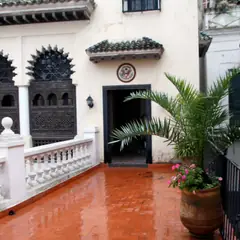
The courtyard of the Lighthouse Museum, with its fountains and plants, is the setting of the lighthouse’s most singular diplomatic scene. On 31 May 1865, in the office of the Belgian consul in Tangier, Morocco signed with the United States, Austria, Belgium, Spain, France, Great Britain, Italy, the Netherlands, Portugal and Sweden-Norway a seven-article convention to administer and maintain the light.
The arrangement was as curious as the city that made it possible. The powers ran the lighthouse, but ownership and sovereignty remained the sultan’s, and only his flag could fly on the tower. As Morocco then had neither a navy nor a merchant fleet, maintenance was borne by the signatories with an annual share identical for all, while repairs fell to the sultan. For Morocco the foreign minister Sid Mohammed Bargash signed; the British diplomat Sir John Hay Drummond Hay signed three times, for Great Britain, Austria and the Netherlands, an oddity the narration unpacks in the courtyard itself.
Neutral even in war, until 1941
101-step spiral staircase
Summary of this stop
At the foot of the spiral staircase, the one with 101 steps and a mahogany handrail, the lighthouse shows its most fragile side. The convention obliged the sultan to guard it with a caid and four soldiers, and the powers to respect its neutrality and keep paying for it even if they went to war with each other or with Morocco. It was a promise designed to withstand any conflict.
In the middle of the Second World War, with Tangier occupied by Spain, the Spanish high commissioner in Morocco set 5 July 1941, at 11 in the morning, as the moment when an engineer of the Khalifian zone would take charge of the lighthouse, outside the international regime from then on. The occupation lasted until after the Anglo-French agreement of Paris in August 1945: on 11 October that year the International Commission of the Cape Spartel Lighthouse regained control. The details of that order and of the return are left for the climb.
A 30-mile light and a sunken island
Upper viewpoint of the tower
Summary of this stop
Up top, the upper viewpoint opens a 360-degree view over the Strait of Gibraltar and the merchant ships crossing it, beside the lantern and its Fresnel lens. The light that leaves from here has changed several times: in 1905 it went from oil to paraffin and gained a diaphone, the fog siren; in 1914 it rose from 6,000 to 20,000 candlepower, in 1931 to 300,000 and in 1950 it was electrified. In 1956 management passed to the Moroccan government and a 1958 protocol ended the 1865 convention. After twelve months of renovation, the building opened to the public in 2021 as a museum, and in 2023 came the IALA’s recognition.
Beneath those waters there also lies the Spartel or Majuan bank, a real island that was submerged some 12,000 years ago when sea levels rose after the last ice age. In 2001 the geologist Jacques Collina-Girard proposed that it was Plato’s Atlantis, a much-disputed theory: one of his initial supporters, Marc-André Gutscher, later concluded that the island could not have sustained a society like the one in the story. How that tale of a lost island ended is the finale the audio guide reserves for the last step.