World Heritage 2026
Chorsu Bazaar Audio Guide (Chorsu bozori)
Under an 86-metre blue dome, spices, bread and dried fruit are still sold at the same crossroads where the four districts of old Tashkent met. Chorsu Bazaar looks like it belongs to another century, yet its silhouette passed through Algeria and a student's diploma before arriving here.
- 60 min of audio
- Soviet modernist architecture
Chorsu means “four roads” in Persian: it was the meeting point of the four dahas of old Tashkent, Kukcha, Beshagach, Sibzar and Sheikhantaur. By the time the Russians arrived, its heart already held 25 rows of bazaar among caravanserais, the Friday mosque and the madrasas of Beklarbek, Khoja Akhrar and Kukeldash. The present building, signed by Vladimir Azimov and Sabir Adylov, was drawn up in the early 1980s and raised its great reinforced-concrete dome in 1990, though the chronology shifts depending on the source.
It was designed as the “Oktyabrsky” market, “of October”, for the planned economy, and opened just as the USSR was liberalising trade: it had to be hastily redesigned with private kiosks. Thirty-six years after its structure was finished, on 26 July 2026, it was inscribed on the World Heritage List as one of the ten components of Tashkent's modernist architecture.
Highlights
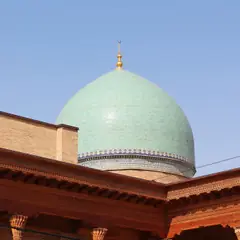
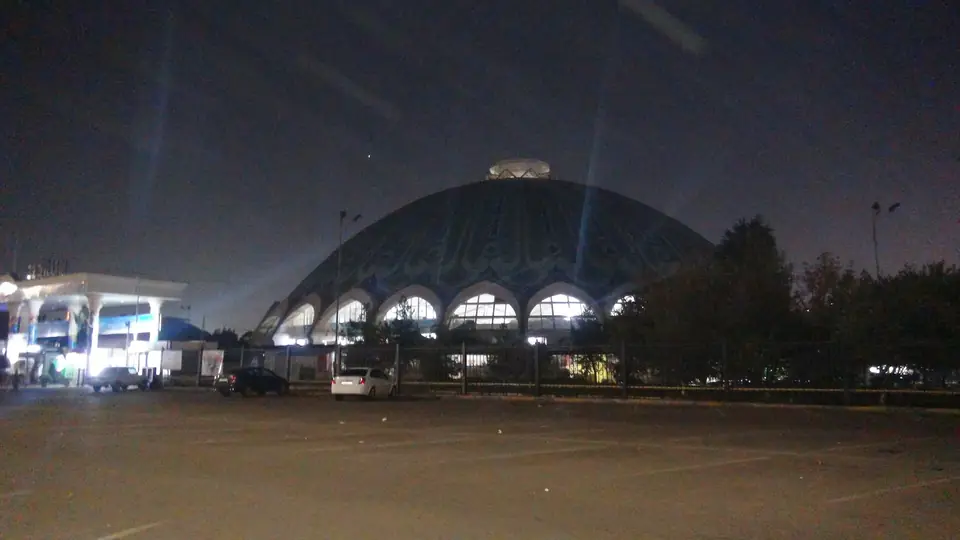
- Great blue dome — 86 metres across and 28 high, visible from the Chorsu metro exit
- Giant ceramic arabesques — Timurid motifs enlarged to monumental scale, like a piala bowl
- Second-floor gallery — dried fruit, teas and spices above the meat and dairy hall
- The canopy of the hotel that never was — the only trace of the cylindrical hotel in the 1980s plan
- Food market — kabob, norin and osh facing the Kukeldash madrasa
From the Chorsu metro exit, the first thing to appear is a pointed dome of blue ceramic that seems to have been there forever. It has not. There has been a market on the site since the 11th-12th centuries, according to Uzbekistan’s Cultural Heritage Agency, with several archaeological layers still unexcavated beneath the stalls (some tourist guides speak of more than 2,000 years, a figure the agency does not back). The dome, by contrast, dates from 1990, and its genealogy is as unexpected as the building itself: a colonial market in Algeria, a Tashkent student’s final-year project and a team of architects who dressed it in Timurid-inspired arabesques.
The history of Chorsu Bazaar is full of dates that dance around. One tourist guide places it in the 1970s; Wikipedia gives the design as 1980 and the works as 1985 to 1990; the study by Boris Chukhovich and Kazakova dates the first sketches to 1980–1981, the start of construction to 1983, the finished structure to 1990 and redesigns up to 1993. The diameter follows suit: 86 metres according to that study, “almost 90” on Wikipedia. What nobody disputes is that the market opened in a hurry, before the vault’s ceramic cladding was complete, and has never stopped trading.
The architecture of Chorsu reads in layers: the great hall under the main dome, the high spice gallery, the smaller domes and the vaulted pavilions of vegetables, fruit, bread and sweets, and the food market, with the Kukeldash madrasa, from around 1570, at the edge of the bazaar. In May 2022, when a rumour spread that one of the domes was to come down in a renovation, the Cultural Heritage Agency met in the market itself to remind everyone that all seven are heritage.
The audio guide tours the bazaar in five stops, outside and in, with documented narration checked against historical sources, to read in a living market the story of a building that survived every plan that tried to change it.
At the edge of the market, on the old city wall, rises the Kukeldash Madrasa, and a little over a kilometre to the north the Hazrati Imam Complex completes the old town. Sabir Adylov, one of the bazaar’s architects, also worked on the Courage Monument, the memorial to the 1966 earthquake.
Four roads under a blue dome
Chorsu Bazaar
Summary of this stop
On the esplanade facing the great dome, the name already explains almost everything. Chorsu, in Persian, means “four roads”: here the four dahas, the districts of old Tashkent, Kukcha, Beshagach, Sibzar and Sheikhantaur, came together. It was the city’s centre of gravity, and the market filled all of it.
When Russian troops conquered Tashkent, the heart of Chorsu already had 25 rows of bazaar, surrounded by caravanserais, the Friday mosque and the madrasas of Beklarbek, Khoja Akhrar and Kukeldash. According to a documented 19th-century tradition, a true city needed a mosque able to gather all its inhabitants and the thirty-two guilds that, it was believed, covered all the trade in the world, as many as the members of the human body.
Beneath the pavement of this esplanade lie layers of market almost a thousand years old that nobody has yet excavated. What is known about that ground, and what it still hides, is the starting point of the narration.
The canopy of the hotel that never existed
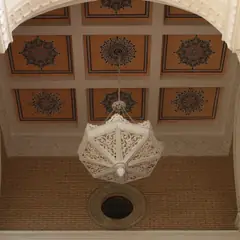
Circular canopy of the trading pavilion
Summary of this stop
Among the smaller domes of blue mosaic and the vaulted pavilions, a detail appears that almost nobody looks at: the round canopy of a nearby trading pavilion. It is all that is left of a cylindrical hotel that the 1980s plan placed on the north side of the market and that was never built.
That phantom hotel belongs to another market, the one that was planned: the “Oktyabrsky”, “of October”, in honour of the revolution, conceived for the planned economy. It opened just as the USSR was liberalising trade, and between 1989 and 1993 it had to be redesigned with private kiosks. Above, the reinforced-concrete domes were clad in vegetal arabesques that enlarge to giant scale the rib motifs of some Timurid domes, until they look like decorated Uzbek bowls.
The neighbourhood’s memory keeps two nicknames from that era. In Soviet Chorsu, a state-made samsa was sold at special counters for 20 kopeks; years later, when Chinese goods flooded the market, the area came to be called the “Shanghai of Tashkent”. How both memories fit into a single building is told in front of the canopy.
A dome that came from Algeria
Skylight of the great dome
Summary of this stop
In the centre of the main hall, under the skylight that ventilates the interior, the concrete geometry stands bare. Its remote model, according to the genealogy traced by Boris Chukhovich, is in Sidi Bel Abbès, Algeria: a covered market that the French architect Marcel Mori built in 1955 with a great dome whose intrados was inspired by the Pantheon in Rome, in the city that had housed the Foreign Legion’s headquarters since 1831.
The second link is a student. In 1967 Yuri Garamov submitted as his diploma a covered market for Chilanzar with a dome 86 metres in diameter and 28 high, exactly the two measurements of the one built here. Other researchers, such as Yuri Miroshnichenko and Jens Werner Jordan, pointed instead to Andrei Kosinsky’s late-1960s centre project for Chilanzar as the prototype, and Chukhovich adds the Felipe II market in Barcelona as the source of the conical elements.
Construction began in 1983, with long interruptions, and the structure was finished in 1990. The market opened before the vault had its ceramic cladding complete. What links the Foreign Legion to a Tashkent market is the revelation of this stop.
Spices in the gallery Garamov never drew
Dried fruit and spice gallery
Summary of this stop
From the upper gallery, the bazaar can be seen in full swing: above, stalls of dried fruit, teas and spices; below, the floor of meat, dairy and cheese. This mezzanine was not in Garamov’s diploma, which only lined up stalls around the perimeter. It was added by the team of Vladimir Azimov, a former student of Andrei Kosinsky and chief architect of the Tashguiprogor institute, who drew the first sketches in 1980–1981 and signed the project with Sabir Adylov.
That second floor is what makes the dome habitable, and also the best place to grasp the rhythm of haggling. A documented tradition from the years after the Russian conquest describes the shopkeepers of the great bazaar sitting cross-legged, bringing out their goods one at a time, delighted to show everything to anyone who had come just for tomasha, for fun.
What they could not stand was selling everything at once. The answer one of them gave to an American traveller who wanted to buy the whole lot sums up an entire bazaar philosophy, and the narration recovers it among the sacks of spices.
Osh and kabob in a bazaar that always reopens
Ovqat Bozori food market
Summary of this stop
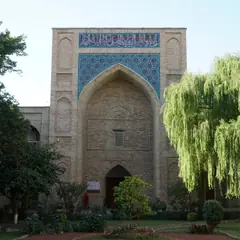
The tour ends where it smells of embers. In the food market, the ovqat bozori, they serve kabob, norin, xasip, osh and xonim, prepared by cooks who have spent several decades at their stalls, according to local press in July 2024. At the back rises the Kukeldash madrasa, from around 1570, a survivor of Chorsu’s old religious core.
This market has withstood a great deal. In May 2022 a rumour spread that one of the domes would be demolished in a renovation, and the Council of the Cultural Heritage Agency met in the market to remind everyone that all seven domes are heritage and that it had already rejected the first reconstruction project. On 26 July 2026, at the 48th session of the World Heritage Committee in Busan, Chorsu was inscribed as one of the ten components of “Tashkent Modernist Architecture”, the first Uzbek national nomination accepted in 25 years.
Between one date and the other there was a summer night when fire reached a few metres from the great blue dome. What burned and what happened the next morning closes the story of a bazaar that always opens again.