16th-century madrasa
Kukeldash Madrasa Audio Guide (Koʻkaldosh madrasasi)
It looks intact, but it is a survivor: perched on Tashkent's old city wall, above Chorsu Bazaar, the Kukeldash Madrasa has been a school, a caravan inn, a fortress, a brick quarry and a museum of atheism before filling up with students again.
- 30 min of audio
- Turquoise majolica
The Kukeldash Madrasa is the great Shaybanid school of 16th-century Tashkent and was the largest of the 23 madrasas of the old town: the complex measures 62.7 by 44.9 metres and its courtyard 38 by 26.9. It rose on the southern edge of the medieval shahristan of Binket, on the embankment of the old wall, and a waqfnoma of 1569-1570 shows it was already operating then. Its name is a court title: kukeldash, “the khan's milk brother”, the office of the vizier of the khans Barak Khan and Darvish Khan.
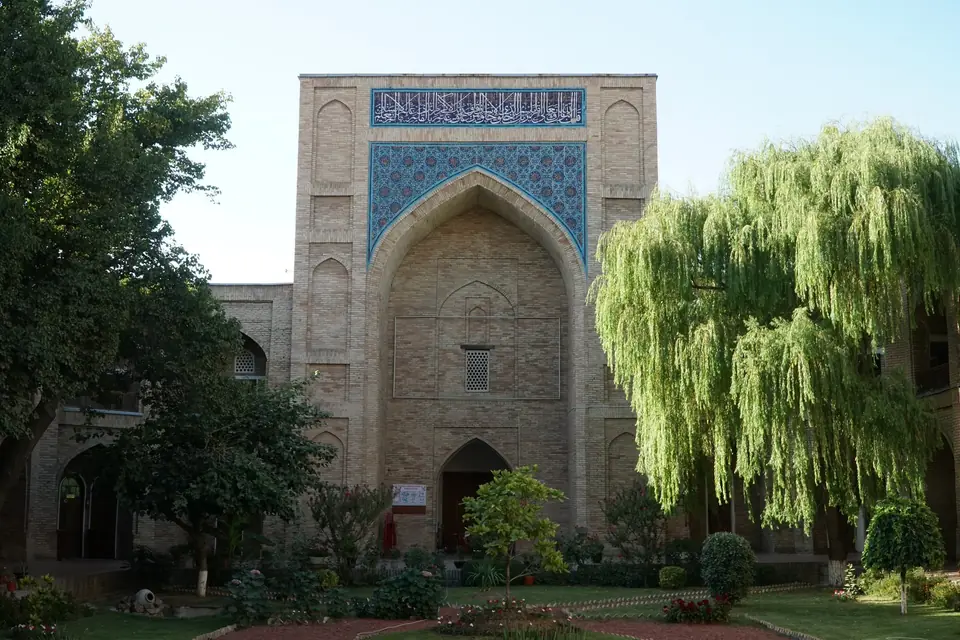
The turquoise, blue and white majolica portal that dominates the square today looks 16th-century, but is largely a reconstruction made after independence from photographs of the 1880s. The earthquakes of the 19th century tore off its upper part, and even so the building was one of the few religious buildings in Tashkent still standing after the 1966 quake.
Highlights
- Majolica portal — almost 20 metres rebuilt from photographs of the 1880s
- Staircase on the wall — the street below occupies the old Binket moat
- 38 x 27-metre courtyard — hujras where the poets Furqat and Hamza lived
- Missing domes — dismantled in 1830-1831 to build a madrasa that no longer exists
- Panjara lattices — the names of Allah and the Prophet Muhammad intertwined
Few façades in Tashkent have had as many lives as the Kukeldash Madrasa. Raised by the Shaybanids in the 16th century on the embankment of the southern wall, a stone’s throw from Chorsu Bazaar, it was the largest of the 23 madrasas of old Tashkent. It later emptied as a school and by 1735 was already housing caravan merchants; around 1860 it was the fortress of the khans of Kokand; in 1865 it suffered the Russian assault; in Soviet times it held an exhibition on the atheist way of life and then a collection of musical instruments. Since 1999 it has been an Islamic school again, with more than a hundred students admitted by competition.
The history of the Kukeldash Madrasa carries several open questions. On who founded it, the sources do not agree: some attribute it to Qulbobo Koʻkaldosh, a high dignitary of the Khanate of Bukhara; others, above all those from before the revolution, to the governor Darveshkhan; others, to an unnamed vizier who held the title of kukeldash under Barak Khan and Darvish Khan. The construction dates dance between the mid-16th century and 1591, and the firmest anchor is the waqfnoma of 1569-1570, in which the governor Sulton Darveshkhan donates a caravanserai to support the madrasa. Even the height of the portal changes from one text to another: 15.7 metres, 19.73 or the round 20 of the guidebooks.
As for its architecture, the original building had three storeys and 38 hujras around the courtyard, with the mosque and the classroom under double domes on either side of the entrance. What remains is lower and full of absences that also tell a story. A 19th-century legend grew up around it: it is said that a sacred pistachio tree sprouted on one of its domes, credited with protective powers.
The audio guide tours the madrasa in four stops, from the staircase to the courtyard, with documented narration checked against historical sources that teaches you to read each of those lives in its walls.
At the foot of the staircase stretches Chorsu Bazaar under its blue dome, and a little over a kilometre to the north the Hazrati Imam Complex holds the Barak Khan madrasa, also from the 16th century.
A madrasa perched on the wall
Kukeldash Madrasa
Summary of this stop
At the foot of the staircase the change in level is already a lesson in urban history. The madrasa rests on the remains of the embankment of the southern wall of the Binket shahristan, and the street running at its feet occupies the old moat. Medieval city, defence and school are stacked in a single cut of the terrain.
Above unfolds a façade 62.7 metres wide by 44.9 deep, the largest of the madrasas of old Tashkent, with its central portal and the two-storey loggias at the sides, the only place where second-floor cells survive. Even the name has a history: kukeldash means “the khan’s milk brother” and was the court title of the vizier of Barak Khan and his son Darvish Khan. What that milk kinship says about power at the Shaybanid court is what the narration reveals in front of the stairs.
A portal of punishments copied from photos
Blue and white majolica portal
Summary of this stop
Beneath the main portal the ornament becomes a stage. Around 1860, when the khans of Kokand ruled Tashkent, the madrasa served them as a fortress, and in 1865 the capture of the city by the Russian troops of General Chernyayev left serious damage to it and to the neighbouring Friday mosque of Khoja Akhror Vali.
A grim tradition is also attached to this portal: it is said that until 1865 wives accused of infidelity were put in sacks and thrown from the upper parapet onto the paved ground. The tale circulates mostly in tourist texts and no historiographical support to confirm it has been found, so it belongs to the realm of what is told, not of what is proven.
And then there is the paradox of the majolica. The turquoise, blue and white portal that looks 16th-century was rebuilt after independence from surviving photographs of the 1880s, and in 2008, for Tashkent’s 2200th anniversary, the entrance and façade were renovated again. What stands in front of you is, to a large extent, a photo from the tsarist era turned into brick and tile, and how that copy was made is told right there.
The domes that ended up in another madrasa
Entrance block seen from the courtyard
Summary of this stop
From the centre of the courtyard, looking towards the entrance, the key lies in what is missing. The building had three storeys, and the mosque on the left and the classroom on the right were covered with double domes. In 1830-1831, under the governor Lashkar Beglarbegi, the blue domes and the bricks of the second floor were dismantled to build the Beglarbegi madrasa in the upper part of the bazaar. The sources differ on exactly what was torn down, but the ending is ironic: that madrasa has vanished and the Kukeldash still stands.
Then came the earthquakes. Those of 1866 and 1886 (other sources say 1868 and 1886) brought down the upper part of the portal, and in 1902-1903 the people of Tashkent paid with donations for a repair that was left half done for lack of money. Rebuilt in the 1950s after the 1946 quake, the madrasa was one of the few religious buildings in the city to withstand the 1966 earthquake, the one that changed the face of Tashkent. Why such a wounded building held on where others fell is what the narration poses at this point.
The cell of the poet who signed “separation”
Courtyard hujras
Summary of this stop
In front of the courtyard cells, each with its small entrance iwan, the tenants of five centuries parade by: students two or three to a room, caravan merchants in 1735, Uzbek poets in the late 19th century, the Soviet exhibition on atheism and the collection of national instruments. In 1991 the building passed to the Spiritual Administration of Muslims and since 1999 the hujras have been taking in students again for four years of study.
Muqimiy stayed here on his visits to Tashkent in 1880-1890, and Hamza Hakimzoda Niyoziy lived in one of the cells in 1910-1911. But the most novelistic tenant is Zokirjon, the poet from Kokand who signed “Furqat”, “separation”. He arrived in June 1889, still ill, and a friend he knew only from afar found him a place in the madrasa, where he spent nine months recovering. In Tashkent he even signed for a time with another pen name, “Farhat”, “joy”.
In May 1891 he set off for Samarkand, Istanbul, Mecca and India, and ended up in Yarkand, in Eastern Turkestan, always with the idea of returning. How that poet’s story ends, and what remains of him among these cells, is what closes the tour.