Religious heart of Tashkent
Hazrati Imam Complex Audio Guide (Hazrati Imom majmuasi)
Five centuries of mosques and madrasas grew around the tomb of a 10th-century scholar whom Tashkent still calls “the locksmith”. What looks like a timeless postcard is a place that was closed, bargained over and rebuilt again and again.
- 60 min of audio
- 16th-century madrasas
The complex takes its name from Abu Bakr Muhammad Kaffal Shashi, born in Tashkent in 903 or 904 and dead in 975 or 976, a scholar who shone in the Baghdad of the Abbasid caliphs as Shashi al-Kabir, “the Great Tashkenti”. Around his mausoleum, raised in 1541-1542 by the architect Ghulam Husayn, were added the Barak Khan madrasa of around 1531-1532, the Muyi Muborak madrasa of 1856-1857, the Tillashayx mosque of 1890-1902 and, in 2007, the great Friday mosque with its two minarets of about 53 metres.
For 36 years the Muyi Muborak madrasa kept the Uthman Quran, a manuscript the Russian army took from Samarkand in 1868 and which passed through St Petersburg, Ufa and a museum's storerooms before arriving here in 1989. Radiocarbon dating places it between 775 and 995, more than a century after the caliph's death. And in November 2025 the original was moved to the building next door.
Highlights
- Kaffal Shashi Mausoleum — signed on the door by the architect Ghulam Husayn in 1541-1542
- Barak Khan Madrasa — carved-brick portal and mosaics, its cells now turned into artisans' shops
- Muyi Muborak Madrasa — for 36 years the home of the Uthman Quran, now with a copy in its display case
- Friday Mosque of 2007 — two minarets of about 53 metres raised in 26 and 28 days
- Tillashayx Mosque — bare façade outside, ornate stucco within
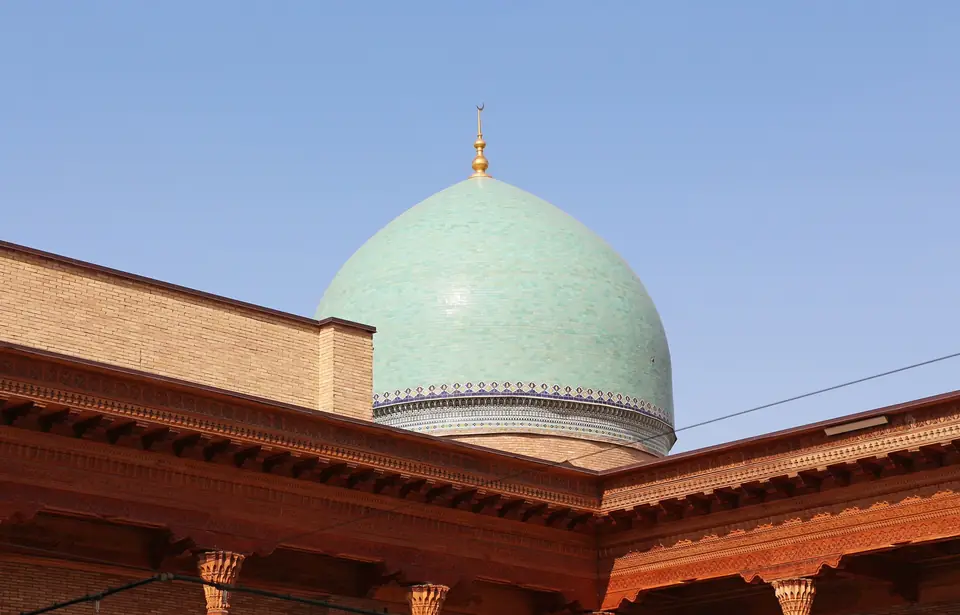
In the old quarter of Tashkent opens a great esplanade ringed by blue domes, mosaic portals and fired brick. It is known as Hazrati Imam, or Hast Imam, and it is the city’s religious heart. Its origin is a single tomb: that of Abu Bakr Muhammad Kaffal Shashi, a 10th-century resident of Tashkent whose nickname, Kaffal, means “locksmith”, because his family made locks. That son of craftsmen spent much of his life in Baghdad, at the court of the Abbasid caliphs, and even corresponded with the Byzantine emperor Nikephoros II before returning home.
The history of Hazrati Imam is not that of a monument frozen in time. The Barak Khan madrasa lost its 22-metre dome in an earthquake (1886 according to some sources, 1868 according to the National Encyclopedia of Uzbekistan), and was a dormitory, a warehouse and the seat of official Islam. The saint’s mausoleum was closed in the Soviet anti-religious campaign and still went on receiving the faithful, until decree no. 410 of 27 March 1945 handed its management to the Spiritual Administration of Muslims of Central Asia and Kazakhstan (SADUM). The most imposing piece on the square, the Friday mosque, opened in 2007.
The architecture of Hazrati Imam reads in layers: the Shaybanid brick of the 16th century, the madrasa from the days of the Khanate of Kokand, a late-19th-century mosque and a newly built one, and beside the complex the Islamic Civilization Centre, with four portals 34 metres high and a central dome of 65, which since 2025 has housed the Uthman Quran.
The audio guide tours the complex in five stops, with documented narration checked against historical sources, from the Friday mosque to the madrasa turned bazaar, by way of the display case that held the Uthman Quran for 36 years and the door of the locksmith’s mausoleum.
To continue through the old town, the Kukeldash Madrasa, another great 16th-century school, and Chorsu Bazaar lie a little over a kilometre to the south. And if the Barak Khan workshops leave you wanting more, the Museum of Applied Arts gathers Rishtan ceramics and ganch stucco in a 19th-century house.
Two minarets raised against the clock
Hazrati Imam Mosque
Summary of this stop
Facing the Hazrati Imam Friday mosque, the first impression deceives. The square looks ancient, but its largest building went up in 2007, on the initiative of President Islam Karimov. Two great blue domes, gilded inside, crown a hall with windows designed to let the sun in from dawn to dusk, and in front opens an ayvan of 20 columns carved from sandalwood brought from India, 8.6 metres high.
The two minarets flanking the entrance, of about 53 metres, have different authors. The right one was raised by the Khorezm masters Ibrohim and Erkin; the left one by the team of the Samarkand master Sharif. One took 26 days and the other 28.
Two schools of builders, two twin towers and less than a month for each. What that race says about the place, and about the way Uzbekistan wanted to dress its holiest square, is what is told at the foot of the minarets.
The mosque that became a Soviet workshop
Tillashayx Mosque
Summary of this stop
The Tillashayx mosque surprises with its sobriety: square plan, undecorated façade, three entrance arches, small side minarets and 18 windows. Inside, by contrast, the stucco (ganch) unfolds in ornate profusion. It was built between 1890 and 1902 by a merchant named Tillashayx, and in the 1930s it was closed and turned into an artisans’ artel.
It was among the first mosques to reopen, in the mid-1940s, with the Spiritual Administration authorised in 1943 (the exact date of reopening varies by source, between 1943 and 7 May 1945). Behind that reopening lies a documented episode: that of Eshon Babakhan, imam of this mosque, whose family property was confiscated in 1928 and who was arrested in 1937 together with his son Zaynuddinkhan, who died in 1938 in an NKVD camp in Buryatia.
In 1943, in the middle of the war, that same man led the petition to Kalinin to create the Central Asian muftiate, and was given back as its seat the neighbourhood house that had been taken from him. What he later had to pay to recover a madrasa, and where he ended up buried, is revealed in front of the mosque.
The Quran that is no longer here
Muyi Muborak Madrasa
Summary of this stop
The Muyi Muborak madrasa was raised in fired brick by the governor Mirzo Ahmad qushbegi in 1856-1857, under the Ming dynasty of Kokand, although some tourist sources trace it back to the 16th century with later reconstructions. Its name means “sacred hair”, after the relic of a hair of the Prophet kept in it. It was the Muftiate’s library and, from March 1989, the home of the Uthman Quran hall.
The manuscript arrived after more than a century of journeys: the Russian army took it in 1868 from the Khoja Ahrar madrasa in Samarkand to St Petersburg, the Bolsheviks sent it to Ufa in 1918, it entered Tashkent on 9 August 1923 and from 1941 it sat in a museum’s storerooms while a facsimile was shown in an anti-religious exhibition. How it left Samarkand is told in two incompatible ways, as plunder or as a sale, and there is no agreement on how it had got there either.
UNESCO presents it as the oldest written version of the Quran, but radiocarbon gave a range of 775 to 995 and palaeography places it in the 8th or 9th century. In November 2025 the original moved to the Quran Hall of the Islamic Civilization Centre, behind armoured glass, and in February 2026 the Muyi Muborak display case held a copy. The two versions of its departure from Samarkand are unpacked in front of that case.
The locksmith’s door in Tashkent
Kaffal Shashi Mausoleum
Summary of this stop
The Kaffal Shashi mausoleum is the origin of the whole complex. It is an asymmetrical mausoleum-khanaqah of fired brick, with a dome of coloured tiles, two side towers and pilgrims’ cells in the corners. It was raised by the architect Ghulam Husayn in 1541-1542, with bricks of 25 × 26 × 5 centimetres on a plan of 13.3 by 12.5 metres, and above the door lintel he left the date, his name and the calligrapher’s signature. To the south opens a small courtyard with later burials.
The building preserves documented customs: the sarcophagus chamber has an arch arranged so that whoever enters bows before the preacher’s remains, and the door, unlike almost all mausoleums, faces north. To be buried beside him was considered an honour, because his spirit was believed to guide the souls of those who lay nearby, and that is why so many Tashkent notables sought burial around it.
Legends also circulate about the saint: that he spoke seventy-two languages, that a poem of his halted Byzantium, that his nickname comes from a prodigious lock whose size even tradition cannot settle. Which of these stories holds up best, and what is truly known of the scholar who lived in Baghdad, is told in front of the signed door.
From a poet’s madrasa to a bazaar
Barak Khan Madrasa
Summary of this stop
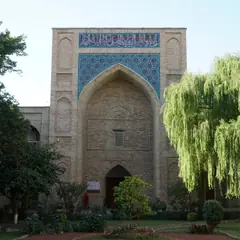
The great portal of the Barak Khan madrasa, a deep niche with carved-brick tympana and coloured mosaics with geometric and girih motifs, is the showiest thing on the square. It was commissioned around 1531-1532 by the ruler Navruz Ahmad Khan, nicknamed Barak Khan, “the fortunate”, for his former teacher, the poet Zayniddin Vasifi, born in Herat in 1485. Inside are two mausoleums: that of Suyunchkhoja Khan, the first Shaybanid ruler of Tashkent, and an unnamed one built for Barak Khan himself; whether it was left empty or holds his tomb is a question the sources do not resolve the same way.
Its later biography has something of a comedy: it lost its 22-metre dome in an earthquake, in 1917 it was a dormitory, from 1936 it housed the society of the blind and a warehouse, and until the end of 2006 it was home to the Muslim Board of Uzbekistan. In April 2000 the US Secretary of State Madeleine Albright took off her shoes and covered her head with a scarf to enter it.
Today its former student cells are occupied by more than twenty artisans and souvenir shops, selling ikat, jewellery, woodcarving and ceramics, and nobody takes their shoes off to go in. What the local cameramen did that day in 2000 is the finishing touch that closes the tour.