House-museum of Uzbek crafts
Museum of Applied Arts Audio Guide (Oʻzbekiston amaliy sanʼati va hunarmandchiligi tarixi davlat muzeyi)
Outside, a Russian merchant's house; inside, a hall of openwork ganch, painted ceilings and Rishtan tiles, and even a mihrab. At Tashkent's Museum of Applied Arts, the first piece in the collection is the building itself.
- 60 min of audio
- Carved ganch and kundal ceiling
In 1896 Alexander A. Polovtsov arrived in Tashkent from St Petersburg, an official of the Ministry of the Interior sent to study agrarian colonisation. His secretary, Mikhail Andreyev, bought on his behalf the house of the merchant Nikolai Ivanov and redid its interiors in Oriental style with the architect A. A. Burmeister and five masters from Tashkent, Bukhara, Khiva and Rishtan. Since 1937 that 19th-century mansion has been the showcase of Uzbek craftsmanship, extended in 1970 with a two-storey building.
Above the doors of the reception hall, an aphorism in Persian script says that the world is a castle which new people enter every day. The house fulfilled it to the letter: after the diplomat came Austrian officers held prisoner during the First World War, then an orphanage, then workshops for ganch carving and embroidery, and finally the museum.
Highlights
- Central hall — a three-tier ceiling painted in kundal style, with muqarnas cornices
- Mihrab, niches and two fireplaces — a prayer niche in a Russian diplomat's reception room
- Persian inscription above the doors — “The world is a castle which new people enter every day”
- “Yulduz” gold-embroidered panel — 445 x 445 cm, the work of 45 embroiderers in eight months
- Blue Rishtan ceramics — the same tradition that gave the hall its tiles
On a quiet Tashkent street, a gallery of carved wooden columns looks out onto Rakatboshi Street and hints at what the façade does not tell. Behind it is a house from the late 19th century that a Russian merchant sold in 1896 to an official arrived from St Petersburg, and that his secretary had clad in carved ganch, painted wood and tiles by masters from Tashkent, Bukhara, Khiva and Rishtan. On 7 July 1937 the Museum of Artisan Crafts opened here with pieces gathered since the Uzbek masters’ exhibition of 1927; some sources, however, push its arrival in the building back to 1938.
The history of the Museum of Applied Arts has more twists than its name suggests. Through its rooms passed a tsarist diplomat who would end up selling antiques in Paris, Austrian officers held prisoner, orphanage children and apprentices in carving and embroidery. The collection is put at more than 4,000, more than 7,000 or more than 10,000 pieces depending on the source, and in 2017 a Council of Ministers resolution refounded it as the State Museum of the History of Applied Art and Crafts of Uzbekistan. In April 2024 the building entered the national heritage list with an unexpected label, “modernist object”, alongside the television tower and the circus, and in March 2025 that same listing was used by a court to halt neighbouring works that threatened it.
What to see at the museum runs from the architecture of the house, with its ayvan and central hall, to the ceramics rooms and the salons where present-day artisans sell their work. The audio guide tours it in five stops, with documented narration checked against historical sources, to read in each ceiling and each wall who made it and what happened to the house afterwards.
The same carved stucco clads the foyers of the Navoi Theatre on a grand scale, and in the former cells of the Barak Khan madrasa, in the Hazrati Imam Complex, today’s artisans still sell ceramics, ikat and carvings.
The ayvan of the brewer’s house
Museum of Applied Arts
Summary of this stop
Facing the façade, the ayvan, the traditional Uzbek terrace-gallery with carved wooden columns, is the only thing from the street that announces that this Russian house is “Oriental” inside. The building was raised for Nikolai Ivanovich Ivanov (1836-1906), the greatest entrepreneur of tsarist Tashkent, and it was from him that Mikhail Andreyev, secretary to A. A. Polovtsov, bought the house on commission in 1896 before redoing its interiors.
Ivanov was the son of a small merchant from Orenburg and began at fifteen as an errand boy. In 1874 he was the first to brew beer in Tashkent; he also distilled vodka, produced artificial ice and mineral water, and came to have 2,700 workers in his enterprises in Turkestan.
Before being a showcase of Uzbek crafts, then, this was the house of the city’s beer and vodka king. What ended up being his summer estate on the outskirts, and why his name is still tied to Tashkent’s largest memorial complex, is the twist the narration keeps for this first stop.
A mihrab in a diplomat’s drawing room
Kundal ceiling of the central hall
Summary of this stop
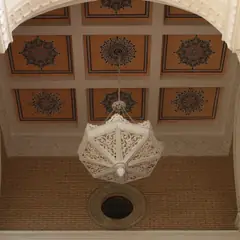
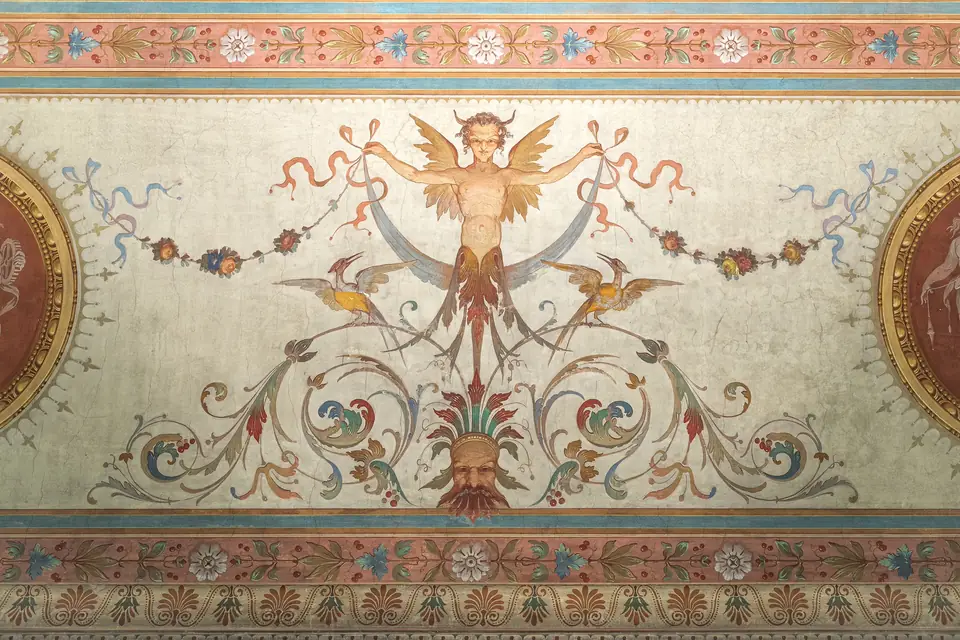
The central hall, the former guest room or mehmonxona, reads like a choral work. The ceiling, stepped in three levels with muqarnas cornices, is painted in kundal style under the direction of usta O. Qosimjonov; the walls are covered with openwork ganch panels coloured in tempera, and the tiles are by the ceramicist usta Abdulla of Rishtan. The decoration, carving and painting of the house are shared among five masters with names of their own: T. Arslonqulov and A. Kazymdzhanov, from Tashkent; Shirin Murodov, from Bukhara; A. Palvanov, from Khiva, and usta Abdulla, from Rishtan. The sources do not agree on everything: the Uzbek one adds masters from Samarkand, and the spelling of some names varies from text to text.
In the midst of that display appear two objects that should not coexist. Two fireplaces, a feature of the Russian house, are dressed in carved stucco to match ceiling and walls. And beside two niches there is a mihrab, a prayer niche, on whose decoration T. Arslonqulov worked: a space for orienting prayer inside a Russian diplomat’s reception room.
Over that late-19th-century skin lies a late Soviet layer: in the 1980s and 1990s the painter Ch. Akhmarov decorated the walls with miniatures on applied art. Which hand signed each part of the hall, and what other palaces the house’s Bukhara master decorated, is what is unpacked under the kundal ceiling.
A castle which new people enter
Persian inscription above the doors
Summary of this stop
Above the doors of the reception hall, beside leaves of openwork carving, an inscription in Persian script says: “The world is a castle which new people enter every day”. Given what came afterwards, the aphorism sounds like prophecy.
Behind the Oriental interior there is, according to documented tradition, a Tashkent native and not a decorator from the capital. Mikhail Andreyev was born in Tashkent in 1873, the grandson of a simple soldier; as a seminarian he would go down to the old town, made friends with madrasa students and persuaded a teacher at the Ishan Kuli-dodjo madrasa to teach him Arabic, Persian and Turkic literature. He became an ethnographer and orientalist, travelled to the Pamirs and in 1907 crossed the Karakoram Pass on foot to western Tibet. Some sources, nevertheless, present Polovtsov as the one who decided on the renovation and invited the architect.
Then came the new people. During the First World War the house lodged Austrian officers held prisoner, and from the 1920s to the mid-1930s it was an orphanage. Polovtsov, first director of the Pavlovsk palace-museum in November 1917, crossed the Finnish border on foot in 1918 and ended up in Paris. And Andreyev was arrested on 10 August 1938, accused of spying for British intelligence. How that arrest ended is what closes this stop.
Rishtan blue and an inherited museum
Rishtan ceramics rooms
Summary of this stop
The ceramics rooms gather blue glazed ware from Rishtan and other centres, such as Gurumsaray, Gijduvan, Khiva and Tashkent: the same tradition that gave the central hall its tiles. Here you can grasp how the collection grew from the pieces gathered at the Uzbek masters’ exhibition of 1927 to the museum opened in 1937, and why in 1970 a two-storey building, designed by U. Abdullayev and M. Ilhomov, had to be added to extend the house’s rooms.
Among the museum’s pieces stands out the gold-embroidered panel “Yulduz”, or girih, “star”, of 445 x 445 centimetres. From 1960, V. Stolyarov, N. Aminov and M. Ahmedov spent two years on its sketch, and 45 gold embroiderers stitched it in eight months.
The circle closes with the owner’s family. According to documented tradition, Polovtsov’s father had founded in St Petersburg, together with Baron Alexander von Stieglitz, the Stieglitz Museum of Applied Arts, and the son took over its direction in 1917. What that Petrograd museum has to do with this one in Tashkent is the echo the narration lets sound in the ceramics rooms.
From ganch workshop to shop
Craft sales salons
Summary of this stop
The house is not just a showcase. Before being a museum it held a training centre in ganch carving and repoussé and an embroidery workshop, and today the site keeps two salons where works by active artisans are bought and commissioned: the craft that decorates the walls is still being sold a few steps from them.
The future is also written. Council of Ministers resolution no. 1003, of 20 December 2017, refounded the institution as the State Museum of the History of Applied Art and Crafts of Uzbekistan and provided for rebuilding it in 2017-2019 with a new exhibition hall and an administrative building. What links the workshop of old with today’s shop is the idea with which the tour ends.