Garden of 1882
Amir Timur Square Audio Guide (Amir Temur xiyoboni)
At the centre of this circular garden there have stood a tsarist general, a red flag, Lenin, Stalin and Marx. Since 1994 Timur has ridden there, the latest tenant of a pedestal that in Tashkent has never known calm.
- 30 min of audio
- Soviet history
Amir Timur Square was laid out in 1882 on the dusty Konstantinovskaya square, on the initiative of Governor-General Mikhail Chernyayev and to a design by the architect Nikolai Ulyanov. The Moscow and Kaufman avenues split it into four quarters and extended old caravan routes towards Kashgar and Kokand. That same year Konstantin von Kaufman, first governor-general of Russian Turkestan, was buried here, so that everyone would know this was “truly Russian soil”. Since then, each regime has placed its own symbol at the same central spot.
The garden also lost its shade all at once. Between 12 and 20 November 2009 about 400 great plane trees marked with yellow tape were felled; an eco-activist chained himself to one of them until the police cut the chain. The reasons are still disputed: the official version spoke of excess density and, later, of pests, while rumours point to clearing the view of the new Forums Palace or to the sale of the timber.
Highlights
- Equestrian statue of Amir Timur — a bronze of 1994, a ruler on horseback with no weapon in his hands
- Strength lies in justice — Timur's motto carved in four languages on the pedestal
- Tashkent Chimes — a 28.7-metre tower of 1947 with a mechanism brought from Allenstein and its twin of 2009
- Radial paths — heirs of the 1882 caravan-route crossing, now among young trees
- Hotel Uzbekistan — a curved façade of 1974 with a concrete lattice inspired by Islamic architecture
Few places in Central Asia have changed owners so many times without moving. The geometric centre of Amir Timur Square, the Amir Temur xiyoboni of the signs, has hosted the tomb of a tsarist general, a monument paid for by public subscription, a red flag ringed with cannon, a revolutionary column, a bust of Lenin, a statue of Stalin, a bilingual stele and a torch topped with the head of Marx. Since 31 August 1994, the eve of the third anniversary of independence, the bronze rider Amir Timur has occupied that spot, and the square bears his name.
The history of Amir Timur Square begins in 1882, when Governor-General Mikhail Chernyayev commissioned the architect Nikolai Ulyanov to create a garden at the crossing of the Moscow and Kaufman avenues, an extension of old caravan routes towards Kashgar and Kokand. In Soviet times it was the city’s drawing room: in 1961 the concrete-and-glass Druzhba café-restaurant opened, there were ice-cream parlours like the Snezhok, chess players would set up some thirty boards a day and, from the late 1960s, Crimean Tatars held unauthorised rallies here to demand the return to the land from which Stalin had deported them in 1944.
Some dates remain in dispute. Most sources place Marx’s removal in 1993 and Timur’s arrival in 1994, but an academic analysis of monumental propaganda moves it all back to 1991, and some recall an intermediate name, “Central”, between independence and 1994. Stalin’s statue is dated to the late 1940s or to 1947, and the age of the felled plane trees runs from the 40-60 years estimated by one journalist to the more than a hundred of other sources, far from the thousand that popular belief credits them with.
What to see at Amir Timur Square runs from the chimes and their twin tower to the garden’s radial paths, the old central pedestal and the equestrian statue, with the architecture of the Hotel Uzbekistan and the Museum of the History of the Timurids as a backdrop. The audio guide tours it in four stops, with documented narration checked against historical sources, to read in a single garden how each regime has told its own version of Tashkent.
Less than a kilometre away, the Navoi Theatre tells another chapter of Soviet Tashkent, and the Courage Monument recalls the 1966 earthquake, after which the clockmaker kept tending the chimes.
A Prussian clock for Victory
Tashkent Chimes
Summary of this stop
At the edge of the garden rise two almost identical towers. The original, 28.7 metres high and clad in Gazgan marble, is the Tashkent Chimes (Toshkent kurantlari), which began striking the hour in 1947 for the second anniversary of victory in the Second World War; sources disagree on whether the first chime sounded on 9 May or 30 April. Its mechanism was not made here: it was brought from Allenstein, today’s Polish Olsztyn, by the Tashkent clockmaker Aleksandr Ayzenshteyn, a veteran of the Belarusian front. The second tower, with a Swiss mechanism, was built beside it in May 2009, the same year the garden lost its trees.
How that clock reached Central Asia has two versions. In the most-told one, a soldier-clockmaker persuaded the command to save the mechanism from Allenstein’s town hall before it was blown up and took it apart with his own hands; in the other, he was sent from Uzbekistan to Germany with the sole task of bringing back that war trophy. What is not disputed is that Ayzenshteyn was named guardian of the chimes and cared for them for the rest of his life, including after the 1966 earthquake.
Many Tashkent residents set their wristwatches by it, and the city named him an honorary citizen. What now commemorates the master at the top of the tower, and which version of the clock’s journey is more believable, is what the narration unpacks at the foot of the chimes.
The plane trees that fell in nine days
Radial paths and young trees
Summary of this stop
The straight paths converging on the centre of the garden are no landscaper’s whim: they are the legacy of the 1882 crossing of avenues, an extension of the caravan routes to Kashgar and Kokand. What catches the eye is the scant shade. The trees lining the paths today are young, dating from after November 2009, when between the 12th and the 20th about 400 great plane trees marked with yellow tape were felled. At the same time the Poytakht hotel was demolished, along with an 1898 building constructed as the church of St Alexander Nevsky of the teachers’ seminary, and the roadway in front of today’s Law University was widened.
Not everyone stood by and watched. On the second day of the felling, the eco-activist Pyotr Stalbovsky chained himself to one of the trees for at least two hours, until the police cut the chain and took him to the station; on 21 November, a vigil with candles and flowers by the garden’s railing was dispersed. Why it was felled still has no settled answer: the official version moved from excessive density and beautification to bark-beetle pests, and rumours speak of clearing the view of the Forums Palace or of the statue, of a presidential order or of the sale of the timber for furniture, something the Nature committee denied.
Tashkent, besides, tells the loss in its own way. There circulates the story of a Soviet leader who refused to sacrifice two trees for the metro and that of a foreman who ordered three sick saplings removed and woke to find no garden. What that leader replied and why people said the trees bled is what you hear walking these paths.
A pedestal with seven tenants
Central pedestal of the garden
Summary of this stop
At the base of the central pedestal a century and a half of changes of guard is summed up. First it was a tomb: Konstantin von Kaufman, first governor-general of Russian Turkestan, died in Tashkent in May 1882 and was buried here, until in 1889 his remains were moved to the side aisle of the new military cathedral. On 4 May 1913 his multi-figure monument, the work of I. G. Shleifer, was unveiled at the avenue crossing, paid for with more than 80,000 roubles raised by public subscription and bearing a double-headed eagle on the pedestal.
Then came the dance. In 1927 a domed column was raised with the bilingual slogan “October, beacon of world revolution”, which had to be removed in 1929 because its Uzbek text was in Arabic script and the language had just switched to Latin; in the spring of 1930 it was replaced by a bust of Lenin with the slogan “The five-year plan in four years!”. In the late 1940s a Stalin by the sculptor Merkurov went up on the old granite, removed after the 22nd Congress of the CPSU in 1961; the pedestal remained as a stele with phrases from the party programme in Russian and Uzbek that Tashkent residents nicknamed “the Russian-Uzbek dictionary”. On 5 May 1968 came Dmitri Ryabichev’s granite torch, whose bronze flame was the head of Karl Marx.
The start of that dance was almost comic. According to a documented tradition, in the summer of 1919 the general’s figure was carried off, leaving his two bronze companions alone on the pedestal, a bugler and a standard-bearer. What happened to them, and to the Lenin that came afterwards, is the story told at this stop.
Timur on horseback, without a sword
Equestrian statue of Timur
Summary of this stop
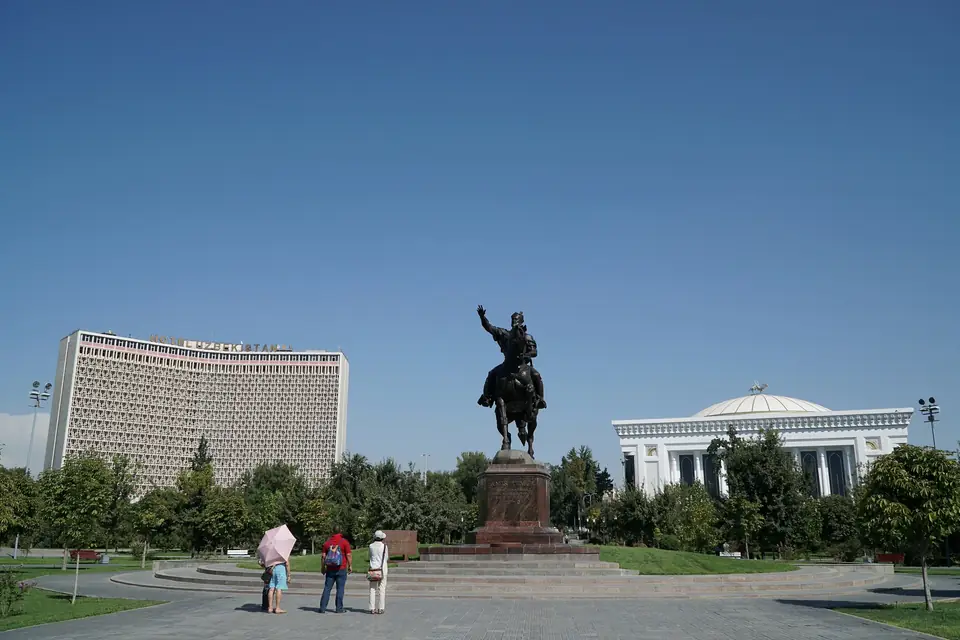
In front of the bronze rider the last change of guard makes sense. After a Council of Ministers resolution of June 1993, the equestrian statue of Amir Timur, the work of Ilhom Jabborov, was unveiled on 31 August 1994 with a speech by Islom Karimov about a people “deprived for years of the chance to honour their great compatriot”. The sculptors Kamol and Ilhom Jabborov dressed him in royal military garb, but put no weapon in his hands: they wanted a ruler and statesman, not a conqueror. On the pedestal his motto is read in four languages, “Strength is in justice”.
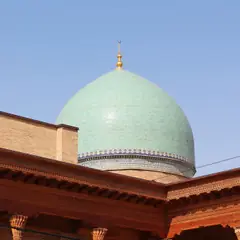
The setting completes the message. Behind it curves the façade of the Hotel Uzbekistan, finished in 1974 to a design by Ilya Merport, L. Yershova and V. Rashchupkin, whose concrete lattice draws on the lattices of Islamic architecture; in the 1970s it housed the filmmakers of the Tashkent international film festival. Beside the garden, the State Museum of the History of the Timurids, crowned by a dome, opened on 18 October 1996 for the 660th anniversary of Timur.
A Soviet hotel, a museum of independence and a rider without a sword make up the shop window of a new national narrative. What this Timur has in common with all those who occupied his place before him is the question that closes the tour.