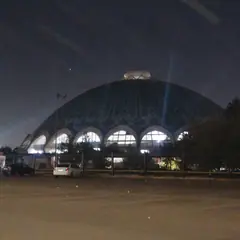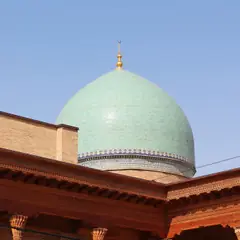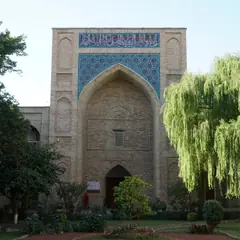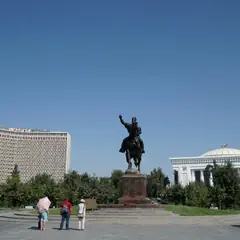
Shchusev's opera house, 1947
Navoi Theatre Audio Guide (Alisher Navoiy nomidagi Oʻzbekiston davlat akademik Katta teatri)
The architect of Lenin's Mausoleum designed it as a marble madrasa, unpaid Japanese prisoners finished the work and a plaque deliberately avoids calling them prisoners. The Navoi Theatre is Tashkent's great opera house and also an archive of silences.
- 30 min of audio
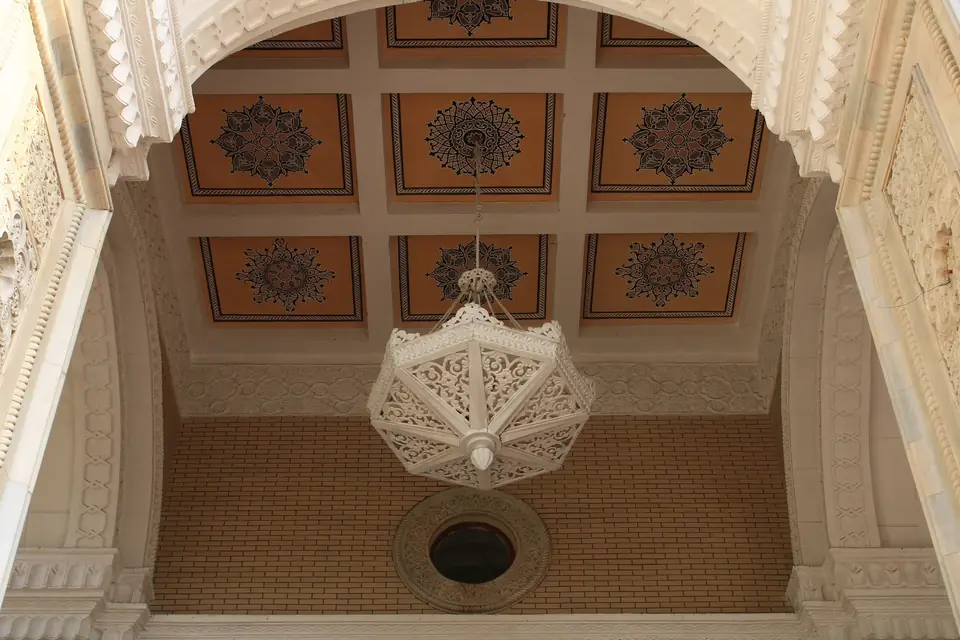
- Uzbek carved stucco
In 1934 Alexey Shchusev, author of Lenin's Mausoleum on Red Square, won the state competition to build a great theatre in Tashkent with a design that fused Soviet monumentality and Uzbek tradition. The foundation stone was laid on 1 September 1940 on the site of the Voskresensky bazaar; the war halted the work in 1942, it resumed in 1943 with mobilised Soviet Koreans and in its final phase it was completed by Japanese prisoners from the Kwantung Army. It opened in November 1947 and in 1948 took the name of the poet Alisher Navoiy.
Inside, six foyers bear the name and style of six regions of Uzbekistan, from Tashkent to Termez, carved in ganch by folk masters, the usto. In the Bukhara hall the white stucco is applied over a mirror background, a technique used earlier in the emir's palace. Outside, a plaque of 1996 honours the Japanese who worked on the building, but calls them “deported Japanese citizens”, not prisoners, and that choice has an author.
Highlights
- Three-arched portal — a madrasa iwan signed by the author of Lenin's Mausoleum
- Plaque to the Japanese builders — placed in 1996, with one word chosen on purpose
- Bukhara Hall — carved ganch reliefs on a mirror background, the work of Usta Shirin Muradov
- Six regional foyers — Tashkent, Fergana, Bukhara, Samarkand, Khiva and Termez in carved stucco
- Navoiy panels — four murals by Chingiz Akhmarov with the lovers of his poems
Few buildings in Central Asia gather so many hands and so many silences. The Navoi Theatre, Tashkent’s great opera house, was conceived by Alexey Shchusev, the architect of Lenin’s Mausoleum, who in 1934 won the state competition announced a year earlier. It was built in the middle of the Second World War, first by mobilised Soviet Koreans and in the end by Japanese prisoners of war who did not earn a single rouble, while the Soviet press presented it as a feat of the Soviet people. The information about those Japanese was not declassified until 1992.
The history of the Navoi Theatre has several versions. Many repeat that Japanese prisoners built it, but the chronology adds nuance: work began in 1940 and they arrived in November 1945 for the final phase, so several sources speak of a building raised “in part” with their labour. The dates do not quite add up either: some place the start in 1939, the resumption in 1944 or the handover in 1948, and the seating capacity varies between 760 and 1,440 depending on the source.
The architecture of the Navoi Theatre is its own argument: a three-arched portal like the iwan of a madrasa, side arcades of grey marble and pink brick and, inside, six foyers carved in stucco in the styles of six regions of Uzbekistan. What to see there runs from the garden and fountain to the portal, the plaque under the arcades and, for those who enter for a performance, the Bukhara hall and the main foyer.
The audio guide tours the theatre in five stops, with documented narration checked against historical sources, to read in its stone and stucco the story of a vanished bazaar, unpaid workers and a gratitude that ended up being shared.
A few minutes’ walk away, Amir Timur Square sums up the city’s changes of regime in a single pedestal, and the Museum of Applied Arts shows up close the same art of carved ganch that clads the theatre’s foyers.
A fountain where a bazaar once shouted
Theatre fountain
Summary of this stop
Before the portal stretches a garden of flowerbeds and ornamental trees with a great pool-fountain at the centre, conceived in the manner of an Uzbek hauz and shaped like a cotton boll. It is the most serene image of central Tashkent, and precisely for that reason it deceives: that rectangular plot of 7 hectares was the Voskresensky bazaar, a great market opened in the 1870s that disappeared with the building of the theatre.
The fountain was proposed by Shchusev himself when the building was finished, and in 2010 it was renovated as a chromomusical fountain, with lights and music. A few years later, between 2012 and 2015, the whole theatre was rebuilt: performances moved to the Turkiston palace of arts and the reopening had an exceptional guest, Japanese Prime Minister Shinzo Abe.
What is now a garden is, in reality, an absence. Who planted some of its trees, and why a Japanese visitor measured them by eye half a century later, is one of the threads the narration weaves.
From Lenin’s Mausoleum to an iwan
Navoi Theatre
Summary of this stop
The main entrance is three great arches on massive piers, with a muqarnas cornice and crowned by small turrets recalling the minarets of Bukhara. It is a madrasa iwan signed by a Kremlin architect: Shchusev wanted to unite monumental Soviet architecture with Uzbek tradition, and at the sides the grey marble arcades and the polished pink-ochre brick walls on a granite plinth extend that idea.
Behind the façade there is reinforced concrete and brick, with the large spans covered by metal trusses and a structure specifically reinforced against earthquakes. The precaution was put to the test: the Tashkent earthquake of 26 April 1966 did not cause it serious damage. It has been said that it was the only building in the city left unscathed, but that claim comes from a Japanese company and other testimonies describe buildings in the centre that also seemed undamaged.
The foundation stone was laid on 1 September 1940. In 1942 the war halted the work, which resumed in 1943, and by October of that year mobilised Soviet Koreans were already working on it. Who came afterwards to finish these walls is the question that opens the next stop.
The word missing from the plaque
Plaque to the Japanese builders
Summary of this stop
Under the side arcades, a plaque remembers the Japanese who worked on the building in 1945-1946. Its text, placed in 1996 with President Islam Karimov, speaks of “hundreds of Japanese citizens deported from the Far East”. The original is now kept in the theatre museum and a new one hangs on the wall. Other sources describe them bluntly as prisoners of war subjected to forced labour and unpaid.
They arrived in November 1945, soldiers of the Kwantung Army: of some 25,000 Japanese interned in Uzbekistan, 13,770 were taken to Tashkent. Among them was Yasuo Odaki, from Okazaki, who worked in a brick factory and then at the theatre. He fell ill within a few weeks and an Uzbek girl, Sarvara, a neighbour of the barracks, cooked him lagman. In 2002 Odaki returned to Tashkent and asked that she be found so he could thank her. He did not succeed.
According to a documented tradition, in 2015 Karimov boasted to Shinzo Abe of having had the plaque rewritten, and the 1996 order had been categorical. Which word he forbade and what childhood memory is said to lie behind it is what the narration reveals in front of the wall.
Carved stucco over mirror, like an emir
Bukhara Hall
Summary of this stop
Once inside, six side foyers bear the name and decorative style of six regions of Uzbekistan: Tashkent and Fergana on the ground floor, Bukhara and Samarkand on the first, Khiva and Termez on the second. They were decorated by the usto, folk masters of traditional ganch carving, under Shchusev’s direction.
The Bukhara hall, the work of Usta Shirin Muradov, is the most dazzling: its white carved-stucco reliefs are applied over a mirror base, a technique previously used in the palace of the emir of Bukhara. In the neighbouring Samarkand hall, Kuli Dzhanilov used two-layer islimi carving and Gazgan marble; higher up, Khiva imitates in ganch the wood carving of Khorezm and Termez is covered in small circles and scrolls.
In 1948 Shchusev received for this building the third of his four Stalin Prizes, and that same year the craftsmen, among them Muradov and the brothers Jalil and Bolta Zhurayev, won the State Prize. How a whole region is read in a stucco panel is what is revealed walking through the halls.
Navoiy’s poems beside the auditorium
Navoiy panels in the main foyer
Summary of this stop
In the main foyer on the first floor, Chingiz Akhmarov painted four large panels with scenes from Navoiy’s poems: Shirin and Farhad, Iskandar on horseback watching over a wall, Bahram Gur hunting a gazelle for Dilaram, and Layli and Majnun in the desert. Below, in the ground-floor foyer, his four muses embody dance, poetry, painting and architecture. Beyond opens the auditorium, with stalls, two tiers of boxes and cream velvet curtains embroidered by Bukhara gold embroiderers to designs by Shchusev.
The theatre opened in November 1947, on the 30th anniversary of the October Revolution, and in March 1948 the Uzbek company merged with the Sverdlov Russian opera theatre, founded in 1918, and took the name of the poet whose lovers hang on these walls.
Half a century later, in August 2001, one of the men who had worked here unpaid returned as a spectator for a Japanese opera about a crane that repays a favour. Who he was and what he found on stepping out into the garden is the episode that closes the tour.