Communist history
Blloku Audio Guide
Tirana's "leaders' block": armed-guarded villas where Enver Hoxha and his inner circle lived, off-limits to Albanians and blank on most maps until 1991, and today one of the city's biggest nightlife areas.
- 40 min of audio
- Hoxha's forbidden district
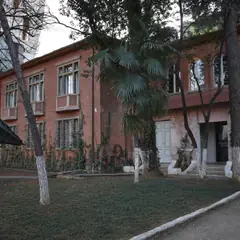
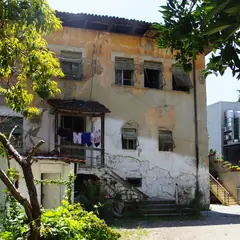
Blloku began as New Tirana, a district of pre-Second World War villas that in the late 1940s was reserved for senior officials of the Party of Labour and guarded by armed sentries. Hence its name, Blloku i udhëheqësve, "the leaders' block". Hoxha and the Politburo comrades occupied those houses, enlarged them and surrounded them with greenery; other leaders moved into homes arbitrarily taken from their owners. Throughout the regime, ordinary citizens could not enter.
In 1973 Villa 31 was completed, the Hoxha family home: 2,500 m² with a swimming pool, private cinema and lift, built with materials secretly imported from Europe. That same year the dictator publicly condemned Western influence on music, art and architecture. Closed for more than three decades, the villa has housed an artists' residency since 2025, while around it the surviving villas coexist with towers, boutiques and terraces.
Highlights
- Postbllok Memorial — a bunker, beams from Spaç prison and a fragment of the Berlin Wall on the former garden of Mehmet Shehu
- Villa 31 — Enver Hoxha's house, "Object X": 2,500 m² with a pool, private cinema and lift, now an artists' residency
- Former villa of Mehmet Shehu — the regime's number two, dead in 1981, and the statues of Stalin and Lenin in its courtyard
- Pre-war villas among towers — leadership residences turned into restaurants, shops and international residences
- Terraces of Rruga Pjetër Bogdani — cafés, boutiques and clubs on streets that were a forbidden zone
Until 1991, for most Albanians Blloku did not exist: on almost every map of Tirana that rectangle of streets appeared unmarked. There, behind an armed guard, lived Enver Hoxha and the members of the Politburo, with their own shop, cooks, chauffeurs, personal doctors and imported goods that the rest of the country never saw. When exactly the district was closed off is something sources do not settle the same way: one places the guard already in the late 1940s, another dates the name “Blloku” as a forbidden zone to 1961 and another holds that Hoxha lived there from 1945.
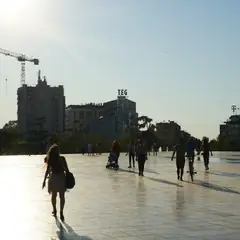
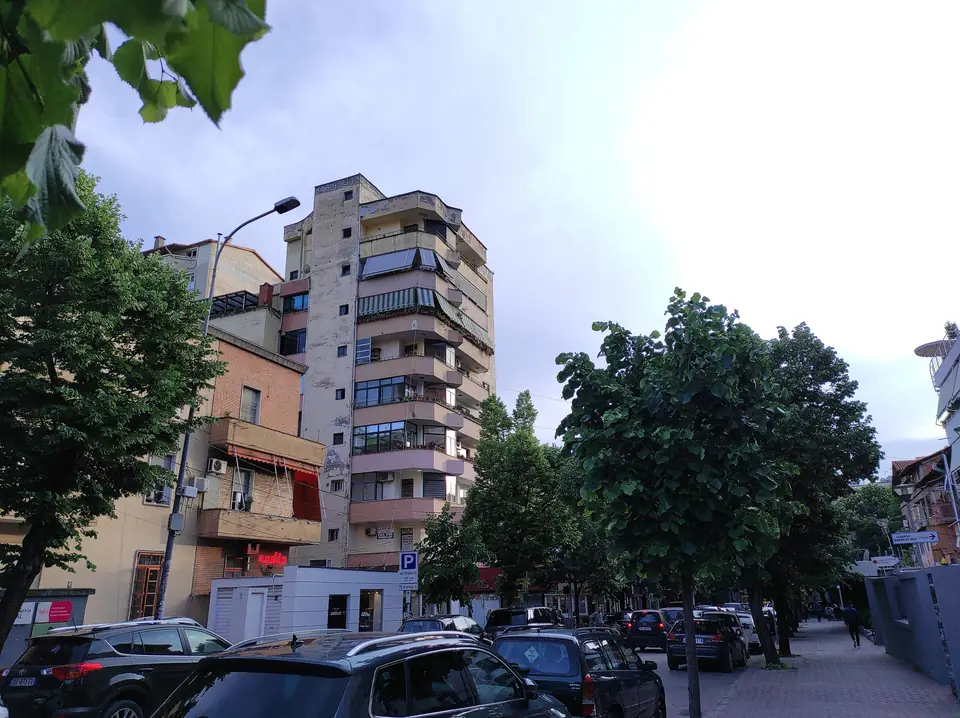
With the fall of the regime the district opened up and became the great curiosity of the moment: astonished crowds came to see how their leaders had lived. Today the history of Blloku is read among multi-storey towers, villas turned into restaurants and one of Tirana’s biggest nightlife areas. What to see in Blloku, who lived in each house and what happened behind its gates is what the audio guide unpacks in four stops and forty minutes of walking, from the checkpoint to the terraces.
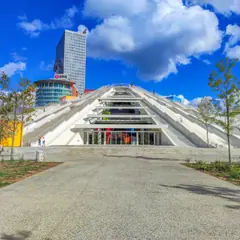
The museum the regime built in 1988 to glorify Hoxha is today the Pyramid of Tirana, a few steps from the district, and the machinery that spied on Albanians from outside the block is shown in the House of Leaves.
The boulevard’s invisible border
Postbllok
Summary of this stop
The tour starts on the Dëshmorët e Kombit boulevard, beside the statue of Ismail Qemali, founder of the Albanian state. There stands the Postbllok memorial, “checkpoint”, the work of the writer Fatos Lubonja and the artist Ardian Isufi, opened on 26 March 2013. It brings together three pieces that need no sign: a concrete bunker, a row of beams brought from Spaç prison and a fragment of the Berlin Wall given by the state of Berlin. All of it occupies what was the garden of Mehmet Shehu’s dacha.
This was the threshold. On 9 April 1970, at 19:05, the Polish deputy commercial attaché Jerzy Legucki tried to drive into the Party leadership’s Blloku; the soldier on guard stopped him and the car’s wing struck his knee. State Security already had him on file as a Polish intelligence agent, and what interested him inside the district is one of the details the narration reserves for this point.
The fall of the number two
Former villa of Mehmet Shehu
Summary of this stop
Behind the wall of Mehmet Shehu’s former villa one of the regime’s darkest chapters closes. Shehu was prime minister for 27 years and Hoxha’s number two, until in December 1981 he was found dead in the bedroom of his house in Blloku, with a gunshot to the chest. Radio Tirana announced it as suicide; he was later declared an “enemy of the people” and his family ended up in prison. The official version is still disputed: his contemporaries, including his personal bodyguard, maintain he was murdered, there has never been an official investigation and sources do not even agree on the day he was found.
It was a world closed in on itself, where the children of the great families married each other and a villa changed tenants as soon as its owner fell from favour. The epilogue is almost surreal. The bronze statues of Stalin and Lenin, removed from the centre of Tirana after the protests of 1990, reappeared in 2022 in the courtyard of this same villa, now the Government’s residence for official receptions, next to a ZIS, the Sigurimi’s car. The Government spoke of an installation, the Ministry of Culture of a move because of works at the Art Gallery and former persecuted of an insult to their suffering. In 2025 they could still be made out among the trees, and the audio guide tells from where.
Pool, cinema and Western catalogues
Enver Hoxha's villa
Summary of this stop
On Rruga Ibrahim Rugova, one of the district’s liveliest streets, an iron gate lets you see a path through vegetation, an empty fountain and, at the back, a heavy volume of concrete clad in white stone slabs that imitates 1930s architecture. It is Villa 31, the Hoxha family home, built between 1972 and 1973 as a large extension of a pre-war house under the code name “Object X”: 2,500 m² with a blue-tiled pool, private cinema and lift, with materials secretly imported from Europe and installed by Italian technicians. While its designers chose furniture from Western catalogues, the dictator was launching his campaign against “liberalism” in the arts, and the image of a Hoxha of austere life clashes head-on with that documentation.
The anecdotes from behind closed doors are no less striking. According to Dash Çollaku, the man in charge of checking the leadership’s food, two bathtubs costing 60,000 dollars each were installed in the house, one red and one blue, and the choice of colour ended in a family scene that the narration reconstructs in detail. The family stayed on after Hoxha’s death in 1985 and left in 1991. After more than three decades closed, the villa became in January 2025 the artists’ residency Vila 31 x Art Explora, with 22 artists from about 15 countries in its first year, and opened to the public in mid-April 2025. What the basement hides, behind the cinema, is revealed by listening to the tour in front of the gate.
From the Politburo club to the terraces
Rruga Pjetër Bogdani
Summary of this stop
The inner streets, such as Rruga Pjetër Bogdani, are now carpeted with terraces, boutiques and clubs. Opposite Hoxha’s villa, where another building now stands, there was a tennis court and the “Party House number 1”, the leadership’s club, where Politburo members went for coffee in the afternoon or to watch a film. Hoxha came out of there, cane in hand, one morning in March 1971, and a single question from him to a poorly dressed bodyguard was enough for the uniform of all the district’s guards to change the next day, according to the documented tradition the audio guide recounts.
The contrast with the country outside was huge: a parliamentary commission of 1991 documented that in 1989-1990, in the midst of shortages, more than 1,300 parcels of clothes, cosmetics and food from Vienna, Paris or London came into Albania for the leadership, including some for Nexhmije Hoxha. Since the opening of 1991 the villas have been giving way to multi-storey buildings, and Blloku has become one of Tirana’s biggest nightlife areas. As mayor, Edi Rama tried to close it to traffic in summer, a measure that did not last long. The hum of bars that now never fades is the end of a walk through a district that barely a generation ago did not appear on maps.