Historic square
Skanderbeg Square Audio Guide (Sheshi Skënderbej)
About 40,000 m² of stone where every regime in Albania left its signature: an Ottoman bazaar torn down, Stalin replaced by Skanderbeg, Hoxha toppled by the crowd and, since 2017, an almost flat pyramid that lifts pedestrians to the height of the buildings of power.
- 30 min of audio
- 20th-century history
Skanderbeg Square is the centre of Tirana and Albania's great collective stage. The Austro-Hungarians laid it out in 1917, during the First World War, and the pedestrian redesign by the Belgian studio 51N4E with the artist Anri Sala opened in June 2017, a hundred years later. Around it stand the equestrian monument to Skanderbeg of 1968, the Palace of Culture built over the Old Bazaar, the National History Museum with its 40-metre mosaic, the Et'hem Bey Mosque, the Clock Tower and the 1930s buildings, such as the Bank of Albania of 1936.
The most telling thing about the square is a gap. Between the National History Museum and the Bank of Albania stood a bronze statue of Enver Hoxha that on 20 February 1991 a crowd pulled down with a cable round its neck and dragged through Tirana behind a rubbish truck. Today that date is the National Day of Remembrance for the victims of communism, and in 2018 the esplanade that occupies that spot won the European Prize for Urban Public Space.
Highlights
- Skanderbeg Monument — bronze horseman of about 11 metres, unveiled in 1968 on the exact spot of the Stalin statue
- "The Albanians" mosaic — 440 m² above the entrance of the National History Museum, with the star removed and the worker's empty sack
- Gap of the Hoxha statue — the absence that recalls 20 February 1991
- Palace of Culture — Opera and National Library on the site of the Old Bazaar, demolished in 1959
- Stone pyramid — about 30 kinds of Albanian stone and more than 100 jets that bring out their colours
In Skanderbeg Square nothing is there by chance. Every statue, every building and every gap is the signature of a power that wanted to mark the centre of Tirana: the Austro-Hungarian empire that laid out the square in 1917, the Italian-inspired urban planning of the 1930s, the communist regime that tore down a bazaar, a church, a mosque and a town hall to build a monumental space, and the Albania after 1991, which in 2017 turned it into a pedestrian esplanade of about 40,000 m².
Some of the moments that define the country have also happened here. On 25 April 1993, at the end of his one-day visit, Pope John Paul II took leave of Albania in this square, invoking Skanderbeg against the long years of state atheism. On 14 September 1998, during the riots at the funeral of the opposition deputy Azem Hajdari, one of the tanks taken by armed demonstrators was left parked here. And in September 2017, a few months after the reopening, hundreds of Muslim worshippers prayed in it for Kurban Bayram.
What to see in Skanderbeg Square, what its history is and how its architecture is read is what the audio guide unpacks in five stops and thirty minutes: a walk round the perimeter reading what each era tore down or put up, and an ending at the top of the pyramid, where the square’s last signature turns out to be the ground itself.
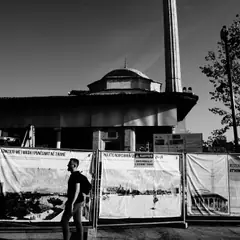
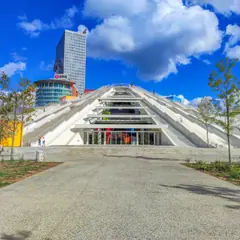
On one side of the square stand the Et’hem Bey Mosque and the clock tower; a few steps away, a concrete dome leads into Bunk’Art 2, and down the boulevard waits the Pyramid of Tirana.
The hero who took Stalin’s place
Skanderbeg Monument
Summary of this stop
The bronze horseman presiding over the square is Gjergj Kastrioti Skanderbeg (1405-1468), the Albanian national hero. The monument, about 11 metres tall, was unveiled on 11 January 1968 for the 500th anniversary of his death. The municipal website attributes it to Odhise Paskali, Janaq Paço and Shaban Hadëri; other sources swap one of the co-authors, though all agree on Paskali as the main author. Behind it stretches the garden known as Europe Park.
What you can’t see is what stood there before. From 4 November 1951 until 1968, a statue of Joseph Stalin rose on that same spot: the medieval hero came to take the Soviet dictator’s place on his pedestal. Even the name of the square is debated, because the municipal website dates its baptism as Skanderbeg Square to 26 November 1937 and other sources link it to 1968. How an Austrian square became this stage of replacements is the starting point of the narration.
Columns over the Old Bazaar
National Theatre of Opera and Ballet
Summary of this stop
The long building of columns is the Palace of Culture, home of the National Theatre of Opera and Ballet and of the National Library. It was built on the site of Tirana’s Old Bazaar, demolished in 1959. Nikita Khrushchev laid the first brick on 3 June of that year, but the Soviet technicians withdrew from Albania for good two years later, and it was Albanian architects and engineers who finished it in 1963.
The bazaar was not the only loss. To turn the centre into a monumental space, the old Orthodox church, the old Town Hall and the mosque of Mahmud Muhsin Bey Stërmasi, of 1837-1840, also fell. Of the old city only the Et’hem Bey Mosque, the Clock Tower and the complex of ministries stayed protected, and they still stand beside the palace. What that survival says about the regime’s taste is one of the keys the audio guide explains in front of the colonnade.
A mosaic with retouching
National History Museum
Summary of this stop
Where the old Town Hall stood, demolished in 1980, rises the National History Museum, opened on 28 October 1981. Above its entrance stretches the mosaic “The Albanians” (1980): about 11 metres high by 40 long, 440 m² made by five artists, Vilson Kilica, Anastas Kostandini, Agim Nebiu, Justin Droboniku and Aleksander Filipi. Thirteen figures from different eras surround a woman with a rifle, Mother Albania.
The facade reads like a corrected document. In the early 1990s the large golden star above the head of the central figure was removed, along with a smaller one above the double-headed eagle of the flag, and the red book held by the worker was changed into an empty sack. In front of this door, in 2012, there was also an unprecedented scene, when Skanderbeg’s original helmet, the goat-headed one kept in Vienna, returned to Albania for 45 days. The figures of that queue are left for the narration.
A void that was a crowd
Gap of the Hoxha statue
Summary of this stop
Between the museum and the Bank of Albania there is a space with no pedestal. There stood the bronze statue of Enver Hoxha, by Sali Shijaku, unveiled in October 1988 for the dictator’s 80th birthday. Its size varies by source, between 8 and 10 metres, but its end is well documented: on 20 February 1991 a crowd pulled it down. The mobilisation grew out of the hunger strike of several hundred students demanding that Hoxha’s name be removed from the university.
Among those who guided people here was Saimir Maloku, jailed for eight years for building a converter to watch banned foreign television, who steered the crowd towards the square and away from the guarded Politburo compound to avoid a bloody clash. According to accounts of that day, the actress Rajmonda Bulku gave the signal, a cable round the neck and work on the bolts did the rest, and the broken bronze ended up dragged for eight hours through Tirana. What happened at the instant of the fall is the moment the audio guide reserves for this gap.
The summit that levels the pedestrian with power
Summit of the stone esplanade
Summary of this stop
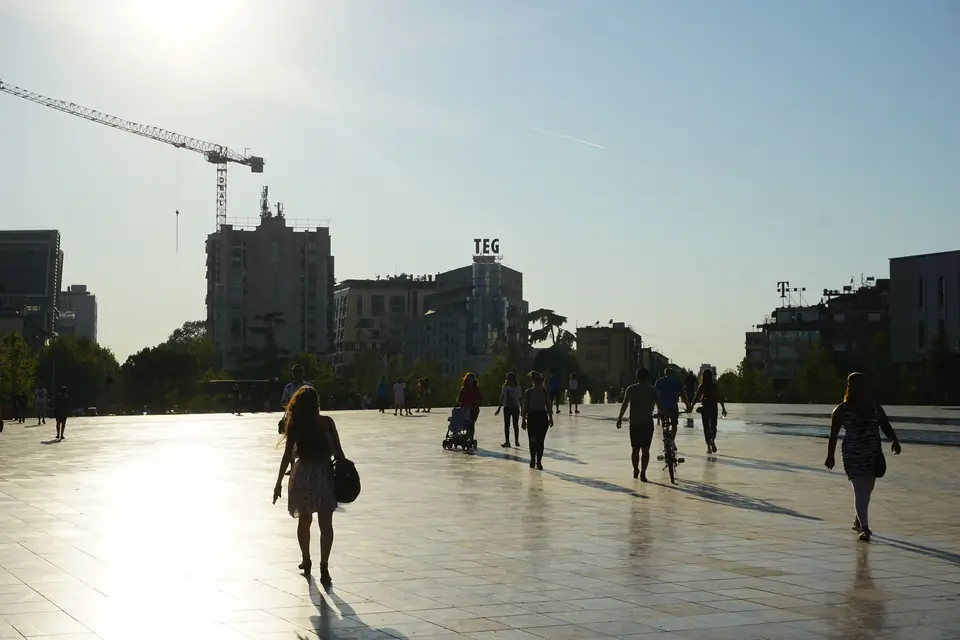
Today’s square comes from an international competition won in 2008 by 51N4E and Anri Sala. Works began in 2010, were halted when the mayor changed in 2011, which brought cars back to the square, and were relaunched in late 2015 until the opening on 10 June 2017. The esplanade is a very flattened pyramid of about 177 by 157 metres whose summit stands about 2.3 metres above its surroundings, exactly at the height of the plinth of the Opera, the museum and the Bank of Albania.
The ground combines about 30 kinds of stone quarried in Albania, in slabs of 45 by 45 centimetres, and more than 100 jets wet the stone to bring out its colours. Some slabs have their place of origin engraved, and that provoked a condemnation from the Greek Ministry of Foreign Affairs in June 2017 for including stone from the Filiates region; the architects present them as a symbol of the country’s unity. The redesign also did not escape criticism over summer heat or its cost. In December, lit fir trees and New Year’s Eve fireworks change the face of the esplanade, and the narration closes the walk at the top, where the square’s last signature is revealed in full.