Ottoman fortress
Tirana Castle Audio Guide (Kalaja e Tiranës)
A six-metre Ottoman wall, covered in creepers, is what shows of the fortress where Tirana was born. Behind its gates, a bazaar street that still belongs to the Toptani family leads out in front of Parliament, built on the site of the old castle.
- 25 min of audio
- Ottoman fortress and bazaar
Tirana Castle is a lowland fortification of rectangular plan, with its long side running east to west, which the City Council dates between 1633 and the second half of the 18th century. Around 1640 Ahmet Bey rebuilt its walls over older structures and raised a long tower that still partly survives. It withstood the wars between lords of the 18th century without being taken, was razed in 1832 on the orders of the grand vizier Mehmet Reshit Pasha and in 1973 was declared a first-category cultural monument.
The oldest part is under the paving: in 2001 the archaeologist Sulejman Dashi found, more than two metres deep, a square tower with walls about 2.90 metres thick and Late Antique technique. And the most recent is also surprising: since December 2018 the interior of the compound has been a bazaar street of crafts and traditional cooking, opened thanks to an agreement between the City Council and the Toptani family, which is still its owner.
Highlights
- North wall — 6-metre Ottoman curtain wall covered in creepers beside the Murat Toptani pedestrian street
- Firearm loopholes — shooting openings cut during the clan wars of the 18th century
- Foundations uncovered in 2008 — walls up to 3 metres that the ring-road works brought to light
- Toptani bazaar street — crafts and traditional cooking inside the compound since 2018
- Toptani Saray — manor houses with a courtyard destined for the future Besa Museum
Among offices, traffic and cafés in central Tirana runs a stone wall that many walk past without looking. It is what is left of the Kalaja e Tiranës, the lowland fortress around which the city grew: a rectangle about 160 metres on its long side, although for the width sources do not agree and give anything from 120 to 200 metres. Today barely survive a six-metre Ottoman curtain wall covered in creepers, loose stretches of the south wall, foundations uncovered beside the pavement and, inside, the houses of the family that has owned it since the late 18th century.
The history of Tirana Castle is that of a compound no clan managed to conquer and that an Ottoman vizier ordered razed, but also that of a family that presented itself almost as heir to Skanderbeg. According to a legend heard around 1900 by the French consul Jules Degrand, posted in Shkodër, the Turkish soldiers who entered Krujë searched the house of Mamica, sister of the national hero, and found there a boy who would become head of the Toptani clan. What to see in Tirana Castle, how to read its architecture in layers and why the country’s power is still gathered on its site is what the audio guide unpacks in four stops and twenty-five minutes of walking, with narration that is documented and checked against historical sources.
A few minutes away, the Et’hem Bey Mosque is the only one of Tirana’s old mosques still standing, and very close you go down into the bunker of Bunk’Art 2.
A road that stumbled on the castle
Tirana Castle
Summary of this stop
The tour starts beside the wall on Murat Toptani Street, a pedestrian street that exists almost by accident. In early 2008, the works for Tirana’s new ring road brought to light, beside the Parliament park, walls up to three metres high and a stone path. The area was placed under special protection, diverting the road towards the Lana river was even considered and the street ended up closed to traffic. In March 2010 the National Council of Archaeology approved restoring the remains with a project by the studio of Gjergj Frashëri, and today those foundations form part of the very layout of the pedestrian street.
The name of the street holds another story. Murat Toptani, poet, sculptor, caricaturist and patriot of the clan, was arrested by the Ottoman authorities on 28 October 1897 for promoting teaching in Albanian in Tirana, where he had managed to get the new Austrian school to give all its classes in that language. What he did afterwards in exile, and that he gave Skanderbeg his first sculpted face, is the detail the narration reserves for this wall.
Loopholes of a fortress never taken
Loopholes and long tower of the wall
Summary of this stop
Below the wall, the stone reads in layers. Beneath everything, on the north side that borders Abdi Toptani Street, the archaeologist Sulejman Dashi found in 2001 a square-plan tower buried more than two metres under the paving, with walls about 2.90 metres thick and a technique typical of Late Antiquity. Hence the popular name “Justinian’s Fortress”, although the dating and the builder remain in debate: the remains of 2008 have been attributed to the Roman period or to the Late Antique fortifications of Epirus Nova, without a conclusive scientific publication and with the excavation suspended. What can be seen above ground, by contrast, is Ottoman work.
On top of those structures, around 1640, Ahmet Bey rebuilt the walls and raised the long tower that still partly survives, beside the base of the north-east corner tower. High on the wall open the loopholes for firearms from the wars between lords of the 18th century, when the troops of Ahmet Kurt Pasha of Berat and those of the Bushatlli of Shkodër clashed here. The people of Tirana shut inside held out and neither side managed to take the fortress. Its end did not come by assault: in 1832 the castle stopped functioning and was destroyed on the orders of the grand vizier Mehmet Reshit Pasha, and the reason for that demolition is told at the foot of the loopholes.
The bazaar street the Toptani still own
Bazaar street and Toptani Saray courtyard
Summary of this stop
Through the open gates in the wall you pass into a pedestrian lane of craft shops, souvenirs, bars and restaurants with traditional cooking, with an old cannon, a well and a mosaic displayed along the way. Since December 2018 it has worked as a bazaar street thanks to an agreement between the Tirana City Council and the Toptani family, which is still the owner of the compound. The Toptani came from Krujë: after the death of Ahmed Pasha Bargjini, who left four young daughters as heirs to lands around Tirana, his relatives asked Kapllan Pasha for protection and offered to marry his sons to the four orphans. The castle passed to the family in 1798. Several explanations circulate for the surname, from the Turkish “toptan”, together, to “top”, cannon, and the one chosen for the tour has its charm.
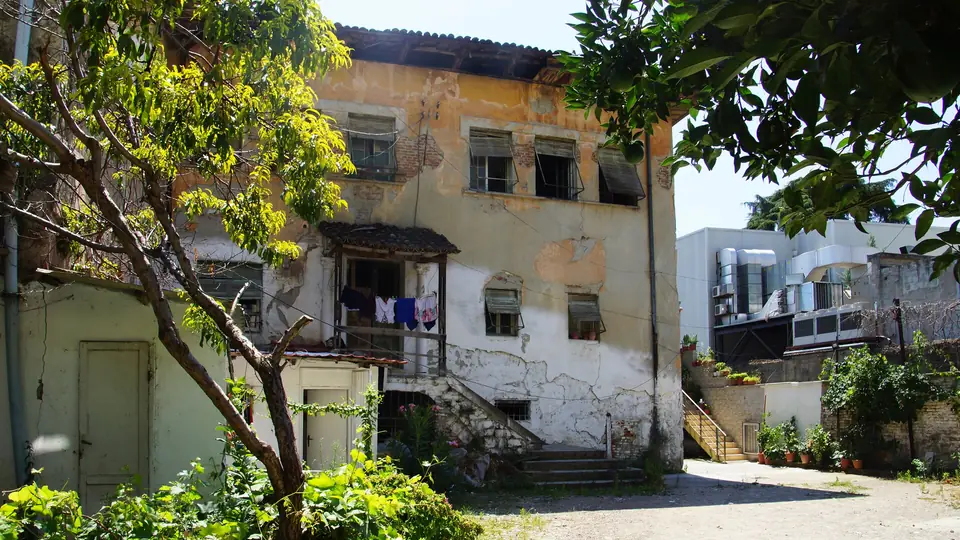
In 1817 the compound suffered a five-month siege that seriously damaged the fortress and a good part of the city; the City Council attributes it to the Bushati of Shkodër against the Toptani, although other sources reverse the roles. After 1814 the family built two houses inside, one to live in and another to receive guests, which are still standing. The Toptani Saray, of traditional Albanian and Ottoman architecture with a courtyard, will house the Besa Museum, whose restoration competition was won by Oppenheim Architecture in July 2023. It will tell of the besa, the Albanian code of honour that obliges you to welcome the guest as your own, and what that given word meant for many of the persecuted is what closes this stop.
From the Toptani salon to Parliament
Academy of Sciences of Albania
Summary of this stop
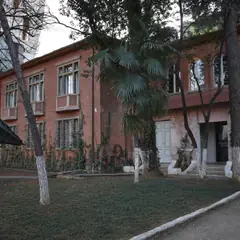
The walk ends in front of the Academy of Sciences, with the Parliament of Albania, the Kuvendi, a step away. Both stand on the site of the old castle, so that the core of Tirana’s rulers remains the seat of power. On 8 February 1920 the leaders who emerged from the Congress of Lushnjë decided to settle in Tirana, and the house of Zija bey Toptani, inside the compound, on the spot now occupied by the Academy, was offered as the seat of government.
The Parliament building adds an episode told with caution. Built in 1924 as an officers’ club, it is said that in it Ahmet Zogu was crowned on 1 September 1928 as Zog I, king of the Albanians, son of Sadije Toptani, born in Tirana within the clan. The parliamentary sessions of those years, however, were held in another building and in a rather more modest hall. Which one it was, and what hung on its walls, is the last detail the narration reveals in front of the facade.