Surveillance museum
House of Leaves Audio Guide (Shtëpia me Gjethe)
A 1931 villa hidden behind a curtain of ivy, opposite Tirana's Orthodox cathedral: it began as a maternity clinic and for four decades was the technical ear of the Sigurimi, the secret police that listened to a whole country.
- 60 min of audio
- Espionage and the Cold War
The House of Leaves was built in 1931 as Albania's first private obstetric clinic, a two-storey villa with a courtyard, promoted and run by the doctor Jani Basho. In 1943-1944 it briefly housed the Gestapo; in the post-war years it was a Sigurimi investigation and torture centre until 1948, and from 1950 the seat of its technical and scientific section, the one that tapped telephones and opened foreigners' mail until the State Security was dissolved in 1991. Since 23 May 2017 it has been a museum: 31 rooms and nine sections that follow the building's uses since the 1930s.
The climbing plant that gives it its name hid the building from public view for about 45 years, and in the regime's papers it appeared as "objekti gjethi", the Leaf object. At the opening, the Minister of Culture Mirela Kumbaro summed up its paradox: a house built to give life and used to take it. That day, a former political prisoner who had spent 23 years in jail asked Prime Minister Edi Rama to shorten his speech, and Rama complied.
Highlights
- Ivy facade — the green curtain that hid the listening centre for about 45 years, opposite the Orthodox cathedral
- Garden antennas — a large listening device that still points at the city and lets you hear the street traffic
- Homemade microphones — made by the Sigurimi itself from 1975 and hidden in furniture, bags and suitcase locks
- Wall of magnetic tapes — alongside transistors, cameras, a darkroom and a fingerprint laboratory
- Black rooms of names — thousands of persecuted people written in white, in a museum awarded the Council of Europe Museum Prize 2020
In Enver Hoxha’s Tirana everyone knew whose house it was, the one covered in leaves standing opposite the Orthodox Cathedral of the Resurrection, and almost nobody said so out loud. The technical section of the Sigurimi, the State Security, worked there: from 1950 to 1991 its technicians intercepted phones and letters, and made the microphones that were hidden in homes and offices across the country. The Ministry of Culture explained in 2015 that the service chose this villa for its closeness to the central post office and the telephone offices, a step from the cables that had to be tapped.
The history of the House of Leaves is longer than that of its darkest period. Built in 1931 as an obstetric clinic, it went through the Gestapo and the post-war interrogators, remained in the hands of the Albanian intelligence service (SHISH) until 2015 and opened as a museum on 23 May 2017. When the project was presented, in January 2015, it was a big old house of fallen plaster and cobwebbed doors that not even ambassadors were allowed to enter. What to see in the House of Leaves, how the listening worked and what trace it left on specific people is what the audio guide covers in four stops and sixty minutes, from the garden to the black rooms.
The Interior Ministry’s secret shelter, turned into a Sigurimi museum, can be visited at Bunk’Art 2, and the villas of those who gave the orders still stand in Blloku.
Ivy, antennas and an object called Leaf
House of Leaves
Summary of this stop
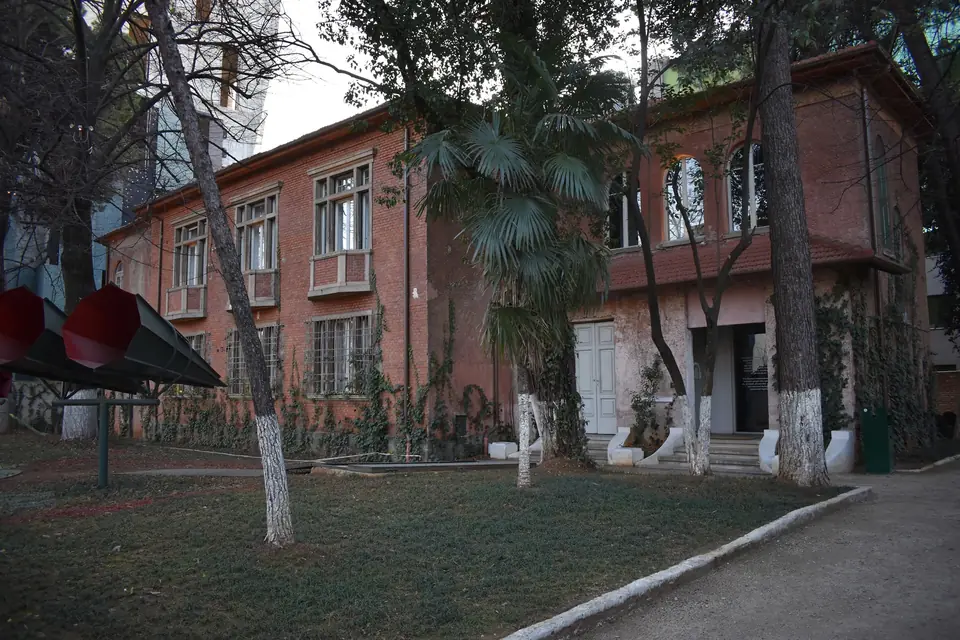
From the garden, the facade of the two-storey villa appears wrapped in the climbing plant that gave it the nickname Shtëpia me Gjethe, the House of Leaves. That green curtain was no ornament: for about 45 years it hid the building from public view. In the State Security documents the house appeared under a code name, “objekti gjethi”, the Leaf object, which the minister Mirela Kumbaro revealed when presenting the museum project.
In the same garden, an enormous listening device shaped like an inverted megaphone still points towards the city, and anyone who brings an ear close hears the street traffic; nearby opens the mouth of an underground tunnel with a concrete door, partly visitable. Kumbaro recalls that as a young woman she walked past every day and saw the agents come and go. All kinds of legends ran through the city about the house, and one of them gives a second reading of its nickname that the narration tells in front of the facade.
A maternity clinic that ended up with the Gestapo
Interrogation room
Summary of this stop
The first rooms follow the house’s successive owners. In 1931 the doctor Jani Basho (1892-1957) built it and ran it as Albania’s first private obstetric clinic. During the German occupation, in 1943-1944, the Gestapo occupied it for a brief period, and in the immediate post-war years the Sigurimi turned it into an investigation centre and place of torture, a function it kept until 1948, the year of Albania’s break with Yugoslavia.
One of the rooms on the tour is presented as an interrogation room, with drawings of torture methods and videos with victims’ testimonies. At the entrance, a plaque dedicates the museum to the innocent people spied on, arrested, prosecuted, convicted and executed by the communist regime. The meaning of all that passage was condensed by Mirela Kumbaro on the day of the opening into a single sentence, the one the audio guide recovers at this stop.
Bugs made in Tirana
Microphones hidden in everyday objects
Summary of this stop
In Hoxha’s Albania hidden microphones were called “çimka”, bugs, and children grew up with a piece of advice: don’t talk, because even the walls have ears. The museum plays on that nickname: its first sector is titled “Bugs and other creatures”, there are giant bugs drawn on the walls and a room of drills that were used to bore through walls and install the mics. The house’s motto sums it up: the walls of the House of Leaves have heard too much, and now they confess.
The display cases gather Japanese, Soviet, German and Chinese spying equipment alongside furniture, bags and suitcase locks with microphones inside, proof that isolated Albania followed foreign surveillance technology closely. From 1975 the Sigurimi’s technicians made their own microphones, and many of those on display were assembled by hand by the service, according to its chief engineer, Nesti Vako. Among the 31 rooms of the tour are those of phone tapping, the darkroom where film was developed and the chemistry and fingerprint laboratories; which everyday object hid the most unexpected mic is revealed in the narration.
Thousands of names and a watched painter
Black rooms of names
Summary of this stop
The installation by the Italian architect Elisabetta Terragni, with graphic communication by Daniele Ledda, keeps bars, windows and traces of the house’s extensions, hangs magnetic tapes on the walls and devotes black rooms to thousands of names of the persecuted written in white. Perforated doors let you glimpse archive shelves and force the visitor to look like a spy. In December 2019 the Parliamentary Assembly of the Council of Europe awarded it the Council of Europe Museum Prize 2020 for preserving its original equipment almost intact.
In a narrow corridor, where a window should be, hangs “The Epic of the Morning Stars”, the 1971 painting for which the painter Edison Gjergo was arrested in January 1975 and served eight years in prison. Below, in a display case, is his operational file, with 148 reports and the real names crossed out in black ink. What a woman wrote in the visitors’ book after the opening, and the date on which the State finally closed that file, are the ending the audio guide keeps for this room.