Secret police museum
Bunk'Art 2 Audio Guide
A nuclear shelter that the Ministry of the Interior dug in secret beneath a square in central Tirana and that was never used: today it is the Sigurimi museum, and you go down into it through a fake bunker dome that the opposition burned before it opened.
- 75 min of audio
- Cold War bunker
Bunk'Art 2 occupies the Objekti Shtylla, the Pillar Object, a deep shaft with a 240-centimetre reinforced-concrete shell covered by several metres of earth. It was designed in 1979 by the Interior Minister Kadri Hazbiu as a command post to withstand a chemical or nuclear attack, and was finished in 1986, a year after Enver Hoxha's death. Since 19 November 2016 its corridors have told the story of the communist regime's political police and its victims.
The bunker never fulfilled the function it was dug for: the bedroom of the minister's suite was not used even in a drill. And the man who commissioned it never saw it finished, because Hazbiu was executed in September 1983 by the same apparatus he had run for a quarter of a century. Underground remain a broom with a microphone in its handle, a wall pierced by a listening tube and the names of more than 5,500 people executed or killed for political reasons.
Highlights
- Entrance bunker dome — a 2015 replica that keeps the cracks and burns of the 8 December fire
- Portraits under the dome — more than 100 people executed by the regime, lit by small lights
- Sigurimi listening room — the broom with a hidden microphone and transmitter in its handle and the spied-on house
- Room of names — more than 5,500 people shot or killed on political charges, on lists hung from the ceiling
- Interior Minister's suite — a meeting room with the ministers' portraits and an unused bedroom
On 5 September 1979, the Interior Minister Kadri Hazbiu signed a precise order: his ministry’s war command post would have 30 rooms, seven already built, eight in the basements of the building and fifteen new ones on the land of service company 324/A. Six days later, a technical study classified as “top secret” calculated the buried part to withstand the direct impact of a 500-kilo aerial bomb. This is how the shelter now visited as Bunk’Art 2 was born, under the code name Objekti Shtylla: one of the last great projects of the bunkerisation of Enver Hoxha’s Albania, dug beneath the square that separates the Ministry of the Interior from the Ministry of Economy.
For years it was invisible: it could only be entered from inside the ministry. Since 2016 it has been a museum devoted to the Sigurimi, the regime’s political police, and to those who suffered it. What to see in Bunk’Art 2, the story of its construction and the architecture of a bunker designed for an atomic war are the thread of a 75-minute, six-stop audio guide, documented and checked against archive sources, that runs through the shelter from the entrance dome to the exit at the other end of the square. The museum also hosts temporary exhibitions: in November 2025 “Besa” opened there, with twelve stories of Albanian families who hid Jews during the Second World War.
The other face of the Sigurimi, that of the eavesdropping, is told in the House of Leaves; the bunker entrance is next to Skanderbeg Square, and a few minutes away stands the Ottoman wall of Tirana Castle.
A set with real scars
Bunk'Art 2
Summary of this stop
The concrete dome that greets the visitor looks like a bunker of the period, but it is not. When the shelter operated in secret, its only access was inside the Ministry of the Interior; the current dome and exit were built for the museum. Beside it, an imitation watchtower, with a searchlight and barbed wire, holds the Bunk’Art 2 sign.
That replica divided the city. Former political prisoners, backed by centre-right opposition deputies, saw in it a resurrection of the symbols of the dictatorship, and on 8 December 2015, during a Democratic Party demonstration, hundreds of people smashed it and set part of it on fire. In February 2016 the Government decided to turn the damaged structure into the museum entrance, and its architect, Artan Shkreli, chose to keep the cracks, holes and fire marks in view.
The controversy did not die down with the opening. On 19 November 2016, while Prime Minister Edi Rama delivered his speech, something crossed the sky above the ceremony with a message addressed to him. What it was and what it asked is the first episode the narration tells in front of the dome.
Underground, the first victim
Portraits under the dome
Summary of this stop
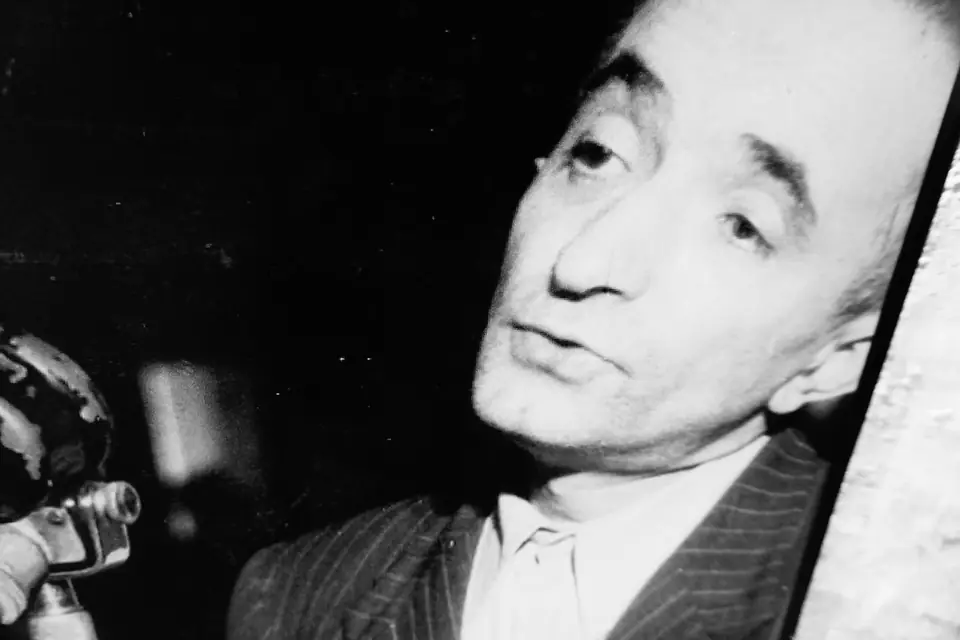
Under the dome, dozens of black-and-white portraits of people executed by the regime, more than a hundred, shine under small lights before the staircase that goes down to the ticket office. From there the visitor enters a deep shaft protected by a 240-centimetre reinforced-concrete shell with several metres of earth above, calculated to withstand a 500-kilo bomb.
The first story waiting below is unsettling. A whole wall is devoted to a young militant of the Party itself, whom the museum identifies as Hatije Tafa, interrogated and tortured in 1945 by Sigurimi officers in the old cells on Barricades Street. According to the report a sub-lieutenant sent to the Central Committee, without ever learning her name, she confessed nothing. How that story ended, and why one of their own recorded it, is heard beside that wall.
A microphone in the broom handle
Listening room and spied-on house
Summary of this stop
In the listening room, surveillance stops being abstract. Real Sigurimi spying objects are on display: a broom with a microphone and a transmitter hidden in the handle, a mannequin with a microphone under its jacket and a wooden table for searching for hidden microphones. The exhibition draws on more than 3,000 pages of archives.
Next to it, the spied-on house reconstructs how a bugging was installed: a tube ran through the wall from a collaborator’s home to that of the person watched, with a microphone inside, and an almost invisible hole, hidden behind a painting, was used to film and photograph. Beside this scene are shown recordings from the day Enver Hoxha died, picked up in Tirana homes and in prison cells. What the watched said that day, and the unexpected voice of a jailed widow who mourned his death, is left for the audio guide.
Repression, name by name
Room of names
Summary of this stop
From the portraits at the entrance we move to the full scale. In this room long lists hang from the ceiling with the names of more than 5,500 people shot or killed on political charges during the communist regime.
They are columns that can be read one by one, and the effect is precisely that: the figure stops being a number and becomes proper names. The narration accompanies this stretch with the context needed to read those lists, without turning the room into a statistic.
The shelter of a minister who never used it
Interior Minister's suite
Summary of this stop
The Interior Minister’s suite keeps a wood-panelled antechamber, a meeting room with the portraits of all the interior ministers of the communist period and a bedroom that was never used, not even in a drill. The shelter was divided into 24 rooms, according to the Tirana City Council, plus this apartment reserved for the minister and a large communications room; other sources give different figures, and the 1979 study even spoke of 41 working rooms.
Among those portraits is that of Kadri Hazbiu, Interior Minister from 1954 to 1980 and overseer of the Sigurimi, the man who dictated how many rooms this bunker should have. He was executed in September 1983, three years before the work was finished. The circumstances of his fall, as reconstructed today and with versions not entirely settled, are one of the darkest stories of the tour.
A generator for a war that never came
Diesel generator and shell-shaped exit
Summary of this stop
Past the exit turnstile appears a large lit diesel generator, and the staircase climbs to the other end of the square under a concrete arch in the shape of a shell. On leaving you understand the geography of the secret: the shelter is not under the ministry, but under the square that separates it from the Ministry of Economy.
The works are usually dated between 1981 and 1986, although some sources place them between 1982 and 1985 or 1986: in any case, the bunker was finished when Hoxha was already dead, and never served as a nuclear shelter. It found its function thirty years later, when it opened as a museum in a project that cost 53 million lekë. What that opening said about the memory of the dictatorship closes the tour.