Ottoman mosque
Et'hem Bey Mosque Audio Guide (Xhamia e Et'hem Beut)
The smallest mosque on Skanderbeg Square is the only one of Tirana's eight old mosques still standing: an Ottoman temple painted with waterfalls, bridges and the skyline of Istanbul, where the city prayed in public again in January 1991.
- 25 min of audio
- Ottoman landscape frescoes
The Et'hem Bey Mosque is the work of two generations of the same Tirana family. Molla Bey of Petrela, a descendant of Sulejman Pasha Bargjini, laid the foundations in the late 18th century and died with the dome already closed; his son Haxhi Et'hem Bey raised the minaret, the roof and the portico, finished the interior paintings and, in 1823, those of the exterior. Declared a first-category cultural monument in 1948, it is today the only survivor of the eight mosques Tirana had between the 18th and 19th centuries.
What sets it apart is not its size but its painting. In an art dominated by geometry and calligraphy, its portico is filled with trees, waterfalls and bridges, and inside appears the Süleymaniye Mosque of Istanbul with its four minarets. In 1930 the National Museum called it "a jewel, an elegant little box" to stop a project that wanted to turn the portico roof into a terrace.
Highlights
- L-shaped portico — frescoes of trees, waterfalls and bridges, landscape motifs rare in Islamic art
- Windowless dome — the Ayat al-Kursi written in a spiral and, at its base, the 99 names of Allah
- The painted Süleymaniye — the skyline of Istanbul with its four minarets in the women's gallery
- Six-pointed star — hidden for decades under green paint and recovered in the restoration
- 18 January 1991 — about 10,000 people fill Skanderbeg Square at the unauthorised reopening
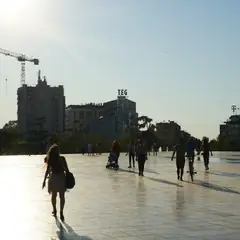
In Skanderbeg Square, among buildings of monumental scale, the Et’hem Bey Mosque looks almost like an object in a display case. And yet it is the building that has held out best: around it the old bazaar, the Old Mosque of Sulejman Pasha and the Karapici mosque disappeared, and at the end of 1967 the campaign against religion closed, demolished or turned into warehouses, gyms and workshops churches, mosques and tekkes across Albania. This one was left closed, but standing. Today it is the only one of Tirana’s eight old mosques that survives.
The history of the Et’hem Bey Mosque begins, according to the most cited chronology, in 1794, although sources do not agree: the start ranges between 1791 and 1794 and the end between 1819 and 1823, with some taking it as far as 1830. What to see in the Et’hem Bey Mosque, how its architecture of painted portico and blind dome is explained and why its door became a symbol in 1991 is what the audio guide covers in four stops and twenty-five minutes, with narration that is documented and checked against historical sources.
The mosque looks out onto Skanderbeg Square, and a few minutes away stands the Ottoman wall of Tirana Castle, the Toptani compound where the city was born.
Father, son and a clock tower
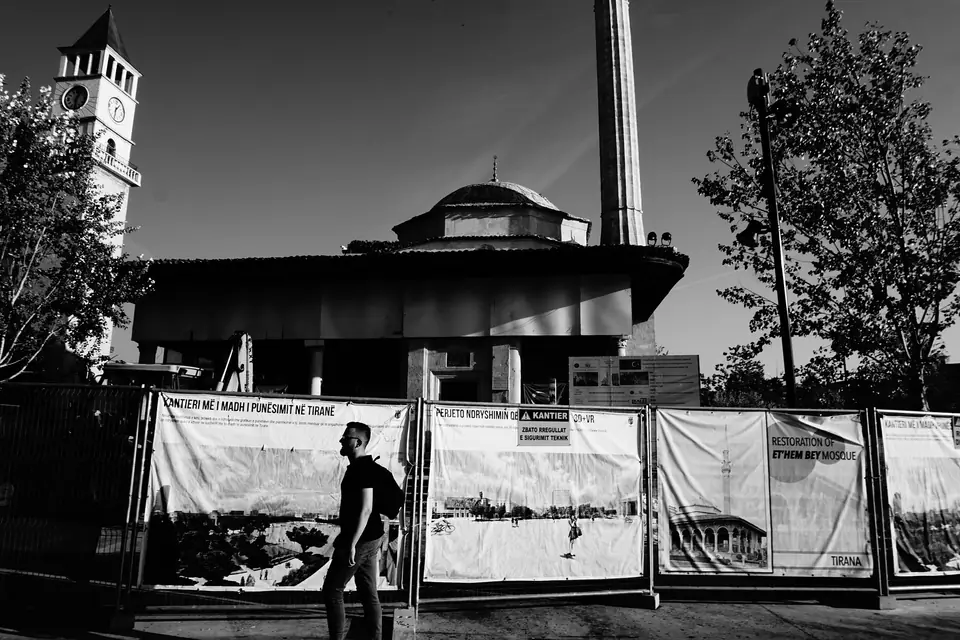
Minaret and clock tower ensemble
Summary of this stop
From the square, the mosque and the clock tower read as a single piece, and they are. Molla Bey of Petrela, a descendant of Sulejman Pasha Bargjini, laid the foundations and died in 1807, by the most accepted date, with the dome finished but without living to see the paintings. His son, Haxhi Et’hem Bey, completed the temple in 1821 with the minaret, the roof and the portico, and in 1822 began the clock tower beside it, finished with contributions from Tirana’s wealthy families. On 28 September 1848 Edward Lear drew the ensemble.
The minaret, to the right of the prayer hall, has a rectangular base, a tapering shaft and a balcony, and inside a helical stone staircase climbs, lit by small loopholes. The neighbouring tower, Ottoman in its lower half, has had a Western-style upper part since 1928, and in Ramadan and Bayram lights are strung between the two.
What weighs most at this stop, however, is what is missing. A few metres away stood the Old Mosque that the family’s ancestor had finished in 1614, a rival to this one for its minaret and frescoes. The fighting of November 1944 left it partly destroyed, and what happened to its remains, according to a story still disputed, explains why of the two mosques of the same lineage only the descendants’ one remains. The narration tells it in front of the empty plot.
Painted waterfalls under the arcades
Portico of the landscape frescoes
Summary of this stop
The portico, L-shaped and open with three arcades on columns, is the mosque’s great showcase. Its panels show trees, waterfalls, bridges and an island with a river and boats, in vivid tones recovered in the latest restoration: landscape motifs that rarely appear in Islamic art, where geometry and calligraphy rule. The portico was not just a vestibule: it has a second mihrab, meant for those who arrived late or did not fit in the prayer hall.
In November 1930 the Muslim Community consulted the National Museum on an engineer’s project to turn the portico roof into a terrace. Five days later the answer came: the mosque should be left as it was. In that letter the museum described it as “a jewel, an elegant little box” and lamented that the neighbouring Karapici mosque had just been demolished to open the Durrës street. The project was not carried out.
Beside the entrance waits another chapter, that of Haxhi Et’hem Bey himself: governor of Tirana fallen from favour in the struggle between rival families, a diwan poet who signed with a pen name and was buried with his wife Balkis in one of the few tombs the communist regime did not destroy. What that pen name meant is revealed in the narration, at the foot of the tomb.
Painted Istanbul and a recovered star
Prayer hall under the painted dome
Summary of this stop
The prayer hall is small, but its decoration has the ambition of a capital. The windowless dome bears the Ayat al-Kursi written in a spiral and, at its base, the 99 names of Allah. On the east side and in the women’s gallery the Süleymaniye Mosque of Istanbul is painted with its four minarets, as in the Bachelors’ Mosque of Berat. One of the chronograms inscribed in the building goes even further: it proclaims that the mosque has given Tirana an eternal beauty, as Hagia Sophia gave it to Istanbul.
Much of what is seen today came to light in the restoration begun in March 2018, which recovered more than 500 m² of frescoes. The earthquake of 26 November 2019 forced the restorers Adrian Çene and Andi Spahia to redo parts already finished, and the mosque was reopened on 17 January 2022 with Recep Tayyip Erdoğan and Edi Rama.
The most talked-about find of that work was a six-pointed star that worshippers had covered with green paint, very likely mistaking it for the Star of David. It was still recognisable by the incisions the painter had left as a preliminary drawing. Its reading remains open: popular interpretation speaks of the Star of David, while the restorer identifies it with the seal of the prophet Sulejman, and some even doubted it was still visible. Where it is and how that doubt was settled is left for the audio guide.
The door that opened in 1991
Edge of the portico facing the square
Summary of this stop
From the edge of the portico, Skanderbeg Square becomes a stage. On 18 January 1991 a group of locals led by Xhavit and Iljaz Alimehmeti, Ramazan Rysheku, Ibrahim Balla and Mehmet Sinella reopened the mosque without permission from the communist authorities. About 10,000 people came with flags, filled the square and the police did not intervene. Sources do not entirely agree on when it had closed: most speak of 1967, though one places it in 1946.
The date is often presented as the rebirth of religious freedom in Albania, but it was not the first: the Lead Mosque of Shkodër had held its first public prayer two months earlier, on 16 November 1990. What made the morning in Tirana different was the place, in the political heart of the capital.
That relationship between the temple and the square is still alive. Twice a year, at Fitër Bajram and Kurban Bajram, thousands of worshippers pray at dawn in the open air, in rows that start at the Et’hem Bey Mosque and extend beyond the statue of Skanderbeg, as far as the National Museum and the Hotel Tirana. Not always without controversy: the one of 2017, when prayer returned to the square, is where the narration closes, at this very point.