Medieval residence
Archbishop's Palace Audio Guide (Erkebispegården)
Right beside Nidaros Cathedral, the fortified residence of the archbishops hides underground the workshop that struck almost all Norwegian coinage before the Reformation. Above it, in the same compound, the crown jewels are kept today.
- 60 min of audio
- Archbishops, coinage and crown jewels
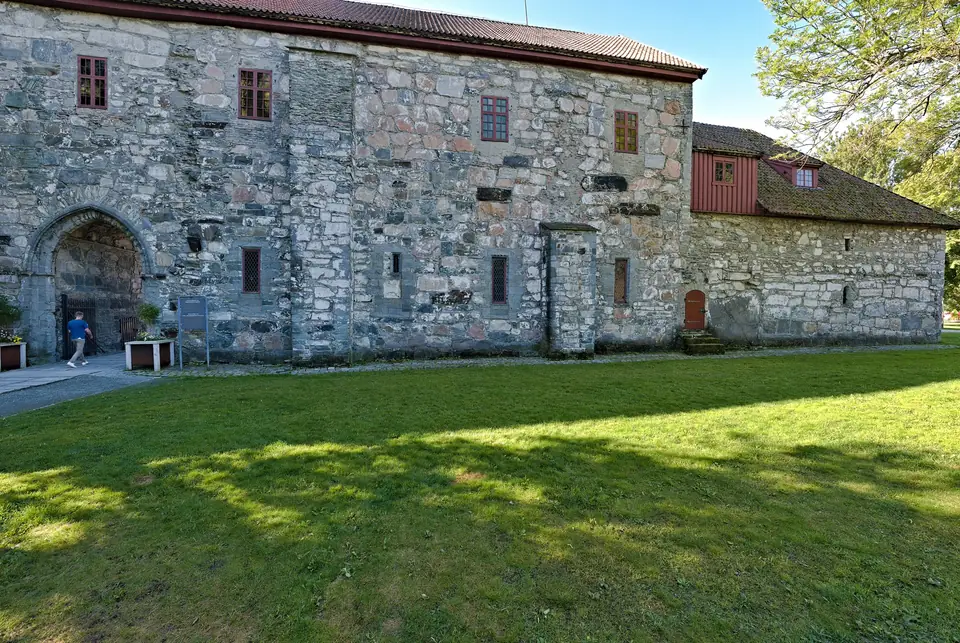
The residence appears for the first time in Sverre's Saga in 1178, under the name Biskopsgaarden, as the fortified house of the Archbishop of Nidaros. It is often presented as the oldest stone civil building in the North, a title that depends on a disputed chronology: some place its origin around 1161 and others date the oldest surviving walls to the thirteenth century. What is certain is the hall of the north wing, finished around 1220 with a double-flight staircase of continental design, unique in Norway, and Archbishop Sigurd's dwelling, built around 1250 and heated from below by open hearths in the vaults.
After the Reformation of 1537 the Church's palace passed to the Crown, then to the army, which stored gunpowder under the former banqueting hall, and in 1983 a fire reduced to ashes two warehouses holding the collections of the Trøndelag resistance museum. On that burnt site, the excavation of 1991–1995 uncovered three mints built one above another, and the lowest is displayed just as it was found.
Highlights
- Mint of Archbishop Gaute Ivarsson, displayed in the basement as it was found, with its red and yellow chequered floor
- The regalia of Norway, the king's crown included, on permanent display in the west wing since 2006
- The double staircase of the Østhuset, of continental design and unique in Norway
- Doorway with the coat of arms of Olav Engelbrektsson, the last archbishop of Norway
- Zigzag arch, probably reused from the first Nidaros cathedral
For more than three centuries, the most powerful man of the Norwegian Church lived in this stone courtyard in the shadow of Nidaros Cathedral. Sverre’s Saga mentions it in 1178 as Biskopsgaarden, the archbishop’s fortified house, and its history is made of blows: on Christmas Eve 1295, according to a line in the Flatey Annals, “the archbishop’s halls burned in Nidaros on Christmas night”; in 1532 Danish troops plundered and burned it; in 1537 its last archbishop fled by sea. After that came the king’s governors, who called it Kongsgården, and the military, for whom it was the Artillerigården, the artillery yard, headquarters of the northern army until 1930. Anyone looking for what to see at Erkebispegården finds today three museums in one: that of the residence itself, with finds from the excavation and the original sculptures of the cathedral, the regalia exhibition and the Rustkammeret with the resistance museum. Among its pieces is the St Olav antependium, painted around 1300, which spent almost two and a half centuries in Copenhagen before returning as a gift at the jubilee of 1930. The audio guide walks the compound from the gate passage to the basement where the country’s money was made.
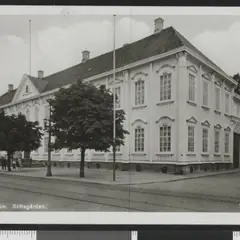
Next to the palace stands Nidaros Cathedral, the seat of its archbishops, and along Munkegata you reach Stiftsgården, the king’s official residence in Trondheim. A few minutes to the east, the Old Town Bridge crosses the Nidelva towards the wooden neighbourhoods.
An arch stolen from the first cathedral
Zigzag arch of the gate passage
Summary of this stop
The route begins in the vaulted gate passage, a way that narrows and darkens as befits the entrance to a fortress of the Church. The residence appears in the sources in 1178, in Sverre’s Saga, and even then it was a fortified house: the Archbishop of Nidaros needed walls, not just halls.
The detail that gives this stop its meaning is in the doorway onto the courtyard. Its arch shows a zigzag motif, the sparremotiv, and everything suggests it is a Romanesque arch reused from the first cathedral of Nidaros, whose nave was begun around 1150 and which was later torn down. A vanished cathedral is thus still present in the door of its archbishops’ house.
Above this same passage, around 1615, a half-timbered tower with a tall, elaborate spire was built, the work of Oluf Naucler; in 1672 Governor Ove Bjelke ordered it demolished. How that tower is known today, and why it looks somewhat distorted, is told by the narration under the arch.
Banquets by rank above a powder magazine
Double staircase of the Østhuset
Summary of this stop
Facing the double staircase rises the Østhuset, the archbishop’s hall in the north wing, finished around 1220. Its double-flight staircase, of continental design, is unique in Norway, and in the east gable open three pointed Gothic windows framed in soapstone. Here the archbishop received his guests, collected taxes and held banquets at which everything was measured by rank: the most important sat beside him with the best food, and those of lower rank ate porridge or simply looked on.
The hall had a second, less solemn life. After the great Hornemann fire of 1681, which devastated the city but spared the cathedral and the Kongsgården, the army occupied the compound: it walled up the windows of the Østhuset, added a floor to store more, and turned the ground floor into a powder magazine, right under the former banqueting hall. In that military phase the staircase was removed, the south wall became unstable and in 1706 massive buttresses were added to it.
The staircase seen today is a reconstruction by Gerhard Fischer, built from remains excavated during the restoration of 1962–1975. What survived of the original hall and what is twentieth-century work is explained in front of the steps.
The last archbishop’s coat of arms
Doorway with Olav Engelbrektsson's arms
Summary of this stop
Beside the west wall, the brick Vekthuset keeps a round-arched soapstone doorway with the coat of arms of Olav Engelbrektsson, the last archbishop of Norway (1523–1537). He placed it when rebuilding the hall of the west wing after June 1532, when the troops of Eske Bille, sent from Bergenhus, plundered and burned the residence as punishment for his support of Christian II’s failed attempt to regain the throne.
Beneath that coat of arms a dark episode took shape, recorded as documented tradition. In December 1535 the retinue of Christian III arrived in Trondheim for the council of the realm to acclaim him king of Norway; the archbishop negotiated with it during the festivities while corresponding with Emperor Charles V. On 3 January 1536 he accused the Danish councillors of treason, and his men killed Vincens Lunge in his inn on Kannikestredet. It was the last meeting of the Norwegian council of the realm. On Easter Sunday 1537 the archbishop sailed with more than 60 trusted men, his archive, his money and the coronation equipment, and died in exile in Lier, in the Netherlands, in 1538.
The paradox lies on the other side of the wall. From 1826 a vaulted room of the Vesthuset kept the regalia, and since 2006 they have been on permanent display in the west wing: the king’s crown, sceptres, orbs, the sword of state, the anointing horn and the standard. Who paid for almost all those jewels, and why, is part of the story in front of the doorway.
New wings on the ashes of 1983
Nils Henrik Eggen's modern wings
Summary of this stop
The east and south wings of the courtyard are modern, and there is a reason. On 18 August 1983 the two wooden military warehouses that occupied those sides burned to the ground. In the south warehouse the weapons and clandestine resistance material of the Nordenfjeldske Hjemmefrontmuseum of Trøndelag were lost; in the east one, some 4,000 plaster casts of the cathedral’s sculptures.
On the burnt site the architect Nils Henrik Eggen built the new wings, finished for the millennium of Trondheim in 1997, which house the museum with the finds from the excavation and the original sculptures of the cathedral. The resistance museum, for its part, has been in the west wing since 1990, next to the Rustkammeret, whose weapons collection begins in 1826.
The courtyard, the Borggården, also has a life that appears in no display case. Every summer, around Olsok, the feast of St Olav on 29 July, it becomes the open-air stage of Olavsfest, the festival born in 1962 as Olavsdagene. Here the audio guide links the night of the fire with the concerts of late July.
The tiny mint that paid for Norway
Gaute Ivarsson's mint
Summary of this stop
The route ends underground, in the basement of the museum. The excavation of 1991–1995 uncovered three mints built one on top of another, and the lowest, the best preserved, belonged to Archbishop Gaute Ivarsson (1475–1510). It is displayed just as it was found, with its floor of red and yellow chequered tiles and its hearth, next to remains of the old wall and of the weapons smithy.
The figures are surprising for how small they are. By order of the king, the workshop could have only one master of the mint and one apprentice, and it produced some 60,000 coins a year. Even so, almost all the Norwegian coinage struck from the early sixteenth century until the Reformation of 1537 came out of the three small workshops of this compound.
And there is one fact that changes the way you see it: not a single archiepiscopal coin earlier than the 1550s has turned up in the soil of the medieval city, while they are plentiful in rural churches and some have reached Denmark and Sweden. Where that money went, and for what, is the last piece the narration fits together beside the chequerboard.