Historic wooden quarter
Bakklandet Audio Guide
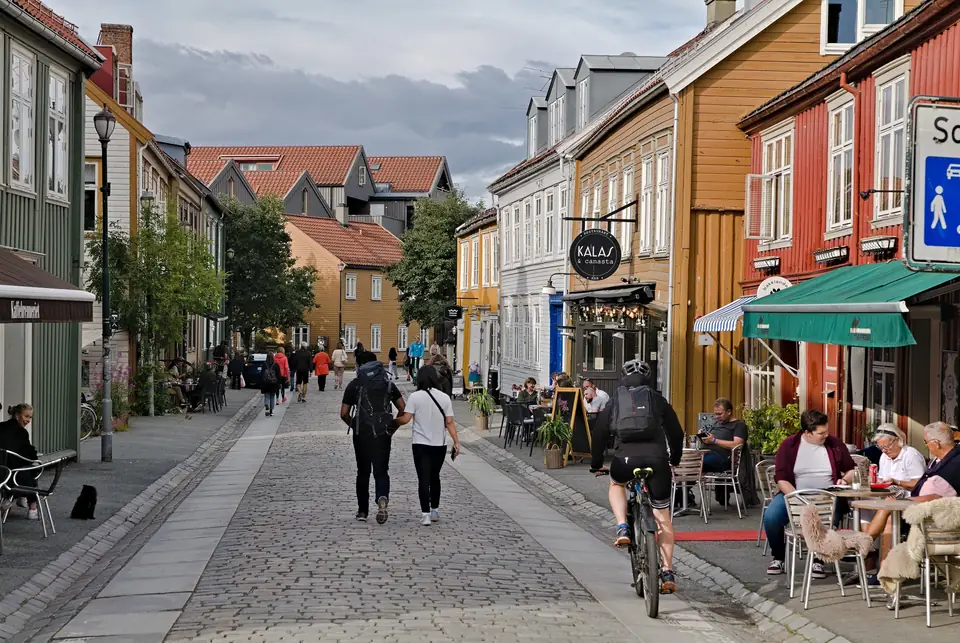
Across the old bridge, Trondheim's first suburb is still a quarter of low wooden houses and quays on the Nidelva. It burned twice, lived off shipyards and foundries, and was doomed by a four-lane motorway that its residents managed to stop.
- 45 min of audio
- Wooden houses and industrial history
Bakklandet was left out of the urban plan that Johan Caspar de Cicignon drew up for Trondheim in 1681, and so its streets grew without a plan, adapted to the terrain. It was inhabited by small traders, craftsmen and day labourers, in plain, often single-storey houses, with quays more modest than those on the city bank. A fire ordinance of 1689 forbade ships with fire on board from docking on the other bank, and goods coming in here did not pay the aksise: the quays of Bakklandet gained weight. In 1776 the suburb counted 160 dwellings and 14 quays.
In 1843 Fabriken ved Nidelven opened at Øvre Bakklandet 4, Trondheim's first industry in the proper sense, where the first Norwegian-built steamship and the country's first locomotive were made. More than a century later, the road plan of 1965 proposed demolishing much of the quarter to open the so-called Bakklandstangenten. Residents, students and architects mobilised during the 1970s, the plan was shelved and the wooden houses still stand, now within the register of urban environments of national historic interest.
Highlights
- Streets cobbled between 1772 and 1780 and low wooden houses that grew without a plan
- Fabriken ved Nidelven, where Norway's first steamship and first locomotive were born
- Trampe, the world's first bicycle lift, on the Brubakken slope
- A quarter saved from a four-lane motorway by residents' protest
- Bakke kirke, the log church that survived the fire of 1718
The story of Bakklandet is that of a humble quarter that refused to disappear. Settled from the mid-seventeenth century on the east bank of the Nidelva, it burned down completely in 1658 during the Swedish siege and burned again in 1718, this time at the hands of the Norwegian forces themselves, who set it alight to get ahead of the troops of the Swedish general Carl Gustaf Armfeldt. Between 1772 and 1780 its streets were cobbled; in the nineteenth century came the foundry, the shipyard and the machine shop; after the opening of the Bakke bridge in 1887 the quarter became working class, sometimes poor; and in 1974 the municipal environmental council even approved its depopulation to make way for a motorway. From the late 1970s its houses were rehabilitated and today it is a highly sought-after residential area, full of cafés, restaurants and small shops. Anyone asking what to see in Bakklandet finds much more than coloured façades: the audio guide walks the quarter from the old bridge to Bakke church and fits together, stop by stop, the story of how it survived.
You arrive by the Old Town Bridge, the wooden bridge of 1861 over the Nidelva, and from its streets you can walk up to Kristiansten Fortress, on the hill to the east.
The suburb that grew without a plan
Gamle Bybro
Summary of this stop
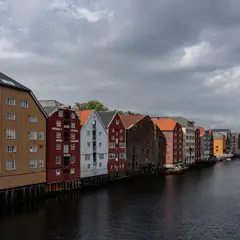
The route starts at the east end of Gamle Bybro, beneath the carved portals painted red of the bridge of 1861, the threshold into the quarter from the city. On the other side opens the cobbled street of Øvre Bakklandet, flanked by low wooden houses painted in colours, and along the bank stand the port warehouses, the brygger. High on the hill appears the white building of Kristiansten fortress.
The shape of the quarter has an explanation. When Johan Caspar de Cicignon designed Trondheim’s new Baroque plan in 1681, Bakklandet was left out, and its streets kept growing without a prior layout, adapted to the terrain. Its residents were small traders, craftsmen and day labourers, with houses plainer than those on the other bank and often of a single storey.
The quays, by contrast, gained importance through a rule meant for something else. The fire ordinance of 1689 forbade ships with an open fire on board from docking on the city bank, and in addition the goods that came in through Bakklandet paid neither the aksise nor the excise tax. What that advantage meant for the life of the suburb is told in the narration, in front of the quays.
The factory of the first Norwegian steamship
Fabriken ved Nidelven building
Summary of this stop
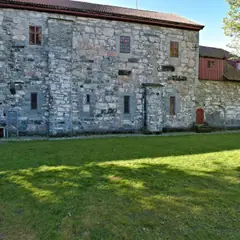
Opposite Øvre Bakklandet 4 stands a former industrial building with a discreet façade and an information sign. Here, in 1843, Fabriken ved Nidelven was founded, with a foundry, shipyard and machine shop: the first industry in the proper sense in Trondheim. It started with 40 or 50 employees and by about 1870 had 300, the largest workplace in the city.
From here came, between 1849 and 1850, the “Nidelven”, the first Norwegian-built steamship, and also the “Thrønderen”, the first locomotive built in Norway, destined for the Støren railway. The Norwegian Wikipedia dates it to 1860–1861; the Store norske leksikon, to 1862.
Before the factory, Bakklandet had been a busy quarter of coastal skippers who brought fish from the north, with herring and fish shops between the bridge and Rianalmenningen. The opening of the Bakke bridge in 1887 put an end to that atmosphere, and the quarter became working class, with conditions that were sometimes poor. The audio guide explains at this point how industrial din and wooden houses lived side by side.
A slope with a bicycle lift
Sykkelheisen Trampe
Summary of this stop
At the foot of the Brubakken slope, an almost invisible rail runs along the ground. It is the Trampe, opened on 18 August 1993 as the world’s first and only bicycle lift: it raises cyclists 130 metres, with a 25-metre rise, pushing them with a plate that rises from the ground under the right foot.
Its origin is utterly everyday. The slope was part of Jarle Wanvik’s daily bike ride (the surname also appears as Wanwik), and the story goes that in 1992 he was fed up with arriving at work every morning soaked in sweat. He devised a sort of ski lift set into the ground, won the backing of the city council, and his company, Design Management AS, built it the following year.
The original Trampe carried more than 220,000 cyclists until it was closed in 2010 for safety and wear. In spring 2013 it was replaced by the CycloCable system from Skirail, of the Poma group, which cost 6.5 million kroner and is free. Where the 1993 mechanism ended up is one of the details kept for the narration on the slope.
Four lanes that never came
Nedre Bakklandet
Summary of this stop
On the quays of Nedre Bakklandet, the coloured façades hide a future that came close to erasing them. Trondheim’s road plan of 1965 proposed demolishing much of the quarter to open a four-lane motorway between Elgeseter gate and Innherredsveien, the so-called Bakklandstangenten, and in 1974 the municipal environmental council went as far as approving the depopulation of the quarter.
During the 1970s residents, students and architects joined forces in protests and actions, and young people and adults even occupied houses to stop the demolition. The fight even had a soundtrack: the duo Knutsen & Ludvigsen and the folk fiddler Gerd Gudding founded the Bakklandet Bassangforening, a comic and political song group against the city’s plans that made records and reached NRK television. The demolition plan was shelved, although sources do not agree on when it was finally abandoned: some speak of the early 1980s and others of 1987.
From the late seventies the quarter lost its working-class character, its houses were rehabilitated and today it appears in the NB!-registeret of urban environments of national historic interest. What the musical group did when the road died is told in the narration, beside the water.
The church that survived the fire
Bakke kirke
Summary of this stop
The route ends at the north end, beside the Bakke bridge, before an octagonal log church with a tall tower and a weathervane in the shape of an angel with a trumpet. In the fire of 1718 it was the only thing left standing in the entire suburb: a log church only a few years old and still without cladding (sources date it to 1714–1715 or to 1717).
In the interwar period, with Innherredsveien widened and the new Bakke bridge opened in 1927, the church got in the way of traffic and demolishing it was considered. According to local tradition, it was saved by the workers of the shipyard Trondhjems Mekaniske Verksted, who lived in Møllenberg and regarded it as their parish church. In 1939 the church was raised on jacks and moved several metres, and in 1941 it was reconsecrated; in the operation the mausoleum of kammerråd Morten S. Hoff, the benefactor who had given it the organ in 1768, was demolished.
Beneath the ground of Nedre Bakklandet lies another survivor. In 2007, when the Fische building was demolished, the bottom of a large cargo sailing ship about 30 to 40 metres long appeared, of Trøndelag coastal pine dated to about 1797, which probably served as a slipway for the Trondhjems Skipsværft shipyard. What was decided to do with it, with nothing on the surface to mark it, is the last secret the audio guide reveals.