Fortified islet
Munkholmen Audio Guide
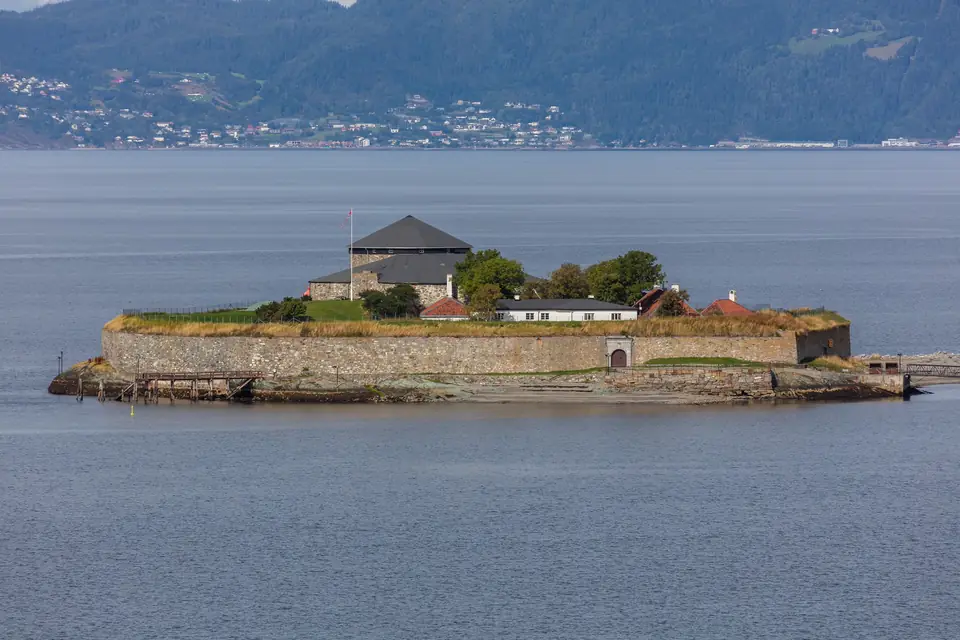
A 13-decare islet in the fjord, some 2 km from the Ravnkloa quay, which in a thousand years was a gallows of the sagas, the oldest known monastery in Norway, a state prison, a sea fort and a German anti-aircraft battery.
- 90 min of audio
- Monastery, prison and fortress
Munkholmen owes its name, “the monk's islet”, to the Benedictine monastery of Nidarholm, the oldest known in Norway, established here between the eleventh century and around 1100 and whose name changed only after the Reformation. Very little of the cloister remains in view, because after 1537 its buildings served as a quarry for the fortress that Denmark-Norway inaugurated on 26 August 1690. Between 1825 and 1850 that star-shaped fortress became the polygonal sea fort that now dominates the islet's silhouette, with the great round tower in the centre.
Its most famous prisoner was Peder Griffenfeld, chancellor of Denmark-Norway, sentenced to death in 1676 for bribery, selling offices and treason; the sentence was commuted at the last moment to life imprisonment, and from 1680 to 1698 he served it on Munkholmen, where he taught the officers' children. The stone table with a circular groove that was attributed to his finger, dragged in his circuits around it, was in fact made by a watchman keen to attract more visitors to the islet.
Highlights
- Central round tower, begun in 1671–1674 and topped with a German concrete roof
- Medieval soapstone doorway, one of the few visible remains of the Nidarholm monastery
- Remains of the cell of Chancellor Griffenfeld, a prisoner on the islet from 1680 to 1698
- A German 105 mm cannon and the Dreiwag rangefinder, the only one of its kind in Norway
- Munkegata, the axis of the 1681 plan that lines up the islet from the cathedral
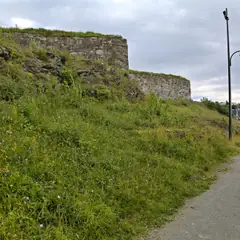
The story of Munkholmen fits on a rock that can be walked around in a few minutes, yet it spans a thousand years: each age has left here what Trondheim preferred to keep outside the city, whether heads, monks, prisoners or cannons. Not even the origin of the monastery is settled. English sources, with the chronicler Matthew Paris, who visited Nidarholm in 1248, attribute the foundation to Cnut the Great around 1028, with a church consecrated in 1031; Norwegian and Icelandic sources, and a good part of the historiography, place it around 1100–1110 and owe it to the lendmann Sigurd Ullstreng, and a study of 2022 has again defended Cnut. Nor do the sources agree on its dedication, to St Mary or to St Benedict and St Lawrence. At the start of the fourteenth century those monks had a ship of their own, a “busse” that traded in the ports of eastern England and paid its customs duties there. The ruins of the monastery were excavated in 1967–1970 and in 1988–1989 and covered over again: they lie half a metre under the grass. An old tradition even speaks of a secret submarine tunnel between the Archbishop’s Palace and the islet, which the Norwegian encyclopedia calls a myth. Anyone looking for what to see on Munkholmen or the history of Munkholmen finds the round tower, the wall of the fort, a medieval soapstone doorway and the German cannon, pieces that the audio guide arranges from the quay to the battery.
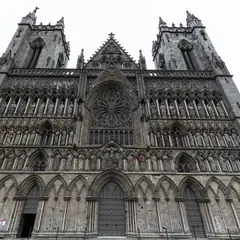
On the mainland, on the eastern hill, Kristiansten Fortress completed the city’s defences after the fire of 1681, and at the other end of Munkegata, behind the Ravnkloa quay, stands Nidaros Cathedral.
Munkegata points to an islet
Ravnkloa
Summary of this stop
The route starts on the mainland, at the Ravnkloa quay, and works even if the boat does not sail that day. Behind you stands Nidaros Cathedral and ahead, the street Munkegata, the axis of the plan that Johan Caspar von Cicignon drew up in 1681, runs to the water and has its vanishing point exactly on the islet, some 2 km out in the fjord.
The coincidence is no accident. The same Cicignon is linked to the fortress of Munckholm, which Denmark-Norway built after the Swedes occupied the region in 1658 and fired artillery at the islet. The great central tower was begun in 1671–1674, the fortress was inaugurated on 26 August 1690 and the commander’s house that still stands dates from 1695. From Ravnkloa the architecture of Munkholmen can be read at a glance: the cylindrical volume of the tower above the ring of walls, and what that perspective says about the city that designed it is told in the narration facing the fjord.
Heads, monks and a blind king
Bauta inside the walls
Summary of this stop
Inside the walls stands a bauta, an upright commemorative stone that could mark the site of the old gallows. According to the sagas, in 995 Olav Tryggvason had the heads of Earl Håkon and of his slave Kark, who had cut his master’s throat to collect the reward, spiked on stakes on the islet, then called Nidarholm. It is an episode that appears only in the sagas, and the versions differ: in Oddr Snorrason’s, Kark dies hanged; in Snorri’s, beheaded.
Beneath that same ground, half a metre down, sleeps the Benedictine monastery of Nidarholm, the oldest known in Norway. Between 1135 and 1137 it took in an unwilling guest: King Magnus the Blind, blinded and mutilated by his rival Harald Gille, who was confined here and was the only king consecrated a monk in the monastery. Gallows, cloister and royal cell on the same patch of earth: the audio guide separates those layers one by one at this point.
The doorway that outlived the monastery
Soapstone doorway of the round tower
Summary of this stop
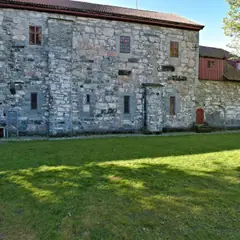
On the east face of the round tower, at the highest point of the islet, a medieval soapstone doorway and window survive, among the few visible remains from the monastery era. The rotunda measures 15.2 m in inner diameter and 19.2 m outside, the same measure as the upper choir of Nidaros Cathedral, built around 1180. What exactly stood here is still debated: the seal of 1280 shows a Romanesque rotunda with four towers that does not fit well with the excavated remains, and the idea that the present tower stands on Cnut’s church is a recent interpretation.
The fall of the monastery was slow and layered. In the 1230s and 1240s, according to the tradition recorded in the saga, Abbot Bjørn, nicknamed Ritabjørn for his skill at cards, acted as adviser to Duke Skule in his struggle with King Håkon Håkonsson; he was excommunicated and deposed, arrested in Hamar on his way to Rome laden with the duke’s letters, and left Nidarholm sunk in debt after taking the monastery’s seal to raise loans with the convent’s lands as security. The building burned in 1210, 1317 and 1531, and at Easter 1537 the last Catholic archbishop of Nidaros, Olav Engelbrektsson, gathered here part of his men, the archives of the archbishopric and many valuables before fleeing into exile.
His men, besieged by the fleet of Jens Splid, surrendered, and with that monastic life on the islet came to an end. Afterwards the buildings were abandoned and served as a quarry for the fortress, and how the soapstone doorway managed to escape that fate is part of what you hear before the tower.
The chancellor who dodged the executioner
Commander's house
Summary of this stop
In front of the commander’s house of 1695, now a café-restaurant, the story centres on Peder Griffenfeld, chancellor of the kingdom of Denmark-Norway. Sentenced to death in 1676 for bribery, selling offices and treason, he saw the sentence commuted at the last moment to life imprisonment; the chronology most consistent with that sentence places him imprisoned in Copenhagen until 1680 and on Munkholmen from 1680 to 1698, although one version speaks of an earlier transfer. On the islet he ended up teaching the children of the officers who guarded him. In 1697 he shared the rock with another prisoner, the cartographer Peter Jacob Wilster, whom General Johan Vibe described as laden with lies and wickedness from the tip of his toe to the crown of his head.
Of the chancellor’s cell only remains and its former entrance are left, which are shown on tours of the fort: the original cell in the tower disappeared between 1825 and 1850, when the vaulted powder magazine was built. More famous was the stone table with a circular groove attributed to his finger, which was in fact made by an overzealous watchman who wanted more visitors for the islet. And tales of apparitions also circulate: popular belief has it that the ghost of Munkholmen is Griffenfeld himself.
Literature did the rest. In 1823 Victor Hugo published the Gothic novel “Han d’Islande”, in Norwegian “The Prisoner of Munkholmen”, set in 1699 with a Schumaker of Griffenfeld still locked in the fortress alongside his daughter Ethel, when the real Griffenfeld had left the islet in 1698 for health reasons. How the chancellor really ended is kept for the narration in the courtyard.
Sixty cannons and five candles
Dreiwag rangefinder and 105 mm cannon
Summary of this stop
North of the round tower the story leaps into the twentieth century. The nineteenth-century fort, with 60 cannons and room for 500 men, was one of the strongest fortresses of the North and was closed in 1893 having hardly ever seen combat. During the German occupation of 1940–1945 the islet protected the Dora submarine base: the Germans removed the conical roof of the tower and poured a flat concrete roof as a base for anti-aircraft artillery, as part of a battery of six 105 mm naval guns installed in 1943.
In 2006 one of those cannons returned to the islet, a 105 mm SKC/32 in a turret, and beside it the optical Dreiwag rangefinder is preserved, the only one of its kind in Norway, along with the concrete bases of the anti-aircraft positions. The contrast comes from a documented episode of the late eighteenth century: around 1797–1798 a lighthouse was installed here that was lit with five small wax candles, with a glass that filled with soot and a keeper who paid for the candles out of his own pocket. What happened next to that light, which is still lit on the islet, closes the route.