National shrine of Norway
Nidaros Cathedral Audio Guide (Nidarosdomen)
The northernmost medieval cathedral in the world rose over the tomb of St Olav to welcome the pilgrims of the north. Its nave lay in ruins for more than three centuries, it was rebuilt stone by stone from 1869, and today it revolves around a saint whose body no one can locate.
- 75 min of audio
- Gothic and medieval pilgrimage
Olav Haraldsson fell at the Battle of Stiklestad in 1030 and was buried in secret beside the River Nidelva; a year later his grave was opened and he was proclaimed a saint, and over it grew first a wooden chapel, then a stone church and finally a Gothic cathedral with an octagon that has no parallel north of the Alps. The Reformation melted down his silver shrine and filled his tomb with earth, yet the Norwegian Constitution of 1814, which names no other building, fixed the coronation of kings here.
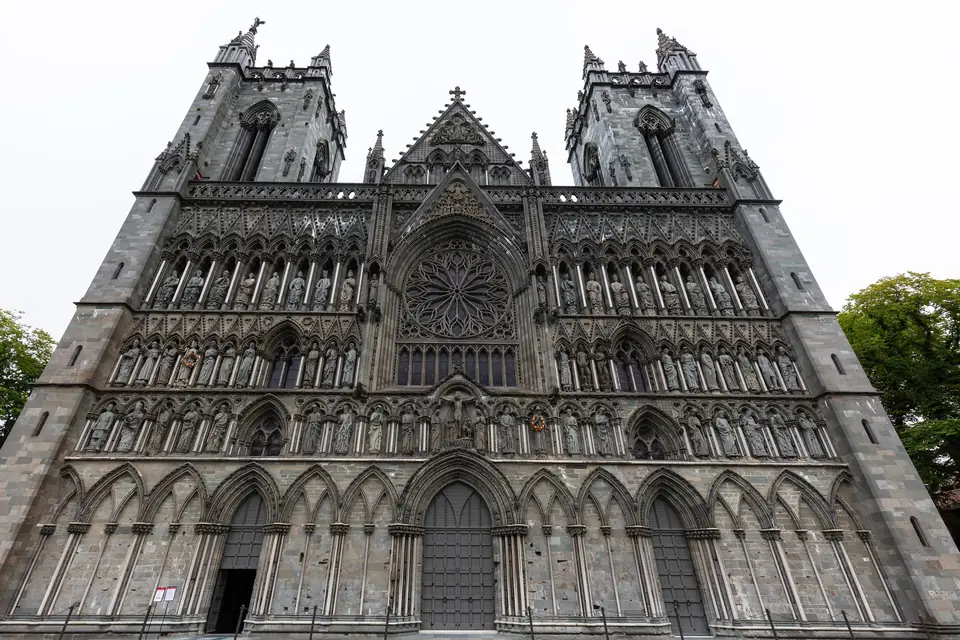
What looks like a medieval façade is largely a twentieth-century work: only five of its great statues were still standing when the restoration began. Among the 76 figures that fill it today are portraits of contemporaries, from an archangel St Michael with the features of Bob Dylan to a bishop holding a dish with three severed heads that bear the faces of the architects of the project.
Highlights
- High altar over the spot marked as the tomb of St Olav, who died at Stiklestad in 1030
- West façade with 76 statues, almost all from the twentieth century, and a St Michael with Bob Dylan's face
- St John's Chapel, with the inscription that dates its altar to 26 November 1161
- Pilgrims' octagon behind a 3-metre openwork wall that only the clergy could cross
- Gabriel Kielland's rose window, about 8 metres across and made of more than 10,000 pieces of glass
The story of Nidaros Cathedral begins with a hidden corpse. On 29 July 1030 Olav Haraldsson died at the Battle of Stiklestad and his body was buried in secret; a year and five days later, in 1031, the grave was opened and those present described an intact body, with hair and nails grown long. Olav was proclaimed a saint, and over his burial place rose first a small wooden chapel, then the stone Kristkirken that his nephew, King Olav Kyrre, began around 1070, and finally the great Gothic cathedral that the archbishopric of Nidaros, created in 1152–1153, turned into a pilgrim destination. In the Middle Ages it came to have 28 altars. Then came the fire of 1531, the Reformation, the melted-down shrine and the tomb filled with earth, more than 300 years of a ruined nave and a restoration that began in 1869 and, according to the official website, was considered finished in 1969. Anyone asking what to see at Nidaros Cathedral finds much more than a façade crowded with statues: a rebuilt church that is still organised around a vanished saint, and the audio guide follows it from the west front to the high altar, the same route the pilgrims took.
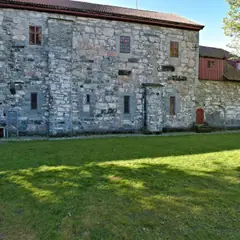
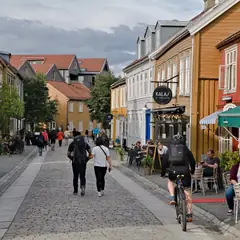
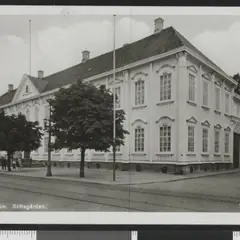
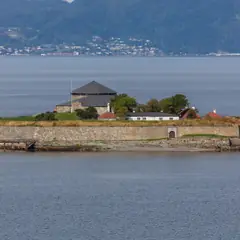
Wall to wall stands the Archbishop’s Palace, the fortified residence of the archbishops of Nidaros, and after the coronation of 1906 the official photograph was taken at Stiftsgården, on Munkegata. At the far end of that same street, in the fjord, Munkholmen keeps the memory of the Benedictine monastery of medieval Nidaros.
An archangel with Bob Dylan’s face
Nidarosdomen
Summary of this stop
The west façade presents itself as a great screen of stone in three rows: Christ and the apostles below, saints and virtues in the middle, prophets and kings of Israel above. It looks medieval and almost isn’t. Only the two lower storeys, with the portals and the first row, date from the Middle Ages; when the restoration began in 1869 barely five of the great statues were still standing. Its reconstruction pitted Olaf Nordhagen against Fredrik Macody Lund for years, until an international commission rejected Lund’s geometric system, and the final design rested partly on an engraving of 1661, on conjecture and on invention. Helge Thiis, who won a competition in 1929, finished the north tower in 1964 and the south one in 1968, although the dates of the last statue vary by source.
Many of the 76 sculptures are portraits of contemporaries. At the very top of the northwest tower, the bronze archangel St Michael that Kristofer Leirdal sculpted in 1965 has the features of Bob Dylan. Lower down, Bishop Sigurd holds a dish with three severed heads, and those heads have the faces of the architects Gudolf Blakstad, Herman Munthe-Kaas and Helge Thiis. In the centre, Gabriel Kielland’s rose window, a gift from the women of Norway for the anniversary of 1930, unfolds the Last Judgement in more than 10,000 pieces of glass.
The bishop’s dish is no whim: it answers to a documented tradition about Sigurd, the bishop who came from England with Olav Tryggvason to Christianise Norway, and about what happened to his three nephews in Sweden. Beneath the mitre, moreover, hides the face of a nineteenth-century Norwegian poet. Who he is, and how the legend of the heads in the river ends, is told in front of the façade, in the audio guide’s narration.
The nave that spent three hundred years without a roof
Main nave
Summary of this stop
Beneath the vaults of the main nave it is hard to imagine that this space was a ruin open to the sky. The fire of 1531 brought down every roof; after the Reformation only the eastern part was repaired, and the great nave stood roofless for more than 300 years. Meanwhile the 110-metre spire was blown down by the wind in 1689 and new fires struck the church in 1708 and 1719.
The nave came back to life thanks to the money approved by the Storting in 1868 and to a stonemasons’ workshop of its own that began work in 1869 and by about 1900 employed some 100 craftsmen. That workshop, Nidaros Domkirkes Restaureringsarbeider, is still active today with traditional techniques: the cathedral has never entirely stopped being built.
This same nave was the stage for one of the tensest episodes of the occupation. On 1 February 1942, the day Vidkun Quisling was installed as minister-president in Oslo, the regime reserved the cathedral for a celebratory service, and Dean Arne Fjellbu moved his own main service to 14:00. What happened when the police arrived, with some 1,500 people inside and thousands singing hymns outside, and how that afternoon ended with the resignation of the seven bishops of the Church of Norway, is told in the centre of the nave.
The chapel with its date written on it
St John's Chapel
Summary of this stop
In the south transept stands the oldest surviving part of the building: the Johanneskapellet, or St John’s Chapel, a Romanesque chapel with blind arcades. An inscription there dates its altar with unusual precision: it was consecrated by Archbishop Øystein Erlendsson on 26 November 1161, in his first year in office, a few years after the archbishopric of Nidaros was created.
From this chapel you can grasp the chain of events that gave rise to the whole building. The tomb opened in 1031 and the saint proclaimed before a body that seemed not to have decayed; the stone church that Olav Kyrre began around 1070 where the wooden one had stood, finished around 1090 and some 50 metres long, with St Olav’s shrine on the altar; and, on top of that, the ambition of an archbishop who wanted a cathedral worthy of his saint. How those pieces fit into the floor the visitor walks on is explained in the audio guide, next to the inscription.
Pilgrims behind a three-metre wall
Openwork wall of the octagon
Summary of this stop
The octagon is the heart of the architecture of Nidaros Cathedral. Archbishop Øystein began it in 1183, on his return from England, to house Olav’s shrine: an eight-sided funerary choir, 18 metres in outer diameter with 10 metres of central space, a form with no parallel north of the Alps. Outside, its walls of greenish-grey soapstone carry little columns of white marble and the archbishop’s doorway with the coat of arms of Erik Walkendorf.
Inside, pilgrims never reached the saint. They walked the side aisles of the choir and the ambulatory of the octagon, separated from the centre by an openwork wall about 3 metres high that only the clergy could cross, with openings through which to see the altar. Of the 28 medieval altars, the Reformation removed 26.
Beside the door of the octagon waits a disconcerting gallery: nobles with wings and tails, a man with his mouth full of snakes and lions biting his ears. They were carved between the fire of 1328, when Archbishop Eiliv Korte pushed for the repair and the pope granted 100 days of indulgence to anyone who contributed, and the arrival in 1349 of the Black Death, which killed 70% of Trondheim. This octagon also holds the legend of Munken, the monk who passes for the most famous ghost in Norway; what those who claim to have met him saw and heard is kept for the narration in the ambulatory.
An altar over Olav’s lost tomb
High altar of the octagon
Summary of this stop
The high altar occupies the spot marked as the tomb of Olav Haraldsson. Above it rises an altarpiece of 1882, a gift from Oscar II, which imitates the shape of the old silver shrine, the most valuable object of medieval Norway. The original no longer exists: after Archbishop Olav Engelbrektsson fled at Easter 1537 it was broken up, and a receipt of 9 September 1540 records 95 kilos of silver and 170 crystals sent to Copenhagen to be melted down. In 1568 the Danish minister Jørgen Lykke ordered the tomb filled with earth to put an end to the pilgrimages, and since then the saint’s remains have lain in an unknown place, inside the cathedral or in its graveyard. There is not even certainty about the body that had been returned to the church shortly before, because the descriptions of the time do not agree.
Even so, this altar remains the symbolic centre of the country. The Constitution of 1814 fixed the coronation here, and on 22 June 1906 Haakon VII was anointed before it and crowned at the same time by Prime Minister Christian Michelsen and Bishop Vilhelm Andreas Wexelsen, the last coronation in Norway. Olav V in 1958 and Harald V with Queen Sonja in 1991 received only the blessing here.
The pilgrimage, moreover, is still considered complete before this altar. Every 29 July, on the feast of Olsok, the cathedral holds the Olavsvaka, a vigil from 23:00 to 06:00 with prayers every hour, and the pilgrim tradition preserves a gesture that anyone can repeat before going in. What it is, and why the saint who drives all this is no longer where he is prayed to, closes the audio guide’s route.