Historic bridge
Old Town Bridge Audio Guide (Gamle Bybro)
The wooden bridge over the Nidelva towards Bakklandet began as an armed gate of Trondheim, watched over by the cannons of Kristiansten. Its red portals owe their nickname, “the gate of happiness”, to the waltz of a plumber whom that same fortress shot.
- 25 min of audio
- Wooden bridge and fortified gate
The first crossing at this spot was built around 1683–1685, within Johan Caspar de Cicignon's urban reorganisation and tied to the construction of Kristiansten fortress; King Christian V paid for it and it was placed where the cannons could reach it, hence its name festningsbroen, the fortress bridge. It had an iron gate, a town gate and guard and customs huts. The present bridge, finished in 1861, was the first work of Carl Adolf Dahl: an 82-metre wooden lattice on natural-stone piers, with two drawbridge leaves by the west bank.
The happy name has a bitter story. Lykkens portal comes from a line of the waltz “Nidelven stille og vakker du er”, whose main part was written in 1940 by Oskar Hoddø, a resistance plumber who could not read music. On 17 November 1943 he was shot at Kristiansten, the fortress that dominates the bridge, and his waltz ended up being sung in Denmark and the Benelux.
Highlights
- Lykkens portal, the carved red portals from which the drawbridge mechanism of 1861 hung
- Brovakten, the surviving guard and customs hut, now a nursery
- An 82-metre wooden lattice on natural-stone piers
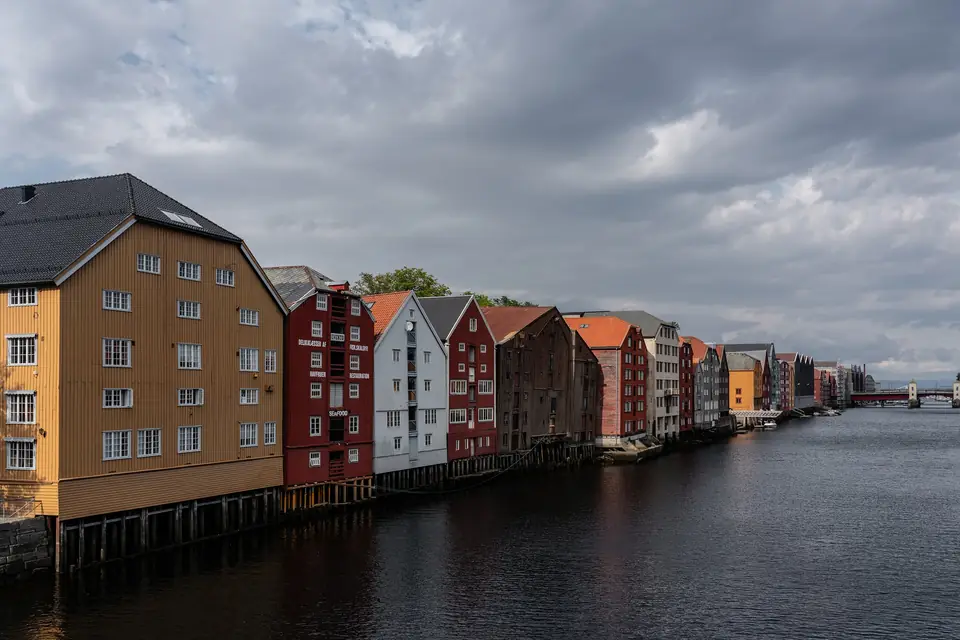
- View of the Nidelva's warehouses on piles and of Kristiansten fortress
- The waltz of Oskar Hoddø, the resistance plumber shot at Kristiansten
The story of Gamle Bybro, the old bridge of the town, begins with fire. On 5 January 1651 around 90% of Trondheim burned in what is considered the largest fire in its history, and local tradition places its origin in a town building right next to where the bridge now begins; Nidaros Cathedral was spared. After another great fire, that of 1681, the city was rebuilt on Johan Caspar de Cicignon’s layout, and with it came the first bridge at this spot: some sources date it to 1681 and others to 1683–1685, and the present one is dated to 1860 or 1861 depending on the source. Its arrival doomed another crossing: the medieval Elgeseter bridge, upstream, already cited in 1178, by which the canons went to the cathedral choir and where in 1199 the Baglers and Birkebeiners fought, was left to its fate. On the other side waits Bakklandet, the wooden suburb that its own defenders burned in the autumn of 1718 to clear the field of fire before Armfeldt’s Swedish army; only Bakke church was saved. Anyone asking what to see at Gamle Bybro finds much more than the photo of the coloured warehouses: a military gate, a silent drawbridge and a waltz with a tragic ending, pieces that the audio guide arranges from one bank to the other.
On the other side waits Bakklandet, the suburb of wooden houses that the bridge leads to. Back on the city bank, Nidaros Cathedral is about 300 metres away.
The customs hut that is now a nursery
Brovakten guard hut
Summary of this stop
At the west end, on the city side, a small, discreet hut survives that almost nobody looks at twice. It is the clue that this stretch beside the river was, for more than a century, a fortified entrance to Trondheim. The bridge had an iron gate in the middle of the deck and, on this bank, a town gate that stood until 1816; on both sides there were guard and customs huts, the aksisehus, and the city one housed a guard detachment of the civic militia. All of it lay, on purpose, within range of the Kristiansten cannons.
Of the two huts only this one survives: the one on the east bank was removed in 1824. The Brovakten, “the bridge guard”, has had several documented lives. In 1776 it appears as a corps de garde, still of wood; in 1795 it was rebuilt in masonry; between 1873 and 1940 it was the home of the vollmester, the man in charge of the fortification’s earthworks. It was protected in 1927, was inhabited until 1968, when it became a nursery, and was restored in 1983.
Its little garden still holds in local memory a name from another age, and the narration on the spot tells whom that peculiar title was owed to.
The red portals that held up the drawbridge
Lykkens portal
Summary of this stop
The two carved wooden portals, painted red, that frame the entrance on the Kjøpmannsgata side are no mere decoration. When Carl Adolf Dahl, municipal engineer since 1859, finished the bridge in 1861 as his first work, there were two drawbridge leaves by the west bank over a narrow navigable channel, and the lifting mechanism was anchored precisely in these portals. Beside them still stand the wooden winches that worked it.
In 1967 the bridge was widened for cars and the mechanism was taken out of service: the moving sections disappeared, but the portals and winches were kept. They did not escape traffic unscathed: in 2002 a lorry wrecked one of the two.
The nickname they are known by, Lykkens portal, “the gate of happiness”, comes from a line of a waltz of 1940: in the first editions, its last verse begins “Den gamle bybro er lykkens portal”. Legend has it that crossing beneath them brings good luck, and some people never pass without a kiss. Who wrote that line, and in what circumstances, is revealed at the next stop.
The plumber’s waltz and the fortress above
Gamle Bybro
Summary of this stop
From the middle of the deck opens the most classic view of Trondheim: the rows of coloured wooden warehouses on piles along the Nidelva. And, high on the hill to the east, the white building of Kristiansten, the fortress that justified the site of the bridge.
The author of the main part of the waltz “Nidelven stille og vakker du er” was Oskar Hoddø, a plumber born in Namsos in 1916 and a member of the resistance. He could not read sheet music: he hummed the melody to his brother, who was the one who put it into notes. Where the song was born is not clear: one tradition has him writing it on this very bridge in 1940 and another places it in the refugee camp of Kjesäter, in Sweden, and some edition shares the authorship with Christian Christensen for a verse added in 1941.
What is documented is its ending. On 17 November 1943 Hoddø was shot at Kristiansten along with eight other resistance members, and after the war his remains were moved to the graveyard of Nidaros Cathedral. His waltz became an international hit, and at this point the audio guide tells what other river and what title it is sung under today outside Norway.
A wooden bridge that was never stone
Bakklandet end
Summary of this stop
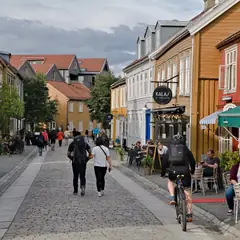
At the east end, at the foot of Brubakken, the slope that climbs towards Bakklandet with the Trampe bicycle lift, installed in 1993, something is missing: the twin of the hut on the west side, removed in 1824. From here you can clearly see the natural-stone piers in the water and the wooden lattice of the main span, with 8.4 metres of clearance for navigation; the main span measures 43 metres according to the national encyclopedia, although other sources give different figures.
The crossing was not always so solid. A royal rescript of 14 August 1770 describes it as almost 300 ells of wood, very high and narrow, without a railing, so much so that two carts could barely pass each other; the city and the rural district of Strinda shared its upkeep equally because the municipal boundary ran through here. That same year a competition was opened for a new one, and Councillor Archdall even offered a stone bridge. In July 1790 the old bridge was pulled down to be rebuilt, with a temporary floating bridge between Rådstuealmenningen and Bakklandet.
The most recent history is that of a bridge gradually freed from cars: one-way towards Bakklandet in 2003, total closure in 2013 for a thorough restoration, reopening just before 17 May 2015 and, in 2016, the municipal decision to close it permanently to motor vehicles. Which bid won in 1770 instead of the stone one, and why the bridge came to carry the name of a farm, is left for the narration at this end.