Seventeenth-century fortress
Kristiansten Fortress Audio Guide (Kristiansten festning)
The white tower that watches over Trondheim from the eastern hill never fought a battle and has still stood guard for more than three centuries: against the Swedes, against fire and, in its worst years, against Norwegians themselves.
- 45 min of audio
- Star fortification and city views
Kristiansten was born from the ashes. After the fire that devastated much of Trondheim in 1681, King Christian V commissioned General Johan Caspar de Cicignon and Anthony Coucheron to draw up a new plan for the city and its fortifications, which produced the wide streets of the centre and this fortress bearing the king's name. It was built between 1682 and 1684 on the hill of Erlandshaugen, the height from which the Swedes had already dominated the city in 1564 and 1658, as an irregular nine-pointed star around a gun tower, the Donjonen.
Its only war it won without fighting: in 1718 the Swedish general Carl Gustaf Armfeldt besieged Trondheim with some 10,000 men and did not dare to storm it. Condemned to ruin in 1816, it was saved by its role as a fire lookout. And the darkest chapter came with the German occupation, which made it a place of execution for Norwegian resistance members; after the war, in the same compound, those who had hunted them were shot.
Highlights
- The Donjonen, the whitewashed gun tower aligned with the axis of Nidaros Cathedral
- The soapstone gate of 1746 with Frederick V's monogram
- The Swedish siege of 1718, which ended without a single assault on the fortress
- The casemates and the ecumenical chapel where the Norwegian resistance is remembered
- The salute battery that still fires 21 rounds on designated days
The story of Kristiansten begins with a city in flames. On the night of 18 to 19 April 1681 a fire devastated much of Trondheim (some Norwegian sources place it a year later, in 1682), and Christian V seized the catastrophe to rebuild it entirely: General Johan Caspar de Cicignon and his chief of staff, Anthony Coucheron, laid out the wide streets that still order the centre and, on the hill of Erlandshaugen, a fortress that would carry the king’s name. The choice of site was no accident: from that same height the Swedes had held the city under their control in 1564 and 1658. The works, directed by Coucheron, are dated by most sources between 1682 and 1684. What followed is a succession of twists: a siege without an assault, an order of abandonment, an explosion in the dead of night, executions during the occupation and cannons that still celebrate national dates today. Anyone asking what to see at Kristiansten Fortress finds, besides one of the widest views of Trondheim, a route of five stops across grass bastions that the audio guide threads from the gate to the salute battery.
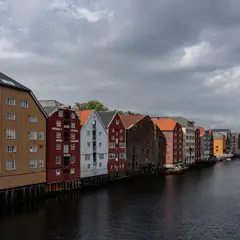
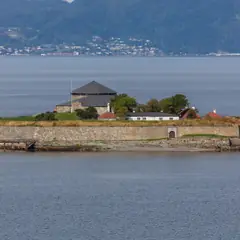
At the foot of the hill stand the wooden houses of Bakklandet, from where you walk up to here, and in the fjord Munkholmen, the other great piece of the defences that Trondheim built after the fire of 1681.
A soapstone gate for a burned city
Kristiansten festning
Summary of this stop
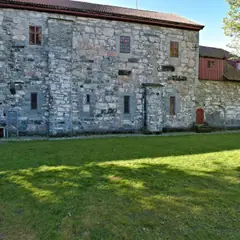
The route starts before the soapstone gate of 1746, a doorway of greenish stone with pilasters and a triangular pediment topped by the monogram of Frederick V, the work of the brothers Rasmus and Andreas Banch. Behind it, a 15-metre passage crosses the rampart diagonally and emerges opposite the Donjonen, the white three-storey tower with a hipped roof that is the heart of the fortress and, in summer, a museum.
The architecture of Kristiansten can be read from here. The compound was designed as a symmetrical star around the tower, but the terrain had its say and it ended up an irregular nine-pointed star. The Donjonen, of whitewashed grey stone, originally measured 17 by 12.5 metres on plan; its wall facing the city was later thickened by 2.5 metres, to about four, and inside it held two vaulted powder magazines, the commander’s quarters and two floors of cannons with embrasures closed by iron shutters.
According to tradition, Cicignon, a soldier born in Luxembourg, attended the laying of the first stone even before the king approved the final plan: a parade of the garrison, speeches, a pile of stones christened “Kristiansten” and nine salute shots. The date of that first stone is also disputed among the sources, and the sentence with which the general promised the king an impregnable stronghold is kept for the narration in front of the tower.
The cathedral in the sights
Kongens bastion
Summary of this stop
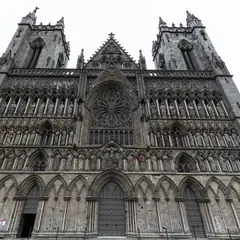
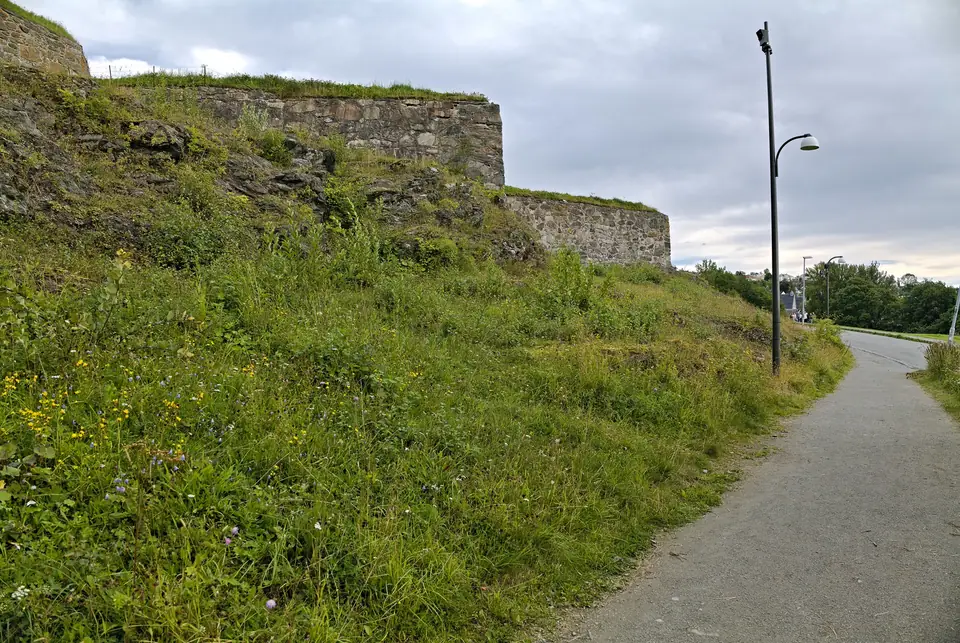
At the tip of Kongens bastion, the tall monumental bastion that looks over the city, the geometry becomes evident: the Donjonen that rises behind is on the exact extension of the longitudinal axis of Nidaros Cathedral, about 700 metres away. Tower and cathedral, military power and sacred power, share the same line on the plan of Trondheim.
That view explains why the fortress is where it is. The hill was fortified so that no Swedish army could again fire on the city from here, as had happened in 1564 and 1658. And the defence had a price for those who lived below: in 1718, to clear the line of fire, Commander Vincents Budde ordered all the houses of Bakklandet, the quarter at the foot of the hill, torn down. Only one building was left standing, and at this stop you learn which one and why.
The ridge by which Armfeldt came
Arnolds batteri
Summary of this stop
Arnolds batteri covers the east side of the Donjonen, and from it you can see the ridge over which the army of Carl Gustaf Armfeldt appeared in autumn 1718, with some 10,000 men. Kristiansten had 76 cannons, 1,000 soldiers and provisions for six months; Armfeldt, who had left his heavy siege artillery behind because of the poor roads, did not dare to storm it, and the fortress never actually fought.
The triumph has, however, a documented reverse. Inside, the garrison lived crowded and unpaid, short of mattresses, uniforms and weapons, and many defenders died of those conditions; in a Trondheim of some 6,500 inhabitants, packed with refugees from the demolished suburbs, disease took some 2,500 civilians and soldiers. On the other side, Swedish rations were so scarce that the soldiers, and Armfeldt himself, fell ill.
The outcome came from far away: after the death of Charles XII at Fredriksten, on 11 December 1718, the Swedish army withdrew in January 1719 through the Tydal mountains and was trapped by blizzards. The figures for that retreat vary by source, but one of them states that only 870 of 5,000 soldiers returned to Sweden. The battery also holds two stories of its own: that of the elderly marshal to whom it probably owes its name and that of builders fined for their own botched work, which the audio guide tells at this point.
The casemates that became cells
Casemates and ecumenical chapel
Summary of this stop
In the inner wall opens a row of doors: these are casemates, vaulted rooms from the 1740s. Those at the back on the right now form an ecumenical chapel, consecrated in the late 1990s, with a plaque listing the names of Norwegian resistance members, and next to them another plaque marks the place of execution on the wall.
Between 1940 and 1945 the German occupation used Kristiansten as a place of execution, and these rooms served as cells for the condemned. General sources speak of some 30 Norwegians shot here, while the plaque in the chapel lists the names of 23 patriots; there were also victims of other nationalities whose number is unknown.
History then took a grim turn in the same place. In the post-war purge, the fortress was the scene of the executions of those convicted: Henry Rinnan, head of the collaborationist gang Sonderabteilung Lola, was shot here at 04:05 on 1 February 1947, and Gerhard Flesch, head of the Sicherheitsdienst in Trondheim, on 28 February 1948. The narration at this point dwells on what it means for the persecuted and the persecutors to share the same wall.
The cannons that warned of fire
Salute battery
Summary of this stop
At Kronprinsessens bastion stands the salute battery, a former fire lookout post and German anti-aircraft emplacement during the Second World War. Kristiansten is one of the seven salute fortresses of Norway: three cannons manned by the Home Guard fire 21 rounds from here, at noon on weekdays, on dates such as 17 May or King Harald’s birthday.
That the fortress still stands is owed precisely to fire. In 1816, with Norway already united with Sweden, King Charles John ordered it dismantled and left to the “destruction of time”; it was saved by its function as a fire lookout, with a battery whose cannons warned the city and which raised the alarm of the great fire of 1841.
The same voice of cannon marked the birth of independent Norway: on 9 June 1905 the naval flag bearing the mark of the union with Sweden was lowered here, and on 18 November of that year the fortress fired 21 rounds for the election of Prince Carl of Denmark as King Haakon VII. From this bastion the view takes in the city that the hill has watched over for three centuries, and the audio guide closes the route here.