Juvarra Baroque
Basilica of Superga Audio Guide (Basilica di Superga)
A hill lowered by 40 metres with pickaxe and shovel to keep a wartime promise: at its summit Juvarra raised the votive temple of 1706, the Savoys sleep beneath its floor and behind it Turin still mourns the Grande Torino.
- 90 min of audio
- Baroque and royal crypt
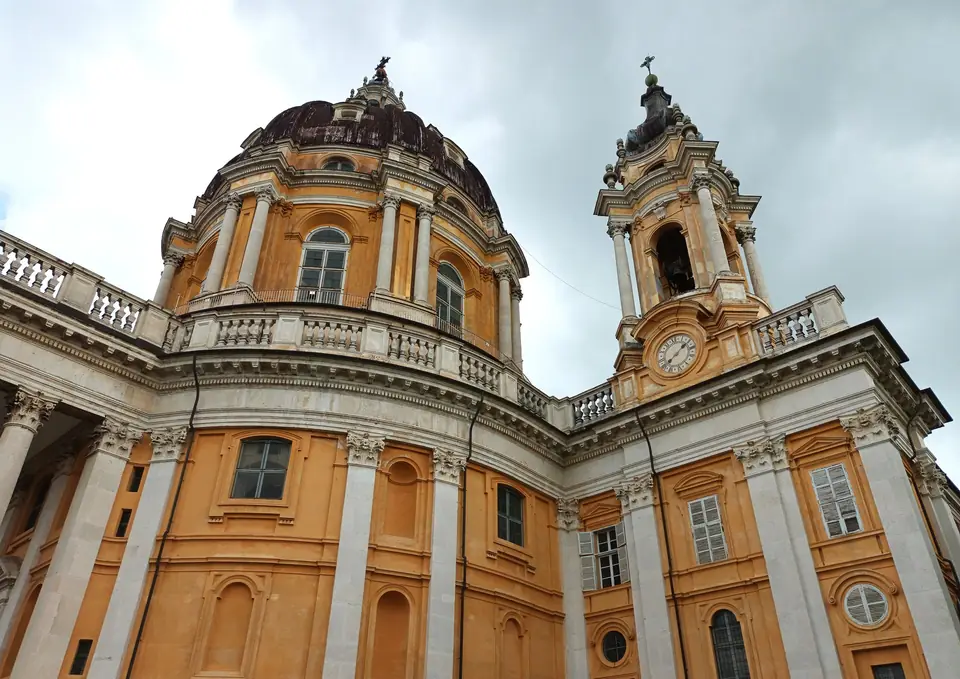
The Basilica of Superga crowns the hill of Turin and can be seen from all over the city. Its story begins in September 1706, with Turin besieged by the Franco-Spanish army: tradition says Duke Vittorio Amedeo II climbed up here with Prince Eugene of Savoy and promised a temple to the Virgin if he won. The victory of 7 September freed the city, and Filippo Juvarra designed a Baroque building with an eight-column Corinthian portico inspired by the Pantheon in Rome, two bell towers and a double-shell dome that lifts the complex to 75 metres.
Beneath the church opens the royal crypt of the Savoys, with funerary rules frozen in time; in the convent, a hall with the portraits of all the popes slips an antipope of the house in among them. And behind the building, the wall into which the Grande Torino's plane crashed in 1949 turns the hill into a place of pilgrimage every 4 May.
Highlights
- Artificial summit — about 100 workers lowered the hill by 40 metres in a year
- Double-shell dome — 131 steps up to the balcony over Turin and the Alps
- Chapel of the Vow — wooden Virgin of 1624 and more than a hundred thousand prayers a year
- Crypt of the Savoys — Carlo Alberto, immovable in the Hall of Kings since 1849
- Grande Torino plaque — memorial to the 31 victims of 4 May 1949
The story of the Basilica of Superga begins with a siege. On 2 September 1706, with Turin surrounded by the Franco-Spanish army, Duke Vittorio Amedeo II climbed this hill with Prince Eugene of Savoy and, according to the account recorded on the Latin plaque above the main door, promised on his knees to build a temple to the Virgin if he won. The battle of 7 September freed the city. Part of the historiography considers that vow on the summit a popular legend adopted in the 19th century, while other authors accept it, relying on 18th-century travellers and on the inscription itself.
What came afterwards is documented: in 1716 the old church was demolished and the hill was lowered, the first stone was laid on 20 July 1717 and Filippo Juvarra’s temple opened to the public on 1 November 1731 (formal consecration would come in 1749). Since then the history of the place has added a royal crypt, a gallery of popes, a residence that was never finished and the tragedy that in 1949 made Superga a shrine of Italian football. The audio guide covers it all in five stops, from the portico to the back wall.
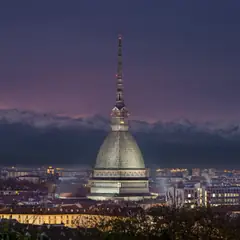
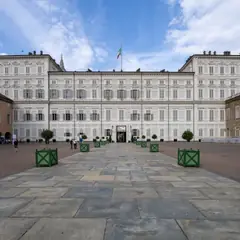
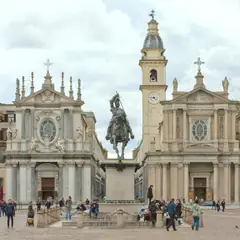
The siege that prompted the vow left cannonballs in the façades of Piazza San Carlo, and the Savoys who rest in the crypt reigned from the Royal Palace. Down in the centre, the other silhouette that defines Turin’s skyline is the Mole Antonelliana.
A hill made to measure for the temple
Basilica di Superga
Summary of this stop
The piazzale in front of the portico looks like a natural balcony over Turin, but it is not. To make room for Juvarra’s project, in May 1716 the church that occupied the summit was demolished and about 100 workers with picks, shovels and wheelbarrows lowered the hill by 40 metres in a single year. Building materials were piled at the foot of the climb, at the place that has been called Sassi, “stones”, ever since. From there today rises the Dentiera, the rack tramway that in 1934-1935 replaced the Agudio funicular of 1884: 3.1 km, 425 metres of climb and gradients of up to 21%, the only one of its kind in Italy.
The architecture of the Basilica of Superga can be read at a glance from here: the pronaos of eight Corinthian columns of Gassino marble, the two Borrominian bell towers and the great dome, built with two superimposed shells joined by arches to lighten the weight. A spiral staircase of 131 steps leads to the outer balcony, with a view over the city and the Alps.
Such visibility has given rise to a Piedmontese saying that turns the summit into a weather forecast, when Superga wears a hat of clouds. Collections classify it as a jest, and the exact joke of its false omen is revealed in the narration, in front of the façade.
Payment of a promise
Basilica high altar
Summary of this stop
Under the dome, facing the high altar, the building explains its own reason for being. The white Carrara marble high relief that Bernardino Cametti carved between 1729 and 1731 shows Blessed Amadeus of Savoy interceding before the Virgin for the victory of 1706, with Turin in the background and an angel representing France trying to snatch away the royal insignia.
Beside the presbytery, the Chapel of the Vow holds the oldest piece of the complex: the wooden statue of the Virgin of Graces, from 1624, a survivor of the small church demolished on the summit. According to tradition, the vow of 1706 was made before it. Every year more than a hundred thousand prayers from all over the world are placed in an urn in the chapel, and the narration explains what links that old image with the marble of the altar.
The crypt where no one moves
Hall of Kings
Summary of this stop
The royal crypt that Juvarra had planned under the presbytery was not built until 1774-1778, when Vittorio Amedeo III commissioned Francesco Martinez, the architect’s nephew, to turn the basement into a mausoleum. At the end of the stairway waits Carlo Finelli’s St Michael, placed in 1878 as guardian of the tombs, and in the centre of the Latin-cross plan opens the Hall of Kings, with Agostino Cornacchini’s Deposition group and the statues of Faith, Charity, Clemency and Science.
The hall had a rule: each dead sovereign occupied the central sarcophagus until the next displaced him to a side niche. Carlo Alberto, deposited in 1849, is still there because his successors were kings of Italy and were buried in the Pantheon in Rome. In the opposite arms of the crypt rest Vittorio Amedeo II and his son Carlo Emanuele III, at odds in life and separated in death too.
The rivalry of the Savoys did not end with the monarchy. Chronicles record that in 2004 Vittorio Emanuele of Savoy and his cousin Amedeo, Duke of Aosta, came to blows on leaving a dinner at the Zarzuela palace, and today both rest under this same basilica. How that last family quarrel ended here is told at the stop, among the tombs.
Popes, an antipope and a half-built palace
Sala dei Papi
Summary of this stop
From the convent cloister you enter the Sala dei Papi, the old refectory, where the portraits of all the pontiffs since St Peter hang in chronological order, antipopes included. Among them appears Felix V, who in civil life was Amadeus VIII of Savoy: the house’s ambition slips even into the Church’s gallery.
The contrast is a few steps away. By the end of 1730 the church and the collegiate residence were finished, but the royal apartments designed by Juvarra were never completed, and the part called “l’incompiuto” is still not open to visitors. Nor did the king of the vow see his temple inaugurated: Vittorio Amedeo II had abdicated in favour of his son in September 1730 and did not attend the opening of 1731. Why he was absent is one of the episodes the narration keeps for this hall.
The foggy afternoon of 1949
Grande Torino plaque
Summary of this stop
At the back of the basilica, the great retaining wall holds the most living memory of Superga. At 17:03 on 4 May 1949, with clouds almost at ground level and about 40 metres of visibility, the Fiat G.212 trimotor bringing the Grande Torino back from Lisbon crashed at 180 km/h into the embankment. All 31 people on board died, including every player of Italy’s five-time champion team. Different hypotheses are weighed about the cause, from crosswind during the turn to a blocked altimeter, and it is also debated whether the marks on the wall come from the impact or from an extension never finished.
A plaque remembers the victims and is a pilgrimage goal. Every 4 May a solemn Mass is held and the granata fans of Torino climb up to pay tribute to Valentino Mazzola’s team. By tradition, the club captain reads the names of the fallen aloud, one by one. In the year the pandemic prevented the usual ceremony, that reading was done in a very different way, and the story of that 2021 closes the route in front of the stone.