Historic market
Porta Palazzo Audio Guide
Turin's largest square bears the name of a gate that no longer exists and has been a market since the 1835 cholera brought it here. Almost two centuries later, it is still the first stop for everyone who arrives in the city.
- 45 min of audio
- Market and working-class neighbourhood
Porta Palazzo, Pòrta Pila to the people of Turin, occupies the 51,300 m² of piazza della Repubblica, an octagon laid out between 1825 and 1830 over the walls torn down in Napoleonic times. Its south entrance is a Baroque set piece by Filippo Juvarra, commissioned by Vittorio Amedeo II in 1729 and raised in only four years; around it are the masonry pavilions of 1836, the iron tettoia of 1916 and the glass building by Massimiliano and Doriana Fuksas.
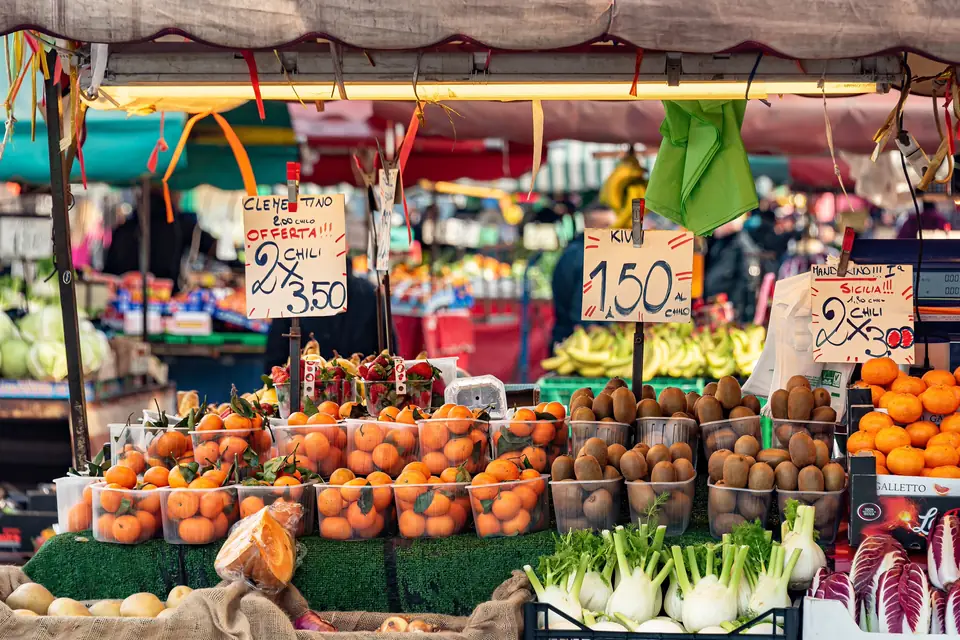
Every day 756 stalls are set up here on the traditional carts, 796 on Saturdays, when the market merges with the Balon of Borgo Dora. And under Fuksas's glass, the signature building that the traders themselves rejected, 19th-century icehouses appear where snow was pressed down to make ice.
Highlights
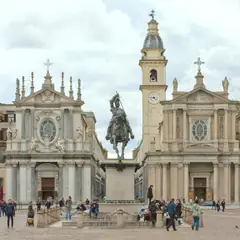
- Juvarra's façades — two Baroque blocks built between 1729 and 1733, with a frieze of bull skulls
- Piazza della Repubblica — 51,300 m², Turin's largest square, with 756 stalls a day
- Antica Tettoia dell'Orologio — Turin's only iron-framed market pavilion, from 1916
- 19th-century icehouses — openings for making ice from snow, visible under the Mercato Centrale
- Amare le differenze — Michelangelo Pistoletto's neon in 39 languages
Porta Palazzo is not a monument to be contemplated but a market to be crossed: Turin’s great daily market, in the city’s largest square. Its story starts with an epidemic, the cholera of 1835, which pushed the municipality to move the food stalls out of the centre and fix them here, two years before the square was finished. Since then piazza della Repubblica has added layers: Juvarra’s Baroque entrance, the pavilions of 1836, the iron tettoia of 1916 and, in the 21st century, a glass building that the market itself did not want.
It is often repeated that it is the largest open-air market in Europe, although no open source provides a measured comparison and some consider it a formula that Turin’s residents repeat with pride. What is documented is its role as a gateway: first for immigrants from the south of Italy, later for those who arrived from Africa and Asia. The story of Porta Palazzo, with its queens, strongmen and rogues, is best understood by walking the square with the audio guide, stop by stop.
The only medieval gate Turin preserves, the Porta Fibellona, still stands at Palazzo Madama, and about 500 metres to the south the Royal Palace holds another work by Juvarra, the Scala delle Forbici.
A gate without a gate on via Milano
Juvarra façades on via Milano
Summary of this stop
The route starts at the south entrance, on via Milano, in front of an absence: in the square that bears its name no gate remains. The name recalls the ancient Roman north gate of Julia Augusta Taurinorum, the Porta Principalis dextera, later called Palatina or “Comitale”. The “Palazzo”, according to the most widespread explanation, would refer to the neighbouring early medieval Casa del Senato, although not all sources agree and some derive the name only from the Roman gate. In Piedmontese the place is Pòrta Pila or Pòrta Palass.
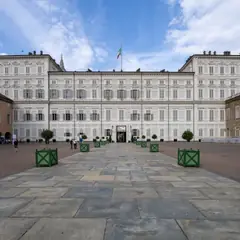
What marks the entrance today is a Baroque set piece. With the regio biglietto of 29 April 1729, Vittorio Amedeo II commissioned Filippo Juvarra to design the new northern entrance to the capital: two blocks of rental palaces, Santa Croce and Sant’Ignazio, with full-height pilasters and a frieze alternating bull skulls, a symbol of Turin, with classical motifs. They were built in only four years, between 1729 and 1733, after completely demolishing the medieval houses and with mostly Lugano-born workmen. In 1819 Gaetano Lombardi lengthened them to fit the new octagonal square.
In the Santa Croce block there also opens the Galleria Umberto I, a glass-and-metal arcade in the former halls of the Ospedale Mauriziano. And the nickname Pòrta Pila holds the first clue that here the market people are in charge; where that name comes from is revealed by the narration on the spot.
The cholera that brought the market here
1836 pavilions
Summary of this stop
In front of the fish pavilion you understand why this square is a market. The cholera of 1835 led the municipality to move the food markets out of piazza delle Erbe, today piazza Palazzo di Città, and piazza Corpus Domini, and to fix them here by an ordinance of 29 August 1835. The following year, engineer G. Barone designed the two masonry pavilions on the south of the square, intended, according to the municipal notice of 6 April 1836, to shelter from the weather not so much the sellers as the buyers.
Those two low buildings are still in use: Padiglione II houses the fish market, with 18 stalls, and V the food market, with 53. They also hold memories of the war: the air raids of late 1942, with attacks on 28 and 30 November and 8 December, hit the fish market, and Juvarra’s Santa Croce blocks suffered damage between December 1942 and August 1943.
This same corner was the stage, in the 1960s and 1970s, of the square’s most famous character: the “Maciste di Porta Pila”, an immigrant born in Catania who every Sunday morning became a fairground hero here. How a street act ended up in an Ettore Scola film is one of the scenes the audio guide reserves for this spot.
The liars’ market and its queen
Piazza della Repubblica
Summary of this stop
In the middle of the square you sense its scale. The octagonal shape was fixed between 1825 and 1830 on the line of the walls demolished in Napoleonic times; the square was completed in 1837 as piazza Emanuele Filiberto and only after the 1946 referendum was renamed piazza della Repubblica. At 51,300 m², split in two by corso Regina Margherita, it is Turin’s largest square, and every day 756 mobile stalls are set up in it on the traditional carts, rising to 796 on Saturdays, when the market merges with the Balon, the second-hand flea market of neighbouring Borgo Dora.
That haggling energy has precedents. Outside the pavilions a spontaneous market grew of farmers selling directly, joined by craftsmen and sellers of goods of dubious origin. Turin’s people called it “l mercà dij busiard”, the liars’ market, and it thrived on its prices; in the late 1920s, part of those stalls moved indoors.
The neighbourhood even had its own monarchy. In 1902, the election of the first “Miss Torino” was held only among the women of Porta Palazzo, and for the occasion the district proclaimed itself an autonomous kingdom, with borders of flower arches. That tradition of the market queen lasted for decades, and the story of its queens, with anthems and unexpected coronations, is told in full at this stop.
The date of 1916 on the iron
Antica Tettoia dell'Orologio
Summary of this stop
In the north-east sector stands the Antica Tettoia dell’Orologio, built in 1916 as “Padiglione IV”, with its clock and the date inscribed above the entrance. It is Turin’s only iron-framed market pavilion; it received its present name in the 1995-1998 renovation and holds 88 numbered food stalls.
That date has its own story told in the neighbourhood: it is said that, with Europe in full war and the steelworks busy making weapons, only a small workshop in Borgo Dora kept working for the city and built this roof to sell fruit. It is a popular tale rather than a verified fact, but it explains the affection with which the inscription is regarded.
The iron and the light tell the same thing here. From the 1960s, Porta Palazzo was the first arrival point for immigrants from the south of Italy and, on Sundays, the place where labourers were recruited for construction; from the 1980s a new wave arrived, mostly from Africa and Asia. Since 2005, the façade of the covered market has carried “Amare le differenze”, Michelangelo Pistoletto’s neon work for Luci d’Artista that writes the phrase in 39 languages as a message of peace, restored in 2020 and most visible as evening falls.
Fuksas’s glass over the icehouses
Mercato Centrale Torino
Summary of this stop
On the north-west side, where the 1963 clothes market stood until its demolition in 1998, Massimiliano and Doriana Fuksas built a glass volume in superimposed layers on steel uprights, finished in 2005. Its start was bumpy: a Chocolate Museum was considered, it hosted exhibitions and fell into disuse until opening as Centro Palatino on 25 March 2011 and as Mercato Centrale on 13 April 2019. Dates of the work vary by source.
Why the market turned its back on it also has no single answer. Some blame rents too high for traders and a use never well defined; Franco La Cecla points to the architect’s intransigence, who, when asked for sliding doors to let the crowd through, replied that nothing should disturb his work, and to a panoramic restaurant without gas pipes.
Under the glass waits the counterpoint. The 2002 excavations brought to light underground 19th-century icehouses: two rectangular bodies, an annular corridor and two circular openings where snow was pressed down through ceiling hatches to make ice, with a sloping floor to drain the water. Some of those openings remain visible in the central space of the building, and the end of the route reveals what that humble machinery of cold says about the whole square.