Savoy Baroque
Piazza San Carlo Audio Guide
Turin's “salotto” looks like a perfect square, but it is a stage rewritten over centuries: a regent's drawing room, a parade ground, a café for conspirators and a firing range, with bullets from 1706 still in the walls and a bronze duke sheathing his sword.
- 30 min of audio
- Baroque arcaded square
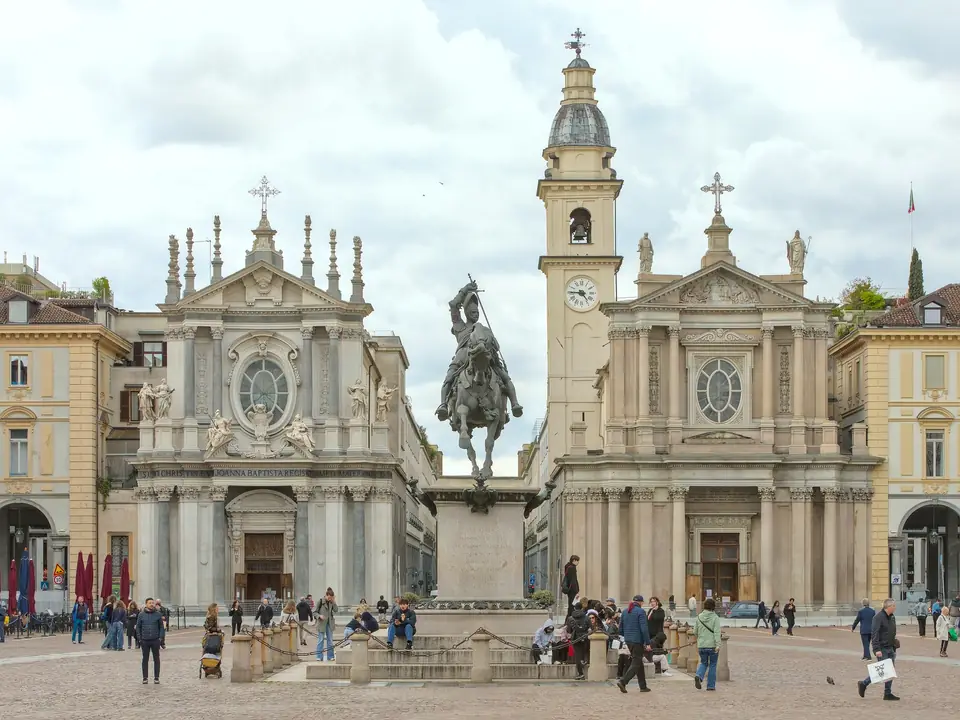
Piazza San Carlo was born between 1618 and 1638 in the southern extension laid out by Carlo di Castellamonte and was inaugurated by Madama Cristina of France as Piazza Reale. Its 168 by 76 metres of porticoes of a single design, built in 1643-1646, unify palaces of different owners and make it the great arcaded square of Savoy Baroque. At the far end, two almost twin churches close the perspective like a curtain.
Around 1650 the court's drawing room filled with troops and was renamed Piazza d'Armi. Centuries later, the same space saw the shooting of September 1864, the 2017 stampede during a Champions League final and, on title nights, Juventus fans climbing the bronze horse of the duke who symbolises peace.
Highlights
- Caval ëd Bronz — Emanuele Filiberto sheathes his sword, a work by Marochetti previously shown at the Louvre
- Cannonballs from the 1706 French siege embedded in the façades
- Caffè San Carlo — opened in 1822, a haunt of Risorgimento patriots
- Brass bull outside Caffè Torino, stepped on by Turin's residents for good luck
- Santa Cristina and San Carlo — two twin churches with façades more than a century apart
The story of Piazza San Carlo begins in 1638, when Madama Cristina of France, widow of Victor Amadeus I, inaugurated in Carlo di Castellamonte’s southern extension a Piazza Reale conceived as a showcase for the court. Since then the square has changed its name and its job more than once: it was Piazza d’Armi, it was the “salotto” of Turin’s cafés and only in time took the name of St Charles Borromeo, although the exact date of that christening is still disputed among local sources. Beneath its impeccable symmetry lie cannonballs, bloody protests, stadium celebrations and a backdrop that took two centuries to complete.
The architecture of Piazza San Carlo reads like a story told in layers, and the audio guide walks it from north to south, from the bronze horse in the centre to the porticoes on the west, the scarred corners and the two churches at the far end, with narration researched and checked against historical sources.
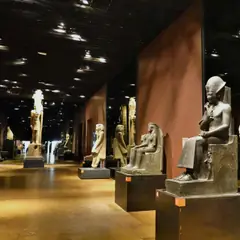
The siege of 1706 that left its bullets in these walls ended with the vow that raised the Basilica of Superga, and less than 200 metres away the Egyptian Museum holds the intact tomb of Kha and Merit.
A royal drawing room that filled with soldiers
Castellamonte porticoes
Summary of this stop
The entrance from via Roma suddenly opens up the perspective: two long rows of arcades that look like a single palace. They are not. Castellamonte’s porticoes, built between 1643 and 1646, a few years after the square was inaugurated, impose a single 17th-century design on palaces of different owners, a court façade placed in front of private houses.
That showpiece salon did not last long. Around 1650 the square became a place of passage and assembly for troops between Piazza Castello and the Cittadella, until it was renamed Piazza d’Armi, a military function it kept until the mid-18th century. Strollers did not fully regain the space until 2004, when the works begun in 1998 ahead of the 2006 Winter Olympics ended and the square became a porphyry-paved pedestrian island.
Those works had their own surprise: digging the underground car park turned up Roman remains, a bridge from the time of Emanuele Filiberto and an air-raid shelter. What those finds tell about the square’s subsoil is left for the narration on site.
The duke who sheathes his sword
Caval ëd Bronz
Summary of this stop
In the centre stands the Caval ëd Bronz, the equestrian monument to Emanuele Filiberto of Savoy by Carlo Marochetti. It was commissioned by King Charles Albert, first exhibited in the courtyard of the Louvre in Paris and inaugurated in the square on 4 November 1838, the feast of St Charles Borromeo. The duke, in a plumed helmet, sheathes his sword after the victory of Saint-Quentin in 1557 and reins in the rearing horse: a gesture of peace, not of conquest.
On the granite pedestal, two bronze reliefs narrate the battle of Saint-Quentin and the Treaty of Cateau-Cambrésis. During the Second World War the statue sat out the bombings enclosed in a bulky wooden frame, while the neighbouring Palazzo Solaro del Borgo, seat of the Accademia Filarmonica, was hit by bombs in 1942 and 1943.
The contrast comes on title nights: the square is the traditional place where Juventus fans go to celebrate, and the party even climbs the horse itself. How the duke’s peace and the bianconeri chants meet on this pedestal is told at the stop.
Conspirators’ cafés and a lucky bull
Caffè Torino
Summary of this stop
The west portico is the city’s true drawing room. There, in Palazzo Turinetti, the Caffè San Carlo opened in 1822 under the name Caffè di Piazza d’Armi. It became a meeting point for Risorgimento patriots, and the authorities closed it several times on suspicion of subversive activity. It is also often credited with pioneering gas lighting, in Italy or even in Europe depending on the version, although neither claim comes with a document that pins it down.
Damaged in the war, the café stayed closed from 1953 to 1963 for a long restoration that recovered the original stuccoes and ceiling frescoes lost in the bombings. Its rooms with statues and painted ceilings still keep that air of a 19th-century salon.
A few steps further on, in front of the entrance of Caffè Torino, a small rampant brass bull, symbol of the city, gleams in the pavement, set there by the Comune in 1930. Stepping on its “attributes” is a Turin good-luck ritual.
Bullets from 1706 and the forgotten massacre
1706 cannonballs
Summary of this stop
Near the corner with via Alfieri, dark spheres poke out of the walls. They are cannonballs linked to the French siege of 1706, which lasted 117 days and in which the square took at least three shots: one over an arcade of Palazzo Solaro del Borgo and two beside upper windows. The most widespread version presents them as impacts that stayed lodged; another holds they were deliberately walled in as a memento, mixing projectiles of 1706 and 1799.
The salon square was also a firing range. On the night of 22 September 1864, during the protests over moving Italy’s capital to Florence, carabinieri cadets fired on the crowd and hit an infantry battalion that returned fire. The toll is still disputed: some speak of 184 dead, although that figure seems to add dead and wounded, and the detailed reconstruction gives 47 dead in this square. According to the documented tradition, a royal decree of 1865 sought to draw “the veil of oblivion” with a full amnesty, and the municipal plaque did not come until 1999, with a victim count that falls short.
Another plaque recalls 3 June 2017, when during the screening of the Champions League final between Juventus and Real Madrid an attempted theft and a loud bang set off a stampede with three dead and at least 1,672 injured. Why the 1864 plaque counts fewer dead than there were is explained beside the walls.
Two twin churches that were not twins
Façades of Santa Cristina and San Carlo
Summary of this stop
At the far end, Santa Cristina and San Carlo close the square like two theatre wings. They look like twins, but they were not born that way: San Carlo was begun in 1619 and Santa Cristina in 1639, both without façades. Madama Cristina bought the land that year to build Santa Cristina in memory of her firstborn, Francesco Giacinto of Savoy, recently deceased, wanted a Discalced Carmelite convent next to it and was buried in this church in 1674.
The symmetry is a late backdrop. Filippo Juvarra gave Santa Cristina its Baroque façade of two orders, curved centre and large oval window, crowned with statues, in 1716; San Carlo, the one with the bell tower, did not receive its own until 1835, when Ferdinando Caronesi copied the model. According to tradition, the great atlas of the Savoys, the Theatrum Sabaudiae of 1682, already drew them with rich façades that did not yet exist.
Above the last stretch of porticoes before San Carlo lived from 1773 a young Vittorio Alfieri, who at 24 rented a flat in the palace of the Avogadro di Collobiano counts and wrote his first tragedies there between 1774 and 1777. How that playwright fits into a square that works like a stage is the close of the route.