Symbol of Turin
Mole Antonelliana Audio Guide
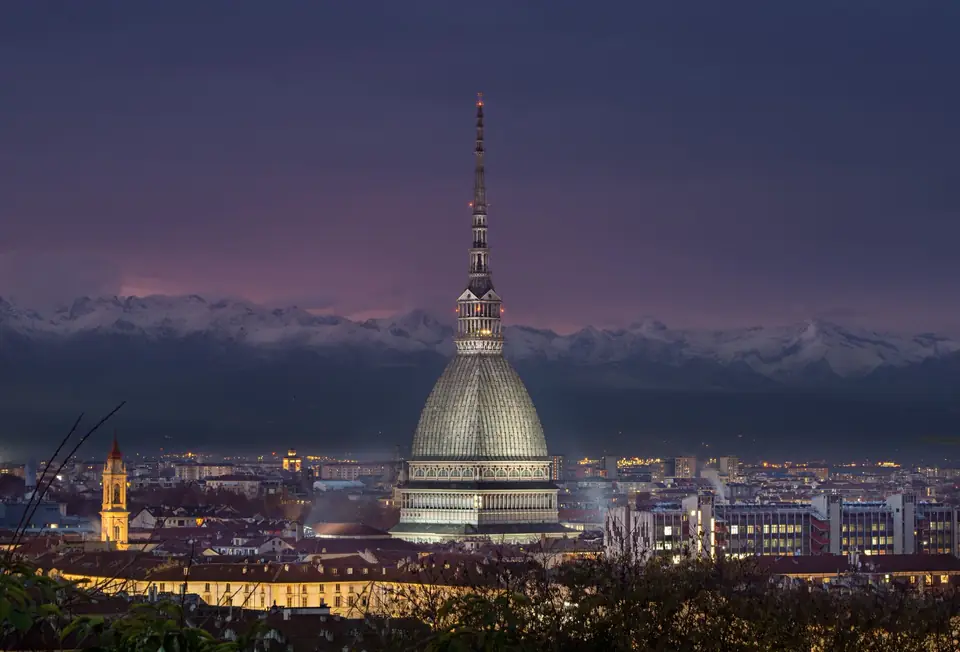
It was meant to be a 47-metre synagogue and ended up nearly 167 metres tall: the Mole Antonelliana is one architect's obstinacy turned into the skyline of Turin, with the National Museum of Cinema inside and a terrace 85 metres up.
- 90 min of audio
- 19th-century architecture
The story of the Mole Antonelliana begins in 1848, when the Albertine Statute emancipated Turin's Jewish community, which then commissioned Alessandro Antonelli to build a synagogue with a school. The 1862 project called for 47 metres; Antonelli kept stretching it mid-construction until the community, out of funds, withdrew and the Comune kept the building to dedicate it to Victor Emmanuel II. Its architecture, a square-based dome crowned by a small temple, a lantern and a spire, made it the most recognisable profile in the city.
Beneath that seemingly eternal silhouette lies a story of fragility: the great dome is a double brick shell with walls only 12 centimetres thick, a storm toppled the statue on the summit in 1904 and a cloudburst snapped the spire in 1953. And yet no building in Turin has dared to surpass it.
Highlights
- Square-based dome — a double brick shell 12 cm thick between roughly 40 and 80 metres up
- Glass panoramic lift — 59 seconds hanging from cables through the dome's central void
- Tempietto terrace — a viewpoint 85 metres above Turin and the Alps
- Aula del Tempio — the former temple hall, now the heart of the National Museum of Cinema
- Original Winged Genius — the gilded statue that crowned the Mole from 1889 to 1904, kept inside
The Mole Antonelliana was not designed to become the symbol of Turin. In 1862 the city’s Jewish community, emancipated since 1848 by the Albertine Statute, commissioned Alessandro Antonelli to build a synagogue with a school on the old Contrada del Cannon d’Oro, today’s via Montebello. The building authorised in March 1863 was to be 47 metres tall. What came out of that commission, after decades of work, a change of owner and two collapses of the summit, is a tower of about 167 metres that now houses the National Museum of Cinema.
The story of the Mole Antonelliana is also the story of its architecture: a brick dome so thin it seems impossible, a small temple with a panoramic terrace, a lantern and a spire rebuilt in metal. The route, researched and checked against historical sources, covers the building from street to terrace in five stops and 90 minutes of audio.
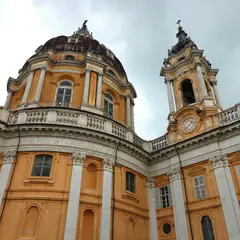
The same Albertine Statute of 1848 that emancipated the Jewish community gave life to the Subalpine Senate, which met in Palazzo Madama. Alongside the cinema in the Mole, the city’s other great museum is the Egyptian Museum, and the other silhouette on Turin’s skyline crowns the hill: the Basilica of Superga.
A spire that lost its head twice
Mole spire
Summary of this stop
From via Montebello, the spire reads as a stack of ever smaller little terraces topped by a star. It was not always so. On 10 April 1889 the Winged Genius was placed on the summit, a figure of embossed, gilded copper weighing about 300 kilos, designed by Celestino Fumagalli as an emblem of the House of Savoy; with it the Mole reached about 167 metres and was completed ten days after the Eiffel Tower. Turin’s residents still call it “the angel”, though it is not one.
On 11 August 1904 a storm knocked it down, and the statue ended up balanced on the lower little terrace, without falling into the street or causing casualties; today it is kept inside the building. Almost half a century later, on 23 May 1953, a burst of rain and wind snapped about 47 metres off the spire, which fell into the garden of the RAI headquarters, very close to Piero Angela’s window.
Between the two episodes, the Mole had already seduced a famous visitor: Friedrich Nietzsche, who lived in Turin in 1888, described it in a letter as perhaps the most brilliant architectural work ever built. The name he said he had given it is revealed in the narration, at the foot of the spire.
A 47-metre synagogue that got away
Mole Antonelliana
Summary of this stop
The pronaos on via Montebello, with six columns of Baveno granite, preserves the language of the temple the building was meant to be. Here the narration tells how a modest project slipped out of everyone’s hands: Antonelli changed the plans mid-construction until they reached 113 metres, and in 1869 the Jewish community, out of funds and unhappy, stopped the works and covered the building with a temporary flat roof at about 70 metres.
The initial budget was 250,000 lire; by 1876, 692,000 had been spent and the building was still far from finished. The community withdrew and the Comune of Turin took over the works in exchange for money and a plot outside Porta Nuova, where in 1884 Enrico Petiti’s new synagogue was completed. The exact date of the handover varies by source, between 1873 and 1878. The Mole was then dedicated to Victor Emmanuel II.
A hollow temple full of cinema
Aula del Tempio
Summary of this stop
In the middle of the Aula del Tempio, the former hall intended for prayer, visitors find red chaise longues facing screens, themed chapels around the edges and a spiral ramp rising towards the dome. Above, the great square-based vault, which spans roughly 40 to 80 metres in height, is a self-supporting double brick shell with walls only 12 centimetres thick, separated by a cavity of about 2 metres. The interior staircase of the walking visit now climbs through that hollow.
The space had another life before: on 18 October 1908 it became the home of the Risorgimento Museum, for which Annibale Rigotti completed the decoration of the hall and the dome, until the museum moved to Palazzo Carignano in 1938. The National Museum of Cinema opened here in August 2000, after a restoration from 1996 to 1999. Its origin lies in the collection of Maria Adriana Prolo, and the place where she kept it during the bombings of 1942 is part of what the audio guide reveals at this stop.
Fifty-nine seconds hanging in the void
Panoramic lift
Summary of this stop
The panoramic lift is a glass-walled cabin hanging from four steel cables that rises in 59 seconds through the central void of the dome, with no fixed guides in sight, up to the Tempietto terrace at 85 metres. It was renewed in 1999. The contrast with the past is stark: according to the story, Antonelli, almost ninety by then, would go up several dozen metres on a rudimentary pulley-driven hoist to inspect the works in person.
The architect, born in Ghemme in 1798, directed the construction until his death in October 1888; the spire was finished by his son Costanzo and his pupil Crescentino Caselli in early 1889. On this ascent you also meet a custom of Turin’s university students, which many respect until the day of their graduation and which the museum itself has ended up turning into a celebration.
The height no one dares to surpass
Tempietto terrace
Summary of this stop
The Tempietto terrace looks out over the rooftops of Turin and, in the distance, the Alps. The Mole still sets the city’s symbolic ceiling: the Intesa Sanpaolo skyscraper, designed by Renzo Piano, was drawn at 166 metres, one less than it. Above the terrace, the spire seen today is the one rebuilt between 1955 and 1960 with a metal frame clad in stone and a three-dimensional 12-pointed star 2.4 metres across, a work directed by engineer Giuseppe Perottino; it was inaugurated on 31 January 1961, the centenary of Italian unification, with lighting by Guido Chiarelli.
From up here you can also see the hill of Superga, tied to the tragedy of the Grande Torino on 4 May 1949. Every year, on that night, the Mole changes colour in their memory: the why and how of that ritual close the route at the very top.