Two thousand years in one building
Palazzo Madama Audio Guide
A Roman gate, a medieval castle and a Baroque palace that was never finished, nested one inside another in the middle of Piazza Castello. In its great hall Turin was governed as a capital until the day it voted to stop being one.
- 75 min of audio
- Roman, medieval and Baroque
The story of Palazzo Madama begins in the 1st century AD, when the building was the east gate of Augusta Taurinorum, flanked by two sixteen-sided towers. On it the Acaja built a brick castle with four cylindrical towers, the Madame Reali turned it into a residence and Filippo Juvarra put a white-stone Baroque façade in front of it. Since 1934 it has housed the Museo Civico d'Arte Antica, with about 75,000 works spread over four floors.
The architecture of Palazzo Madama holds a paradox: the most spectacular façade on the square is only the first piece of a palace that stopped in 1721. A German traveller summed it up in 1731 with a phrase repeated by Grand Tour guidebooks: before, it was a residence without a staircase; afterwards, a staircase without a residence.
Highlights
- Juvarra's façade and grand staircase (1718-1721), the only part built of an unfinished palace
- Sixteen-sided Roman towers of the old gate of Augusta Taurinorum
- Sala del Senato: seat of the Subalpine Senate from 1848 until the 1864 vote that moved the capital to Florence
- Porta Fibellona, the only medieval gate of Turin to survive
- The staircase down which three Minis drive in The Italian Job (1969)
Few buildings in Europe stack so many eras in so little space. Palazzo Madama stands like an island in the middle of Piazza Castello, and each of its sides tells a different century: towards Via Garibaldi, Juvarra’s Baroque façade; towards Via Po, the towers of the Roman gate and the brick castle that Ludovico of Acaja rebuilt in the early 15th century. In between lie a monumental staircase, the hall where the Subalpine Senate met in 1848 and a medieval moat turned into a garden.
The story of Palazzo Madama is also the story of Turin as a capital: home to two regents, refuge for the royal artworks during the French siege of 1706, saved from demolition under Napoleonic rule, an astronomical observatory for almost a century and, since 1934, a museum of ancient art. The complete route, in five stops with narration researched and checked against historical sources, runs from the outside in and from top to bottom, like excavating layer by layer.
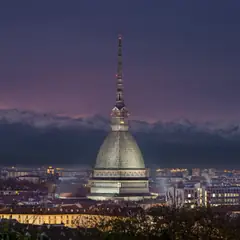
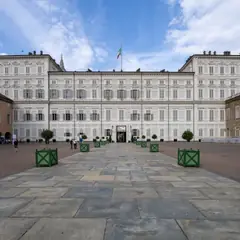
Opposite rises the Royal Palace, seat of the Savoy court for three centuries, and to the north the square of Porta Palazzo takes its name from another city gate, this one long gone. The Albertine Statute that gave life to the Subalpine Senate in 1848 also emancipated the Jewish community that commissioned the Mole Antonelliana.
The façade of a palace that doesn’t exist
Piazza Castello
Summary of this stop
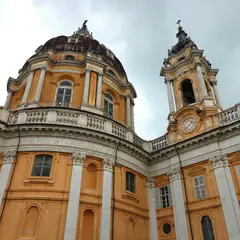
From Piazza Castello, the west façade looks like that of a grand palace: rusticated base, giant columns and pilasters, very tall windows and a balustrade crowned with white marble statues and vases. Filippo Juvarra designed it in 1716 for the second Madama Reale, Marie Jeanne Baptiste of Savoy-Nemours, as the beginning of a new palace that was to wrap entirely around the old castle. Works stopped in 1721 with only the front block finished: behind that façade there is no Baroque palace at all.
The central balcony has been the stage for crowds. According to the chronicles, on 21 May 1815 Pope Pius VII held up the Sindone there before the square, a scene repeated in 1842 for the wedding of Victor Emmanuel II, and in May 1961 Queen Elizabeth II and Prince Philip came out to greet a cheering crowd. In May 1949, after the Superga tragedy, the players of the Grande Torino lay in state in this building, and their funeral procession set out amid hundreds of thousands of people. The narration at this stop reveals what links a pope, a queen and a football team on the same balcony.
Roman towers that became castle and prison
Roman towers and Acaja casaforte
Summary of this stop
The rear reads like a geological cross-section. In the 1st century AD the east gate of Augusta Taurinorum opened here: two sixteen-sided towers flanking four arches, two for carts and two for pedestrians, similar in size and shape to the Porta Palatina. Its Roman name is still disputed: many texts call it Porta Decumana and part of the historiography identifies it as Porta Praetoria. On top, the square castle of the Acaja, with courtyard, portico and cylindrical corner towers, is still recognisable.
The towers keep a less pleasant memory than that of court festivities. The Acaja treasurer’s books record at the end of the 14th century that they housed prisoners, and for a long time they served as a jail. According to tradition, in this castle Amadeus VI, the Green Count, negotiated the 1381 peace between Venice and Genoa. Under French rule the gallery linking it to the Royal Palace was demolished and the demolition of the whole castle was even considered, which sources date to 1801 or 1802; Napoleon’s opposition saved it. What that void on the north side, where nothing remains of the gallery, says is told by the audio guide beside the towers.
The staircase left without a palace
Juvarra's grand staircase
Summary of this stop
The atrium of the grand staircase is a lantern of light and echo: two facing ramps rise towards the piano nobile under a vault more than twenty metres high, and the large glass panes that close what Juvarra conceived as an open loggia let the staircase be seen from the square. Built between 1718 and 1721, it is the piece that inspired Carl Ludwig von Pöllnitz’s paradox in 1731: a residence without a staircase turned into a staircase without a residence.
The staircase also has a film life. In 1969, in a scene of The Italian Job, directed by Peter Collinson and starring Michael Caine, three coloured Minis race down these ramps. And legend has it that the ghost of Madama Cristina, the first Madama Reale, about whom the court whispered tales of vanished lovers, greets visitors from here. The narration reviews that rumour and the detail that casts doubt on it.
The hall where Turin stopped being capital
Sala del Senato
Summary of this stop
The Sala del Senato was born from a medieval courtyard. Christine of France, daughter of Henry IV and regent after the death of Victor Amadeus I, chose the castle as her permanent residence around 1638 (some sources say 1637) and had the courtyard covered over to a design by Carlo di Castellamonte. This is how the great hall on the first floor came about, with its Doric columns, the personifications of the Savoy provinces and a large scroll in gold letters on a black background.
On 8 May 1848, with the king at war with Austria, the Subalpine Senate was inaugurated here, later the Italian Senate. On 2 April 1860 Victor Emmanuel II opened in this hall the first Parliament of northern and central Italy, but seats were lacking, and the first Parliament of the Kingdom of Italy met in 1861 in Palazzo Carignano. The last session, on 9 December 1864, approved moving the capital to Florence. Ernesto Melano’s tiered seating, dismantled in 1927, was reinaugurated on 18 March 2011; how it was recovered is part of this stop’s story.
Turin’s last medieval gate
Porta Fibellona arch
Summary of this stop
The route ends in the deepest layer. From the staircase that descends to the moat, beside the south tower, the round arch of the Porta Fibellona appears, opened between 1225 and 1260 when the Roman arches were closed: it is the only medieval gate of Turin to have survived the city’s expansion. At the foot of the towers stretches the medieval garden opened in 2011, and on the way to the exit remains of the Roman wall come into view.
The Museo Civico d’Arte Antica now arranges the eras by floor: medieval lapidary in the moat, Gothic and Renaissance on the ground floor, Baroque on the first floor and decorative arts on the second. And on top of the Roman towers, from 1822 until its demolition in 1920, stood the dome of Giovanni Plana’s astronomical observatory. The audio guide ends the visit looking upwards, towards that sky an astronomer studied for a century from a Roman gate.