Mughal mausoleum
Tomb of Itimad-ud-Daulah Audio Guide (Baby Taj)
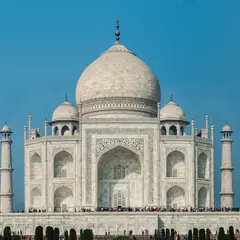
A white marble jewel box inlaid with coloured stones, on the banks of the Yamuna, which Empress Nur Jahan raised for her Persian parents. It was finished before the first stone of the Taj Mahal was laid.
- 45 min of audio
- Marble and hard-stone inlay
Between 1622 and 1628, Empress Nur Jahan turned the garden of her father, Mirza Ghiyas Beg, into a mausoleum for him and for her mother, Asmat Begum. The result is usually considered the first Mughal mausoleum clad in white marble with inlay across its entire facade: the link between the red sandstone of the tombs of Humayun and Akbar and the marble of the Taj Mahal.
Behind so much delicacy lies the story of a family of Persian emigrants who reached Agra after being attacked by bandits and ended up at the summit of the empire. The daughter who clothed her parents' tomb in marble and hard stones asked for herself, in Lahore, a sandstone burial without lamp or rose.
Highlights
- Makrana marble facades with carnelian, jasper, lapis lazuli, onyx and topaz
- Cypresses, wine bottles, sliced fruit and vessels topped with duck heads
- The couple's cenotaphs, the only asymmetrical element of the complex, as in the Taj
- Central chamber with flowers painted in red, the colour of mourning in Persian poetry
- Red sandstone pavilion overlooking the Yamuna
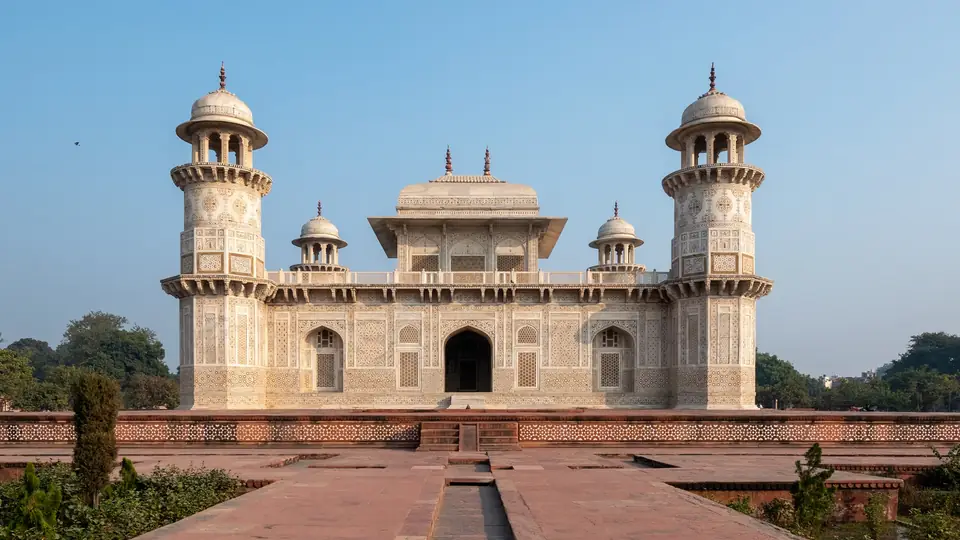
On the eastern bank of the Yamuna, outside the old walls of Agra, stands a small mausoleum without a great dome that is often presented as the Baby Taj. The nickname misleads: it is not a miniature copy of the Taj Mahal but its precursor. Empress Nur Jahan had it built between 1622 and 1628 for her parents, Mirza Ghiyas Beg, who held the title I’timad-ud-Daulah (“Pillar of the State”), and Asmat Begum. It was finished four years before work began, a few kilometres away, on the tomb of Mumtaz Mahal, Ghiyas Beg’s granddaughter.
The story of Itimad-ud-Daulah is that of a Persian family who fled their land around 1576, were attacked by bandits on the road and found refuge at Akbar’s court. Four decades later, the daughter born on that journey was empress, and the father, prime minister of the whole empire. The architecture of Itimad-ud-Daulah tells that rise in Makrana marble and hard stones, and the audio guide covers it in four stops, from the garden gate to the pavilion over the river, with an account that is documented and checked against historical sources.
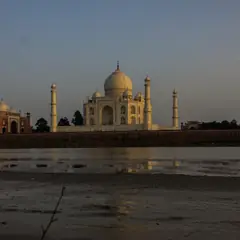
Its inlaid marble anticipates that of the Taj Mahal, the mausoleum of Nur Jahan’s niece; on this same bank of the Yamuna, downriver, lies the garden of Mehtab Bagh, and across the river, the Jama Masjid of Princess Jahanara.
A family garden turned into a tomb
Eastern red sandstone gate
Summary of this stop
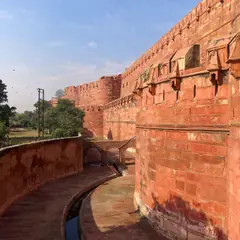
The main entrance is an eastern red sandstone gate with geometric motifs and niches inlaid in white marble that draw vessels, fruit stands and flowers. The north and south gates of the enclosure are false: they were raised only for symmetry. On the other side appears a charbagh, a garden divided into four quadrants by raised stone causeways with water channels in the middle.
That garden had belonged to Ghiyas Beg himself, and there lies much of its charm: it was not born as a state monument but as a family estate turned into a tomb. Its present appearance also has a history. Under British rule, the garden, reduced almost to farmland, was levelled and covered with English lawn. A four-year project by the Archaeological Survey of India and the World Monuments Fund, concluded in January 2019, replanted flower beds and fruit trees and installed a system that treats the groundwater of the enclosure itself. What the narration reveals beneath this gate changes the way the whole complex is seen.
Hard stones, wine and a scent of rose
Inlaid marble facade
Summary of this stop
On a red sandstone platform with four pools, the white marble facade reveals itself up close as a catalogue of stones: carnelian, jasper, lapis lazuli, onyx and topaz form cypresses, wine bottles, sliced fruit and vases with bouquets. On some vessels small duck heads peek out, and inside appear fish, felines, birds and deer, something exceptional in a Mughal mausoleum, with Jahangir’s tomb in Lahore as almost the only parallel. Carved marble lattice screens close the openings and four corner towers topped by small domed pavilions frame the complex.
It is here that the skin of the Taj Mahal was rehearsed: a total cladding of inlaid marble that the Mughals had not applied before to an entire facade, although the exact extent of that primacy is still debated. And among so many flower vases fits an episode that Jahangir himself wrote down: Asmat Begum, the woman buried in this tomb, saw a foam form on the rose water she was preparing, and from that came atr-e jahangiri, the perfume that the emperor presented as the discovery of his reign. How he rewarded it and who ended up taking the credit is left for the stop.
A family saga beneath red flowers
Cenotaphs of Ghiyas Beg and Asmat Begum
Summary of this stop
The central chamber, accessible only from the south, holds the cenotaphs of Ghiyas Beg and Asmat Begum, placed side by side. It is the only asymmetrical element in the entire complex, the same arrangement that will be repeated in the Taj Mahal. The flowers painted on the walls are predominantly red, a colour associated with suffering and death in the family’s Persian literature. In the four corner chambers lie other relatives, including a brother and a sister of Ghiyas Beg.
Asmat Begum died in Agra in October 1621 and her husband a few months later. Nur Jahan, rich from her business and her lands and heiress to her father’s fortune, built the tomb with no budget limit. But the story that weighs in this room begins much earlier, in Kandahar, where the future empress was born during the exodus from Persia. A legend, with no historical backing, says that ruined parents left the newborn there at the roadside and that, on returning for her, they found her protected by a snake. The end of that tradition, and what it means to read it before these two cenotaphs, is reserved for the narration in the chamber itself.
From the river to the granddaughter’s Taj
Pavilion over the Yamuna
Summary of this stop
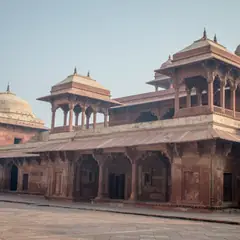
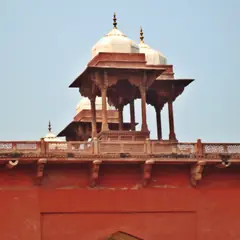
To the west, a red sandstone pavilion overlooks the Yamuna. It was conceived as a place of leisure and as a river access, and it also carries animals in its decoration. From here the family’s arc closes: after Nur Jahan’s wedding to Jahangir in 1611, Ghiyas Beg became prime minister and around 1615 reached the rank of 6,000 men with standard and drums, an honour reserved for princes. His granddaughter Mumtaz Mahal would later rest in the Taj Mahal, whose architecture is anticipated by the reticulated vaults, the gallery ceilings and the inlaid marble of this tomb.
The final contrast comes from Lahore. The daughter who clothed her parents’ mausoleum in marble died in 1645 and was buried in a red sandstone tomb, with an epitaph asking that there be neither lamp nor rose upon her. What happened afterwards to that burial, and why it changes the meaning of this marble jewel box, is told with the water of the Yamuna in front.