Mughal mausoleum
Akbar's Tomb Audio Guide
A red sandstone pyramid that was never closed at the top holds the great emperor Akbar in Sikandra: plundered in 1688, dismantled for auctions in London and rebuilt in 1905, it tells the story of a father and a son with a guilty conscience.
- 60 min of audio
- Mughal architecture
On the outskirts of Agra, in Sikandra, the mausoleum of Emperor Akbar rises at the centre of a charbagh of some 48 hectares. His son Jahangir redesigned it in 1608 with new architects, finished it around 1612-1613 after seven years of work and paid 15 lakh rupees for it. The calligrapher of its Persian inscriptions would later write those of the Taj Mahal.
The marble tomb on the upper terrace is still open to the sky: the cover that the traveller William Finch saw announced in 1611 was never built. And among its carved verses appears a phrase with a double reading, "Allahu Akbar", which, depending on who read it, praised God or the emperor himself buried below.
Highlights
- South gate: four white marble minarets that predate those of the Taj Mahal
- Charbagh of some 48 ha: lawns roamed by herds of blackbuck
- Truncated red sandstone pyramid: upper terrace without a dome and a cenotaph open to the sky
- Dim crypt: marble sarcophagus emptied by the Jat plunder of 1688
- Gilded vestibule: paintings some 400 years old, propped up since 2024
In October 1605, Jahangir shouldered one of the four corners of the bier of his father, Emperor Akbar, as it left through the gates of Agra Fort; his three sons carried the other three. The procession continued to Sikandra, where Akbar was buried and his son kept seven days of mourning beside the tomb. Who began the mausoleum remains in dispute: the widespread tradition, reported by the official websites of the district and of Uttar Pradesh, says that Akbar began it in his lifetime, while historians such as Nandalal Chatterji and S. K. Banerji maintain, on the basis of Jahangir’s memoirs, that it was his work from start to finish.
What is not disputed is the result: a building unlike any other Mughal monument, a truncated red sandstone pyramid left unfinished, which the Jat rebels plundered in 1688, from which pieces were torn out to be auctioned in London and which Viceroy Curzon rebuilt in 1905. What to see at Akbar’s Tomb, what its history is and how to read its architecture: the audio guide route advances from the south gate to the crypt, with a narration that is documented and checked against historical sources.
The capital this emperor built, Fatehpur Sikri, lies some thirty kilometres away, and the white minarets that debuted on its south gate reappear around the Taj Mahal.
The white minarets that came before the Taj
South gate and its four white minarets
Summary of this stop
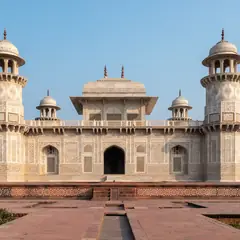
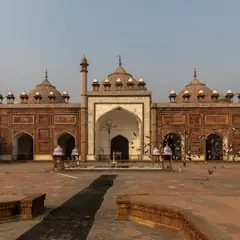
The visit begins before the south gate, the largest of the four in the enclosure and the only one that serves as an entrance today. Its great red sandstone portal is covered in geometric and floral panels inlaid with white marble and black slate, and at its corners rise four white marble minarets crowned with chhatris. They predate those of the Taj Mahal and closely resemble them: a kind of dress rehearsal for Agra’s most famous silhouette.
The Persian inscriptions of the gate carry the signature of the calligrapher ʿAbd al-Ḥaqq of Shiraz, who signed in three places of the complex and who years later, already with the title Amanat Khan, wrote the inscriptions of the Taj Mahal. Above the central arch opens the Naqqar Khana, a chamber with arches and a balcony from which drums and shawms sounded at dawn, and again for a vigil after sunrise, in honour of the dead emperor. What today’s minarets owe to a British viceroy is part of what the narration tells right there.
Antelopes in the emperor’s garden
Causeway and charbagh of the antelopes
Summary of this stop
Beyond the gate, a stone causeway leads to the mausoleum between two great rectangular lawns. This is the charbagh, the four-part garden, of 119 acres (about 48 hectares), enclosed by a wall with three other sandstone gates on the north, east and west sides, now unused as entrances, which complete the symmetry of the complex. On the grass graze herds of blackbuck, one of the most unexpected images in Agra.
The place already had a name before the tomb: Sikandra owes it to Sikandar Lodi, sultan of Delhi from 1488 to 1517. A pavilion from his time, a baradari of 1495, ended up inside the garden that Mariam-uz-Zamani, Akbar’s widow, planted beside the mausoleum, and became her tomb after her death in 1623.
A red pyramid without the promised dome
Akbar's Tomb
Summary of this stop
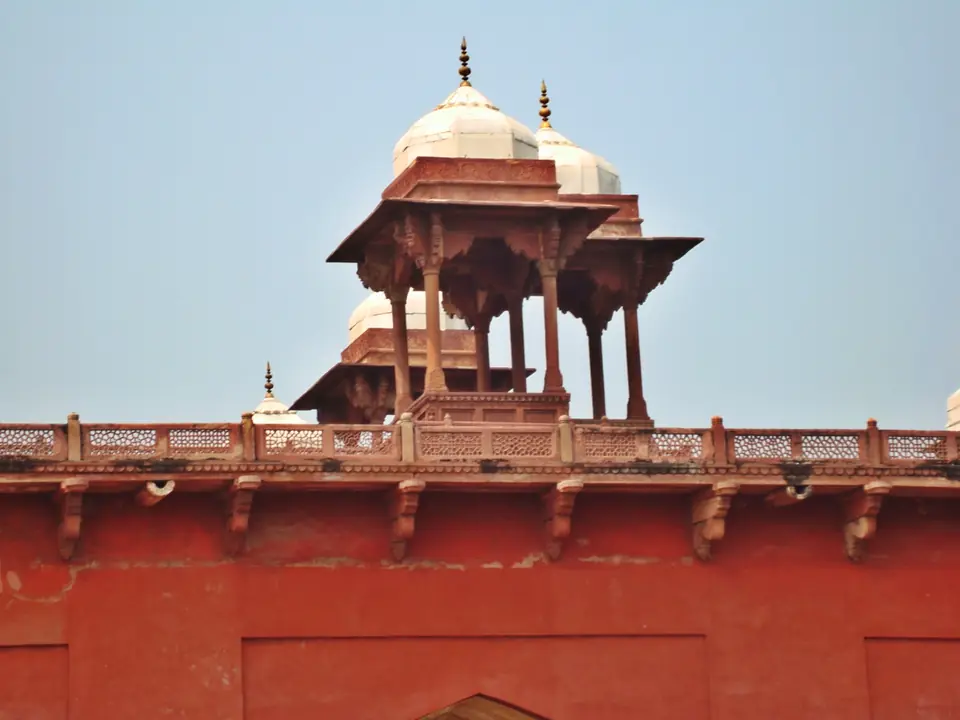
Facing the south facade, the mausoleum reads from bottom to top: stepped levels of red sandstone with iwans, kiosks and chhatris, and a last storey of white marble with lattice screens that looks half finished. In October 1608, Jahangir visited the work, found it raised to the taste of the master builders while he was fighting the rebellion of his son Khusrau, and ordered several parts redesigned with new architects. In 1611, the English traveller William Finch saw the tomb still unfinished, covered with a white sheet embroidered with golden flowers under a rich tent, and noted that it was to be vaulted with white marble and lined with gold leaf. That cover never came: Fergusson, relying on Finch, maintains that a marble canopy was planned and not built; others attribute the unfinished look to Jahangir’s own redesign.
Above, on a terrace surrounded by cloisters with marble lattice screens and closed to the public today, a solid block of white marble reproduces the true tomb in the crypt. It has the 99 attributes of God carved on it, “Allahu Akbar” at the head and “Jalla Jalaluhu” at the feet, beside a pedestal that held a golden incense burner, although a disputed legend, already circulating in Victorian photographs, turned it into the stand for the Koh-i-Noor diamond.
Behind so much stone there is, according to a documented tradition, a guilty conscience. In 1602, Abul Fazl, grand vizier and close friend of Akbar, died in an ambush near Narwar at the hands of the Bundela chief Vir Singh Deo, on the orders of Prince Salim, the future Jahangir, who received his head in Allahabad. It is said that, already emperor, he wished to atone for it with the limitless money he poured into this tomb. How father and son were reconciled is one of the episodes the audio guide reserves for this point.
The crypt the Jats emptied
Crypt with Akbar's true tomb
Summary of this stop
A sloping passage descends to a vaulted chamber, high and dim, with a simple white marble sarcophagus at the centre. A popular tradition holds that, contrary to the custom of orienting tombs toward Mecca, Akbar’s head faces the rising sun. Beside the tomb were kept his armour, his clothes and his books, until on 28 March 1688, in the reign of Aurangzeb, the Jat chief Rajaram of Sinsini assaulted the mausoleum, carried off gold, silver, carpets and lamps, smashed the great bronze doors, mutilated the minarets of the entrance and emptied the crypt. A couple of years earlier, the faujdar of Sikandra, Mir Abul Fazl, had repelled a first attempt. That the attackers also burned the emperor’s bones is claimed by the account of Niccolao Manucci, but the Mughal chronicle of the plunder does not mention it.
Popular tradition saw in that assault a revenge. In 1670, the Jat leader Gokula, ringleader of the rebellion of 1669, had been dismembered alive on the platform of the Agra police station by order of Aurangzeb. Eighteen years of resentment that, according to that tradition, fell upon the tomb of the great-grandfather of his executioner. In the neighbouring chambers rest two daughters of Akbar, Shakr-un-Nissa Begum and Aram Banu Begum, and beneath their vaults a local woman usually demonstrates to visitors, in exchange for a tip, an echo that lets one hear the size of the building.
Four centuries of gold held up with scaffolding
Gilded vestibule at the crypt entrance
Summary of this stop
The portal leading to the crypt, in the central arch of the ground floor, preserves relief stuccoes painted in blue and gold, with a different design on each wall. In September 2024, the damp from the rains loosened panels of that roughly 400-year-old paint; the ASI propped up the ceiling with scaffolding and formed a committee of experts for its conservation.
It is not the first wound. On 28 October 1843, The Illustrated London News announced at the East India Docks in London the sale of the “palace of the Mogul sultan Akber”: marble panels with inlay and sandstone lattice screens torn from Agra Fort and from this tomb to be auctioned. Sixty years later, Viceroy George Curzon directed a great restoration, completed in 1905 in the wake of the Ancient Monuments Preservation Act of 1904, and one of his last acts before leaving India was to rebuild the broken minarets of the gate. Between those who dismantled it and those who rebuilt it, the gilded vestibule is a reminder that its beauty remains fragile even today.