Great Mughal mosque
Jama Masjid Audio Guide
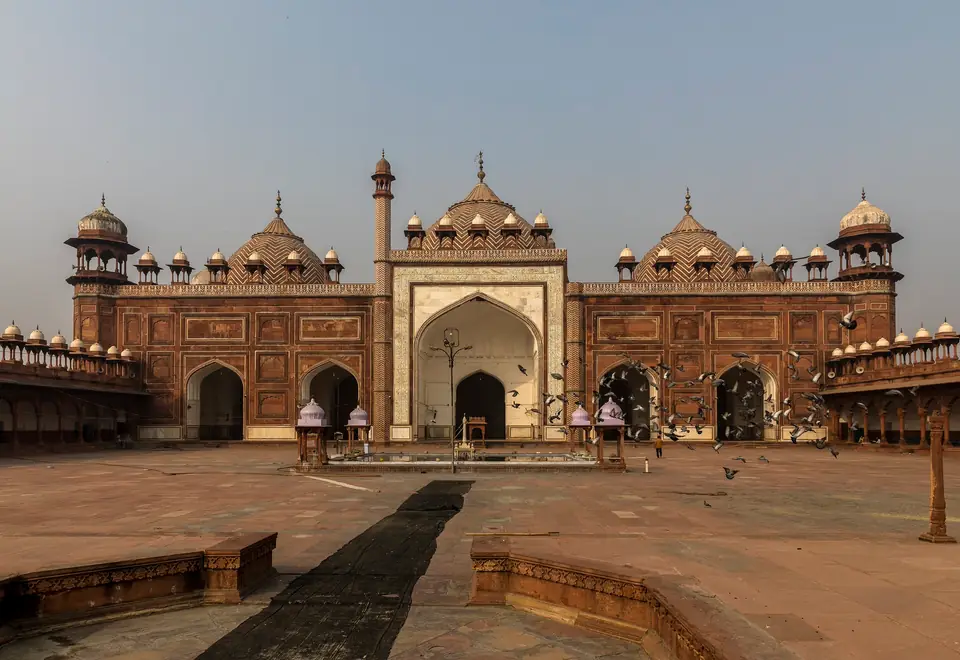
Agra's great mosque was paid for by a woman: Princess Jahanara, who in 1648 crowned her work with three domes striped in red and white and praised herself in Persian above the great arch, something no Mughal lady had signed before.
- 40 min of audio
- Mughal architecture
The history of the Jama Masjid begins with a decree of Shah Jahan in 1637: a new mosque and a new square facing the Delhi Gate of Agra Fort. His eldest daughter, Jahanara Begum, asked to pay for it herself and the emperor agreed. Work began in 1643 and ended in 1648 at a cost of five lakh rupees. Raised on a podium above the street, with its five-arched prayer hall and its courtyard with ablution pool, it remains today the great mosque of the city.
What is missing today tells as much as what remains. Around the revolt of 1857, the Fort's British garrison knocked down its main gate to clear the line of fire and mined the building with gunpowder; later, the Tripolia square that joined it to the Fort was demolished to lay the tracks of the Agra Fort station, opened in 1874. And in 2024 even the metro station that bore its name was renamed Mankameshwar.
Highlights
- Three zigzag domes: stripes of white marble and bands of red sandstone topped with lotus flowers
- Persian inscription of the great arch: black letters on white marble praising Shah Jahan and Jahanara
- Unique minbar: the pulpit has the east facade of the mosque itself engraved on it
- Vanished Tripolia square: the tracks of 1874 now separate the mosque from Agra Fort
- Staircase in litigation: a 2023 lawsuit asks for excavation beneath its steps
Facing the Delhi Gate of Agra Fort, across the tracks, stands the Shahi Jama Masjid, the city’s great mosque. Its history begins in 1637, when Shah Jahan decreed the building of a new mosque next to a new square facing the Fort. Another had been begun earlier on the banks of the Yamuna, but that work was abandoned when efforts were poured into finishing the Taj Mahal. This time the initiative was taken by his eldest daughter, Princess Jahanara Begum, who asked to pay for it out of her own pocket: plots were bought, houses were pulled down to widen the streets and, between 1643 and 1648, the building was raised for five lakh rupees. E. B. Havell’s guide read the year 1644 in the inscription of the main arch, one of the dates still disputed.
Almost four centuries later, the story of the Jama Masjid reads as much in what it preserves as in what was torn from it: a gate brought down by British cannon, a square erased by the railway, a staircase taken to court and a name removed from the metro signs. It is often confused with Akbar’s mosque in Fatehpur Sikri or placed inside the Fort, when it is outside, facing it. The audio guide covers its four key points in 40 minutes with a narration that is documented and checked against historical sources, from the esplanade facing the Fort to the pulpit of the prayer hall.
Facing it rises Agra Fort; across the Yamuna lies the Tomb of Itimad-ud-Daulah, and on the outskirts of the city, in Sikandra, Akbar’s Tomb.
Where the Tripolia square stood
Tracks facing the Delhi Gate
Summary of this stop
On the east side, facing the Fort, there is no great gate or square. There was an imperial axis: the decree of 1637 joined mosque and square facing the Delhi Gate, and between them stretched the Tripolia, a broad octagonal square built at the same time as the temple. James Abbott drew it in 1826, with its gate now demolished. Then came the railway: the square was knocked down to build the Agra Fort station, opened in 1874 and the city’s first, and today road, tracks and platforms separate the mosque from the Fort’s gate, visible on the other side. The exact dates of that demolition vary by source.
Before the tracks, the mosque was already viewed with nostalgia. In 1831 an engraving by T. Boys, after a drawing by William Purser from a sketch by Captain R. N. Elliot, was published in London accompanied by a poem by Letitia Elizabeth Landon that presented it as the only survivor of Agra’s glory. Soon after came the cameras: the physician John Murray photographed it with waxed-paper negatives, with merchants and carts in front of the domes, and Felice Beato, between 1858 and 1860, portrayed it probably from the Fort opposite.
Beato’s image keeps something that no longer exists today. What exactly it is, and how it fits into the gap that opens before the Fort, is left for the narration at that same point.
A staircase amid demolitions and lawsuits
Jama Masjid
Summary of this stop
The mosque occupies some 1,200 m² and rises on a raised podium above the street, so one enters by climbing stairs. That podium was built at the expense of what was around it: to make way for Jahanara’s work, private plots were bought and several houses were pulled down to widen the streets leading to it.
Two centuries later, its closeness to the Fort nearly cost it its life. Around the revolt of 1857, the British garrison entrenched in the Fort destroyed the mosque’s main gate and the enclosure attached to its east side to clear the line of fire of its cannon, and mined the building with gunpowder prepared to blow it up.
The same stairs remain in dispute. In May 2023, a Hindu trust linked to the preacher Devkinandan Thakur sued before an Agra court asking that they be excavated, alleging that beneath them lie images of Krishna from the Keshavdev temple of Mathura; in January 2024 the court rejected the Muslim side’s petition against the suit. The suit attributes the burial to Aurangzeb, whereas the mosque was finished in 1648, under Shah Jahan, and the case remains open.
Jahanara’s three crowns
Pishtaq of the Persian inscription
Summary of this stop
From the courtyard, with the ablution pool at the centre and arcades of lobed arches on the sides, the prayer hall shows five entrance arches. Above it rise three bulbous domes decorated in a herringbone pattern, with narrow stripes of white marble alternating with wide bands of red sandstone and topped with lotus flowers. Not everyone liked them: Havell’s guide judged the mosque very inferior to the one Shah Jahan built in Delhi and called the zigzag of its domes decidedly unpleasant.
The great central arch, the pishtaq, bears Persian inscriptions in black letters inlaid in white marble, the same calligraphic technique as the Taj Mahal, praising Shah Jahan and Jahanara. There is the building’s boldest gesture: the princess praises herself as the “pride of her sex” and “mistress of the three domes as worldly crowns”. Neither Jahangir’s mother in Lahore nor Nur Jahan in Srinagar had signed their mosques this way.
Behind that signature lies an uncommon spiritual life. Jahanara was initiated in 1641 into the Qadiriyya Sufi order by her master, Mullah Shah Badakhshi, who according to his biographer, Tawakkul Beg, would have named her his successor had she not been a woman. How that master, those domes and those words in Persian intertwine is what the narration reveals in front of the arch.
A pulpit that portrays its mosque
Minbar with the engraved facade
Summary of this stop
Inside the prayer hall, beside the mihrab, the white marble minbar holds a detail unique among the pulpits of the great Mughal mosques: it has the east facade of the mosque itself engraved on it. A building that portrays itself in the place from which one preaches.
The mosque is not a museum piece. It remains Agra’s great mosque: at Eid al-Fitr of 2026, the mass prayer was held at 8:15 in the morning, with tents set up by its Intezamia committee.
In the north and south wings, behind marble lattice screens, are the women’s rooms, which are not used for daily prayer or for Friday prayer. According to a custom documented in the early 21st century, whose antiquity is unknown, women gather there on Thursday evenings for a Sufi ritual with incense, flowers, candles and mystical poetry, and close it with a prayer for Jahanara as patron saint. The gesture with which they take their leave, and what it leaves on the wall facing Mecca, is told by listening to the audio guide in the prayer hall.