UNESCO World Heritage
Taj Mahal Audio Guide
A garden of paradise laid out with obsessive symmetry around a white marble tomb, and a single detail out of place: the cenotaph of the emperor who built it and ended up gazing at it as a prisoner from across the river.
- 120 min of audio
- Mughal architecture
- Marble and pietra dura
Shah Jahan commissioned the Taj Mahal in 1631, the same year Mumtaz Mahal died giving birth to her fourteenth child, and work began in 1632 on the banks of the Yamuna. Beneath the white Makrana marble lies a core of brick and lime mortar; set into it are 28 kinds of precious and semi-precious stones from China, Tibet, Afghanistan, Sri Lanka and Arabia, along with Quranic passages written by the calligrapher Amanat Khan, who signed and dated his work.
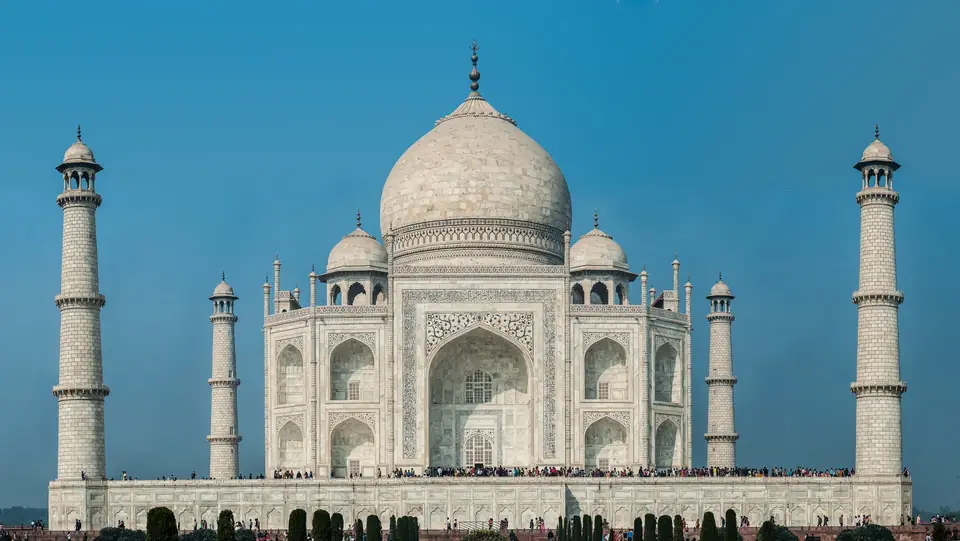
The symmetry of the complex is almost total: the mosque on the west has a twin on the east, the jawab, built only to balance it, and the minarets lean outward so they would not fall on the dome. The one thing that departs from the plan is at the heart of the building: Shah Jahan's cenotaph, shifted to the west beside his wife's, which occupies the exact centre of the chamber.
Highlights
- Great Gate: calligraphy by Amanat Khan whose letters grow larger toward the top so they look equal from below
- Charbagh garden: central pool with five fountains and the four marble Curzon benches (1907-08)
- Minarets: four towers of about 40 metres leaning outward to protect the mausoleum
- Cenotaph chamber: 28 seconds of reverberation and Shah Jahan's tomb off the axis
- Yamuna terrace: views of Mehtab Bagh and of Agra Fort, where the emperor spent his confinement
On 17 June 1631, in Burhanpur and in the midst of the Deccan campaign, Mumtaz Mahal died giving birth to her fourteenth child, a girl named Gauhara Begum. That same year Shah Jahan commissioned a mausoleum for her in Agra, on a plot on the banks of the Yamuna that belonged to Raja Jai Singh I of Amber and that he ceded in exchange for a large palace in the centre of the city. Work began in 1632, and on 5 June of that year the first Urs, the anniversary of the empress’s death, was held there, under tents in what is now the entrance courtyard, open to all social classes, with alms and prayers.
The story of the Taj Mahal does not end with that tomb. Its builder ended up deposed by his own son and confined in Agra Fort, with the mausoleum in sight; the building was plundered in 1857, restored by a British viceroy, covered in scaffolding to mislead bombers and defended in court against the smoke that was yellowing its marble. Myths also circulate that do not withstand the sources, such as that of the workers whose hands were supposedly cut off or that of a black Taj on the other bank. The audio guide covers the complex in five stops, from the great gate to the river terrace, with a narration that is documented and checked against historical sources and that separates what is proven from what is only told.
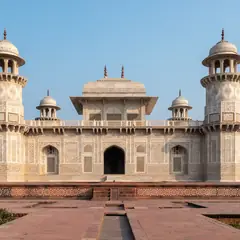
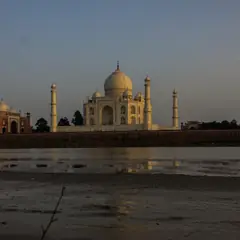
From the river terrace one can see, on the other bank, Mehtab Bagh, the garden laid out on the same axis as the mausoleum, and upriver Agra Fort, where Shah Jahan spent his confinement. The precedent for its inlaid marble is found in the Tomb of Itimad-ud-Daulah, which Nur Jahan built for her parents.
The red gate signed by a calligrapher from Shiraz
Darwaza-i-Rauza
Summary of this stop
The great gate, the Darwaza-i Rauza, is a red sandstone portal framed by calligraphy in black marble on white. The Quranic passages were chosen and written by Abdul Haq, a calligrapher who arrived from Shiraz in 1609 and whom Shah Jahan gave the title Amanat Khan. Above the entrance one reads surah 89: “O soul at rest, return to your Lord.” On the north arch of this gate appears his signature with the date 1648; another, on the south arch of the mausoleum, bears the date 1638/39, and between the two they allow the work to be dated.
The inscription hides an optical trick: the thuluth letters increase in size in the higher panels, so that from below they all appear equal. It is the first sign of a complex designed for the visitor’s gaze, and the best prologue for a mausoleum born of a death in childbirth. What the calligrapher left written about himself, at the base of the inner dome, is revealed in the narration in front of the gate itself.
Curzon’s bench and the most photographed reflection
Central pool and marble benches
Summary of this stop
At the crossing of the four quadrants of the charbagh garden stands the marble platform with the lobed pool of five fountains, the classic spot for the reflection photo. The four marble benches around it are not Mughal: they were placed in 1907-08 by Lord Curzon, the viceroy who drove the great restoration completed in 1908 and who remade the garden with the English-style lawns that remain today in place of the original Mughal paradise.
This same garden holds the memory of Mumtaz’s journey. After her death she was buried provisionally in the garden of Zainabad, beside the Tapti river, and in December 1631 her body was exhumed and taken to Agra in a gilded coffin escorted by her son Shah Shuja. Near the northwest corner of the garden, a small enclosure is identified as the place where she rested before her final burial.
In February 1992, during the official visit to India with Prince Charles, Diana, Princess of Wales, arrived alone at the Taj Mahal and was photographed sitting on a marble bench in front of the mausoleum; that image was read as the end of her marriage. In April 2016, William and Kate sat, smiling, on that same bench. What Diana answered that day when asked about the visit is part of the story told beside the pool.
Minarets that lean to spare the dome
Southwest minaret and mosque
Summary of this stop
From the southwest minaret, the architecture of the Taj Mahal can be appreciated in all its logic. The four towers, of about 40 metres and divided into three sections by balconies, lean slightly outward so that, if one were to collapse, it would fall away from the mausoleum. On one side rises the red sandstone mosque, with its mihrab; on the other, its twin, the jawab or “answer”, without a mihrab, built to balance the symmetry and used as a guesthouse for important visitors.
Beneath the cladding there is a core of brick and lime mortar. The white marble came from Makrana, in Rajasthan, and the red sandstone from Fatehpur Sikri; into the marble were inlaid 28 kinds of precious and semi-precious stones that draw flowers and vines in pietra dura, alongside floral reliefs carved into the dados.
That marble also has enemies. A lawsuit filed in 1984 by M. C. Mehta over the yellowing of the stone led the Supreme Court to ban, on 30 December 1996, coal and coke in the Taj Trapezium Zone, of 10,400 km², and to force 292 industries to switch to natural gas. The remedy with which the ASI has been restoring the white to the facades since 1994 is explained in the narration at the foot of the tower.
The cenotaph that breaks the symmetry
Cenotaph chamber
Summary of this stop
The cenotaph chamber is a dim octagonal room, with a latticed marble screen around two cenotaphs inlaid with stones and, high above, the great lamp commissioned by Curzon, inspired by a mosque in Cairo. Its reverberation time reaches 28 seconds, designed so that the continuous recitation of the Quran by the hafiz in memory of Mumtaz would hang suspended in the air. On the walls there are also traces of another era: during the rebellion of 1857, British soldiers and officials prised out precious stones and lapis lazuli.
Mumtaz’s cenotaph occupies the exact centre of the chamber. Shah Jahan’s, on a larger base and crowned by a small pen box that marks it as a male tomb, was shifted to the west: it is the piece that breaks the symmetry of the complex. The royal tombs are not here, but in the crypt below.
That crypt is opened only three days a year, during the Urs of Shah Jahan, on the 26th, 27th and 28th of the month of Rajab. It is a documented tradition: on the first day the tombs are washed and covered in flowers, on the second the sandal is celebrated and the last brings the chadar poshi, a procession that carries over the tomb a seven-coloured cloth woven with contributions from people of all religions, which in January 2026 measured about 1,720 metres. Where that procession sets out from is one of the most surprising details this stop holds.
The Fort from where Shah Jahan watched it as a prisoner
Yamuna river terrace
Summary of this stop
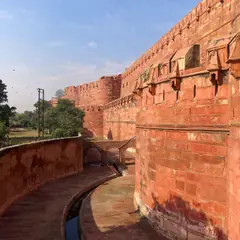
The north terrace of the platform looks out over the Yamuna. Opposite stretches the garden of Mehtab Bagh, with its octagonal pool; upriver, Agra Fort stands out. In 1658 Aurangzeb deposed his father and confined him there, from where Shah Jahan could see the Taj Mahal. He died in 1666, and Aurangzeb buried him in the mausoleum beside his wife; that is how the cenotaph that throws the chamber off balance came to be.
The building came close to vanishing from view more than once. In 1942 the government covered it with scaffolding to disguise it against possible Japanese air raids, and repeated the disguise in the Indo-Pakistani wars of 1965 and 1971. Earlier, around 1830-31, when Lord William Bentinck ordered the Fort’s imperial marble bath to be auctioned, word spread that the Taj was also for sale; it is a disputed story, which some accounts maintain with bids and figures and which British historians deny. Who spread it and why no one has found the order is told facing the river, with the Fort in sight.