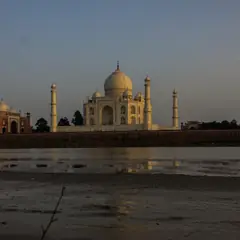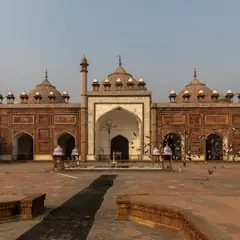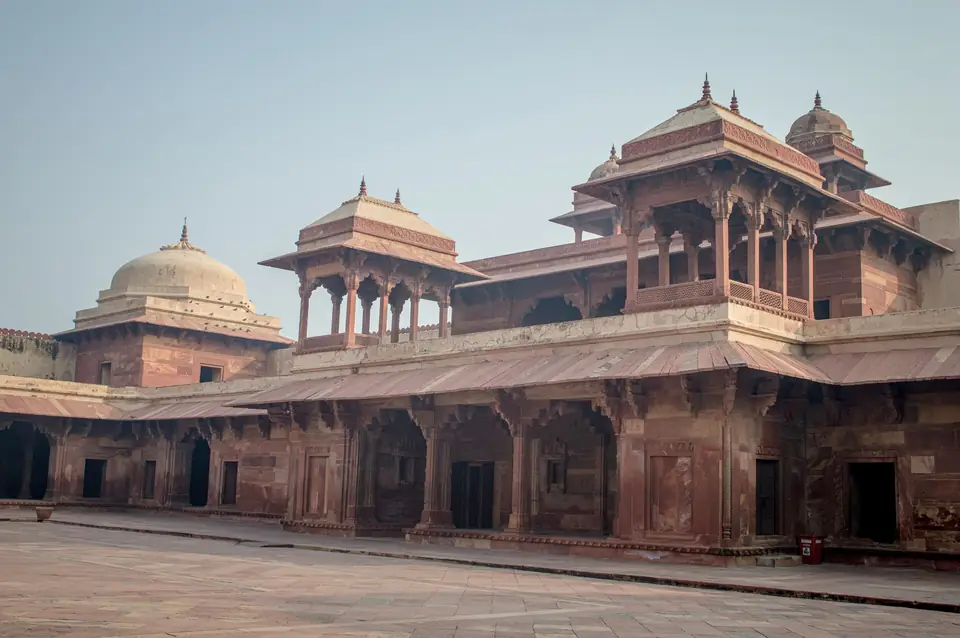
Akbar's Mughal capital
Fatehpur Sikri Audio Guide
An imperial city of red sandstone that Akbar raised on a ridge beside a Sufi saint's cave and that ruled the Mughal empire for fourteen years. Its abandonment carries a myth, that of the lack of water, which historians dismantle.
- 120 min of audio
- Mughal architecture
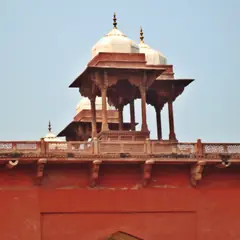
Fatehpur Sikri stands about 37 km from Agra, on the ridge where Salim Chishti lived, the Sufi saint who predicted the birth of Akbar's heir. In 1569 the future emperor Jahangir was born there and in 1571 Akbar founded the walled city and its palace, which was the capital of the Mughal empire until 1585. The Gujarat victory of 1573 gave it its name: Fatehpur, the city of victory. Courtyards, pillared pavilions, harem palaces and a great mosque make up today an empty and surprisingly intact complex.
The usual explanation says the city was abandoned because of thirst. Yet it had a large dammed lake, at least 13 stepwells and 8 reservoirs, and one of those baolis still supplies the present-day town. Historians such as S. A. N. Rezavi and S. S. Sinha attribute the court's move to the crisis in the northwest after the death of Mirza Hakim in 1585. While the palaces emptied, the saint's tomb never stopped receiving pilgrims.
Highlights
- Diwan-i-Khas: a single column with 36 serpentine brackets holds up Akbar's platform
- Panch Mahal: five storeys and 176 columns, every one carved differently
- Anup Talao: the pool that in 1578 was filled with copper, silver and gold coins
- Tomb of Salim Chishti: white marble, mother-of-pearl and lattice screens covered in wish threads
- Buland Darwaza: a gate of some 54 m with a phrase attributed to Jesus on its arch
The history of Fatehpur Sikri begins long before Akbar. The Archaeological Survey of India’s excavations in 1999-2000, at Birchhabili Tila, on the shore of the ancient lake, uncovered a settlement inhabited since the 6th century and a red sandstone Jain temple, with a sculpture of the Jain Sarasvati dated 1010 that already called the place Saikrikya. According to tradition, the first building of the Mughal city was not imperial either: the stonecutters of Agra who surrounded Salim Chishti raised in his honour a small mosque around the cell where the saint made his forty-day retreat, the Stonecutters’ Mosque (Sangtarash), west of the Jama Masjid.
Then came the emperor. In 1569 Akbar’s first surviving son was born in the village of Sikri, just as the saint had predicted; that same year a religious complex was begun in his honour and in 1571 he founded the walled city. For fourteen years it was the capital of the Mughal empire. Around 1585 the English traveller Ralph Fitch described Agra and Fatehpur Sikri as two cities “much greater than London”; in 1610 William Finch found the palaces “like a desolate waste”.
The history of Fatehpur Sikri, the architecture of its pavilions and the real reasons for its abandonment are better understood on site: the audio guide route advances through six stops, from the private audience hall to the monumental gate, with a narration that is documented and checked against historical sources.
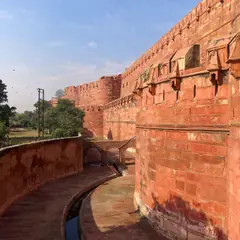
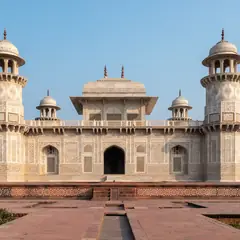
The emperor who founded it rests in Akbar’s Tomb, in Sikandra, on the outskirts of Agra, and the same red sandstone of his reign raises the walls of Agra Fort.
An emperor seated on a single column
Diwan-i-Khas
Summary of this stop
From outside, the Diwan-i-Khas looks like a stone box with hardly any decoration. Inside comes the surprise: a single central column with an octagonal shaft whose capital of 36 serpentine brackets holds up a circular platform for Akbar, joined to the four corners of the first floor by four stone walkways. From that suspended seat the emperor received private audiences and had representatives of different religions debate.
That eagerness to hear everyone had its own building. In 1575 Akbar built in Fatehpur Sikri the Ibadat Khana, the “House of Worship”, where he gathered Hindus, Catholics, Zoroastrians, Jains, Buddhists, Sikhs and even atheists. A miniature of the Akbarnama from around 1605 shows the Jesuits Rodolfo Acquaviva and Francisco Henriques in the assembly. Exactly where that hall stood remains in dispute: some authors placed it in the Diwan-i-Khas itself, while others put it on a mound between the Jama Masjid and the Jodha Bai palace, where an excavation in the 1980s found remains that match the painting of the period.
What was heard beneath that platform and why an emperor wanted to preside over the debates from the top of a pillar is part of what the narration tells right there, in front of the column.
The pool that was filled with coins
Anup Talao
Summary of this stop
The Anup Talao, the “peerless pool”, is an ornamental pool of red sandstone with a central platform and four bridges. Today it conveys calm, but according to a tradition documented in 1578 Akbar ordered it filled with copper, silver and gold coins, which he then handed out himself. According to tradition, the central island was also the stage from which Tansen, the legendary court musician, sang.
Beside the pool stretches a courtyard paved like a great game board. The legend, disputed, turns it into a giant pachisi in which courtesans dressed in colours served as living pieces; it is not even certain that the courtyard dates from Akbar’s time.
That extravagance fits with what travellers reported: around 1585 Ralph Fitch saw a continuous market along the 12 kos separating Fatehpur Sikri from Agra, two cities he judged greater than London.
Five storeys of columns over a vanished lake
Panch Mahal
Summary of this stop
The Panch Mahal is a pavilion of five decreasing storeys held up by columns alone: 84 on the ground floor, 56 on the first, 20 and 12 on the following ones and 4 beneath the chhatri at the top. That makes 176 in total and none is carved the same. Originally, stone lattice screens between the columns hid the ladies of the court. From its base, looking north, one sees the dry depression where the great lake that Akbar dammed around 1579 once lay.
That empty landscape feeds the myth of the city abandoned out of thirst, but the data point in another direction. Besides the lake, Fatehpur Sikri had at least 13 baolis and 8 reservoirs, and the Hakim’s Baoli still supplies the present-day town. Water, in fact, struck through excess: in 1584 the dam of the Hauz-i Shirin burst in the middle of a festival, while the nobles were playing chaupar, chess and ganjifa, and the flood swept away the houses below and killed Madadi, the cheetah keeper.
In July 1585 Mirza Hakim, Akbar’s half-brother, died in Kabul, and the emperor moved the court to Lahore. On returning in 1598 he settled in Agra, not here. The tourist version still speaks of lack of water; historians such as Rezavi and Sinha deny it and point out that this complaint first appears in 1619. The debate unfolds in the audio guide at the foot of the pavilion.
The palace of a queen with the wrong name
Jodha Bai Palace
Summary of this stop
The single great eastern gate, in Rajput style, opens onto the largest complex of the zenana, enclosed by high walls around a courtyard. Everyone calls it the Jodha Bai palace, but it was the residence of Mariam-uz-Zamani, Akbar’s Rajput wife since 1562 and mother of Prince Salim. Inside it holds a Hindu temple and a tulsi math for the queen’s worship, connected from within to the emperor’s quarters.
It is not the only misleading label. The so-called “Birbal’s House”, a two-storey palace profusely carved with Hindu and Islamic motifs, is officially the North Palace of the Haram Sara, dated by an inscription to 1572 or 1582, because one digit is illegible. Being inside the imperial harem, closed to men except the emperor, it was probably inhabited by Akbar’s two principal wives, Ruqaiya Sultan Begum and Salima Sultan Begum, and not by the minister Birbal.
Coloured threads on the saint’s lattice
Tomb of Salim Chishti
Summary of this stop
In the middle of the Jama Masjid courtyard gleams a white marble pavilion: the tomb of Salim Chishti (1478-1572), built in 1580-1581. The cenotaph lies beneath a wooden canopy inlaid with mother-of-pearl and is surrounded by an ambulatory closed by pierced stone lattice screens. Here is the reason a capital exists on this ridge: the saint who predicted the birth of Akbar’s heir.
The dargah still receives women without children who come to pray for offspring, and as early as the 17th century the city survived as a pilgrimage centre for the saint’s disciples. A living tradition covers the lattice in colour: whoever arrives with a wish ties a thread to the pierced marble as a permanent reminder of what they have asked for. Believers of all religions do it, and in February 2025 so did former British prime minister Rishi Sunak, who offered a chaadar and tied his own thread.
A victory arch that advises against staying
Buland Darwaza
Summary of this stop
The exit passes through the Buland Darwaza, a gate of about 54 m above the ground reached by 42 steps, of red and buff sandstone with inlays of white and black marble and crowned by chhatris. It was added to the Jama Masjid as a victory arch for the Gujarat campaign of 1573, although its date is disputed: other sources bring it to 1576-1577 and even 1602. On its arch, a Persian inscription attributes to Isa (Jesus), son of Mary, a surprising phrase on a triumphal gate: “The world is a bridge: pass over it, but do not build houses on it.”
The central bay is known locally as the Horseshoe Gate, from the custom of nailing horseshoes onto its great wooden leaves to attract luck. And the empty city is not always empty: according to a documented tradition, when the annual Urs of Moinuddin Chishti in Ajmer ends, thousands of pilgrims arrive by bus to prostrate themselves before the tomb of Salim Chishti, repeating the path of thanksgiving that Akbar made after the birth of his son. How that phrase about the bridge fits with a city that emptied in fourteen years is the closing note the narration reserves beneath the arch.