Mughal citadel
Agra Fort Audio Guide
A red sandstone citadel on the banks of the Yamuna where three Mughal generations moved from Akbar's ashlar to Shah Jahan's marble, and where that same emperor ended his days confined by his son, with the Taj Mahal in sight.
- 90 min of audio
- Mughal architecture
Akbar built this fort between 1565 and 1573 on the old brick enclosure of Badalgarh: a brick core, a facing of red sandstone from Dhaulpur and, according to the chronicles, some 4,000 workers a day for eight years. His son Jahangir and his grandson Shah Jahan turned it into a palace, and each generation left its signature in the stone: red carved like wood for the grandfather, inlaid white marble for the grandson.
Of the hundreds of buildings it once had, fewer than 30 remain today, crowded on the southeast side facing the river. The rest fell first to Shah Jahan's marble palaces and then to British barracks, while the Jats and colonial governors carried off silver doors, fountains, lattice screens and even an entire bath.
Highlights
- Musamman Burj: octagonal tower of inlaid marble with a direct view of the Taj Mahal
- Salim's black throne: a touchstone slab from 1602 with a crack that, according to tradition, bled
- Diwan-i-Am: public audience hall of sandstone plastered to look like marble
- Jahangiri Mahal: the largest surviving palace from Akbar's era, in carved red sandstone
- Double walls: some 21 metres of red Dhaulpur sandstone with round bastions
About 2.5 kilometres from the Taj Mahal, upriver on the Yamuna, Agra Fort tells the story of a family in which every son wanted his father’s throne. Akbar rebuilt it between 1565 and 1573 with a skin of red sandstone; Jahangir hung a golden chain from its battlements so that anyone with a grievance could call on him; Shah Jahan dressed it in white marble and ended up shut inside it by his own son, Aurangzeb, from 1658 to 1666.
The history of this fort does not stop with the Mughals. In 1761 the Jats of Bharatpur took it after a month-long siege and melted down its silver doors; the British pulled down almost everything that remained between 1803 and 1862 to build barracks, and in 1857 they took refuge within its walls during the rebellion. Even Sherlock Holmes has the origin of one of his cases here. Walking it with the audio guide, documented and checked against historical sources, makes it possible to read in each courtyard who built, who demolished and who carried off what.
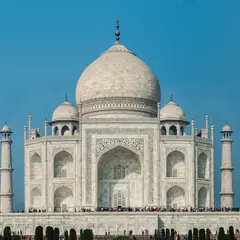
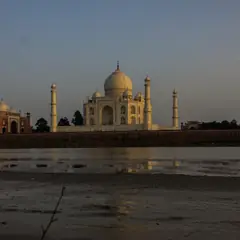
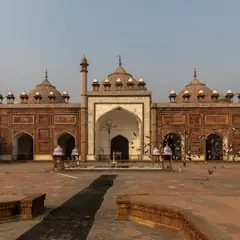
From its marble pavilions one can make out the Taj Mahal, about two kilometres downriver; outside its walls, facing the Fort, stands the Jama Masjid paid for by Princess Jahanara, and Akbar’s red sandstone has its other great work in Fatehpur Sikri.
A stone trap named after a murder
Amar Singh Gate
Summary of this stop
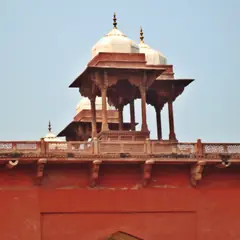
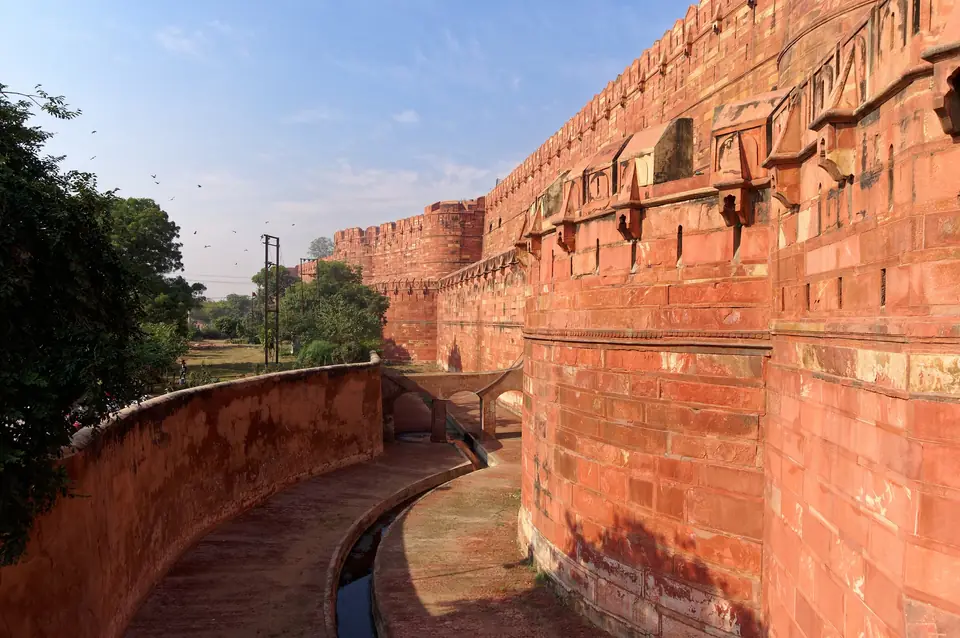
The visit begins at the Amar Singh Gate, the south gate, and continues along a ramp with a bend that forces a turn without seeing what waits on the other side: an approach designed to slow any attacker. The double walls, of about 21 metres, show Akbar’s technique: a brick core faced with red sandstone from Dhaulpur, in Rajasthan, the material that gives the complex its nickname, the Red Fort.
The gate’s name goes back to 1644, when the Rathore prince Amar Singh, furious over a fine imposed by Shah Jahan, killed Salabat Khan, the man in charge of collecting it, in the emperor’s presence. The attribution is popular and not entirely certain: the outer gate that bears his name was added under Aurangzeb, and the famous horseback leap from the wall that is usually associated with him does not appear in the sources.
One enters here because Akbar’s great ceremonial gate toward the city, the Delhi Gate, built around 1568, lies in the northern part, which remains Indian Army territory. From outside its white marble inlays can be made out; what the layout of this ramp conceals is better understood by listening to it on the spot.
The red survivor of a vanished fort
Jahangiri Mahal
Summary of this stop
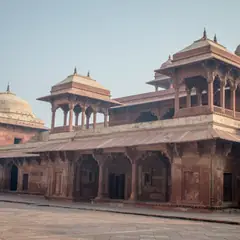
The Jahangiri Mahal is the largest surviving palace from Akbar’s era: red sandstone with carved brackets in the Gujarati and Bengali tradition, as if the stone imitated wood, a central courtyard and a facade open to the river. In front rests the Hauz of Jahangir, an enormous monolithic cistern of 1611 with steps inside and out and a Persian inscription on the rim.
Its value lies in having survived. The account attributed to the chronicler Abul Fazl speaks of some 500 buildings in Akbar’s fort (other sources raise the figure to 5,000). Shah Jahan demolished part for his marble palaces and the British pulled down almost all the rest between 1803 and 1862 to build barracks. Fewer than 30 Mughal buildings remain today.
At this height of the walls an episode from the documented tradition is set: a Brahmin named Debi was hoisted on a charpai, a rope bed, until he hung beside the balcony where Akbar slept, and from the air explained to him the secrets of Hinduism. Priests of other religions went up in the same way, and the narration traces how the emperor’s religious curiosity was forged in this manner.
The tower that looks onto the Taj Mahal
Musamman Burj
Summary of this stop
The Musamman Burj, an octagonal tower on the largest bastion on the river side, sums up three emperors in a single structure. First it was a red sandstone balcony where Akbar showed himself to the people every day, the jharokha darshan. In 1605 Jahangir tied to the battlements of the nearby Shah Burj his Chain of Justice, of pure gold, 30 gaz long and with 60 bells, which came down to a stone post on the bank so that anyone with a grievance could call on the emperor. Between 1632 and 1640 Shah Jahan rebuilt the tower in white marble with inlay.
From its balcony the Taj Mahal appears head-on. In its courtyard a sunken fountain and a black marble pachisi board have been preserved. This is where Shah Jahan’s end is usually set: confined by Aurangzeb and tended by his daughter Jahanara, he died in 1666, and his body left in a sandalwood coffin through the passage of the Musamman Burj and a low gate opened for the occasion, bound for the Taj by the river.
The exact place and harshness of that captivity remain in dispute: some sources place him under arrest in this tower, others speak of certain apartments of the palace and not a strict prison, and even the duration varies between seven and eight years. The audio guide separates what is known from what is told.
A black throne with a cracked stone
Diwan-i-Khas
Summary of this stop
On the terrace of the Diwan-i-Khas, the private audience hall of marble from 1637 with pillars inlaid with flowers in hard stones, two thrones wait facing the river: one white and one black. The black one, of touchstone and 10 feet 7 inches long, bears Persian inscriptions from 1602 that call Prince Salim “Shah” and “Sultan” while his father Akbar was still reigning. Already as Jahangir, he brought it from Allahabad to Agra in 1610.
A long crack runs across it from side to side. According to tradition, it opened in 1765, when the Jat raja Jawahar Singh of Bharatpur, then master of Agra, sat on the throne of the Great Mughal: the stone is said to have bled from two points, and some reddish marks are still pointed out as proof. The raja was murdered in the fort itself in August 1768.
The terrace also speaks of plunder. After the Mughal garrison surrendered in 1761, the Jats carried off to Deeg the marble, fountains and fish ponds of the Machchi Bhawan courtyard, now bare. Later, Governor-General Lord William Bentinck auctioned marble mosaics and lattice screens from the palace, and the Marquess of Hastings dismantled one of the baths and sent it as a gift to the future George IV. Why the Taj Mahal escaped the same fate is part of what is heard on the terrace.
Shivaji, a British tomb and Sherlock Holmes
Diwan-i-Am
Summary of this stop
The Diwan-i-Am, the public audience hall where the emperor heard petitions, was the first thing Shah Jahan commissioned in the fort after taking the throne in 1628. It began as a wooden hall on forty pillars and was rebuilt in red sandstone plastered with white shell-lime stucco to look like marble. At the back, the emperor’s inlaid marble niche, with side screens for the women of the court.
At an audience in the fort, on 12 May 1666, Shivaji was placed among third-rank nobles; after protesting he was put under guard, and on 19 August he escaped from Agra hidden with his son in baskets of sweets. The sources do not agree on whether the audience was in this hall or in the Diwan-i-Khas. In front of the Diwan-i-Am there also remains the tomb of John Russell Colvin, a British lieutenant governor who died of cholera in September 1857, when the fort served as a refuge for the British during some three months of rebellion.
That same siege inspired Arthur Conan Doyle. In The Sign of the Four (1890), Jonathan Small stands guard in “the old fort of Agra” and, with two Sikh soldiers, murders a merchant who was entering with a rajah’s jewels and hides the treasure in a wall. The visit ends where Mughal history and the Victorian novel share a stage.