Mughal garden
Mehtab Bagh Audio Guide
The other half of the Taj Mahal lies across the Yamuna: a Mughal garden laid out on the exact axis of the mausoleum to contemplate it by moonlight, which the floods buried and legend turned into a black tomb.
- 40 min of audio
- Mughal garden facing the Taj
Mehtab Bagh, the "moonlight garden", is a square enclosure of about 300 x 300 metres on the north bank of the Yamuna, aligned exactly with the Taj Mahal and of the same width. It was the last of the eleven Mughal gardens raised on this bank facing the Taj and Agra Fort, and Shah Jahan turned it into a nocturnal pleasure garden with white plaster paths, open pavilions, pools, fountains, fruit trees and narcissus.
For centuries the river swallowed it bit by bit: in 1652 Prince Aurangzeb was already writing to his father that the garden was completely flooded, and in the 1990s it was no more than a mound of sand and silt. In 1994 the Archaeological Survey of India removed some 90,000 m³ of earth and a large octagonal pool with 25 fountains appeared, the very place that fed the myth of the "black Taj" for generations.
Highlights
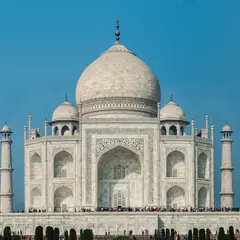
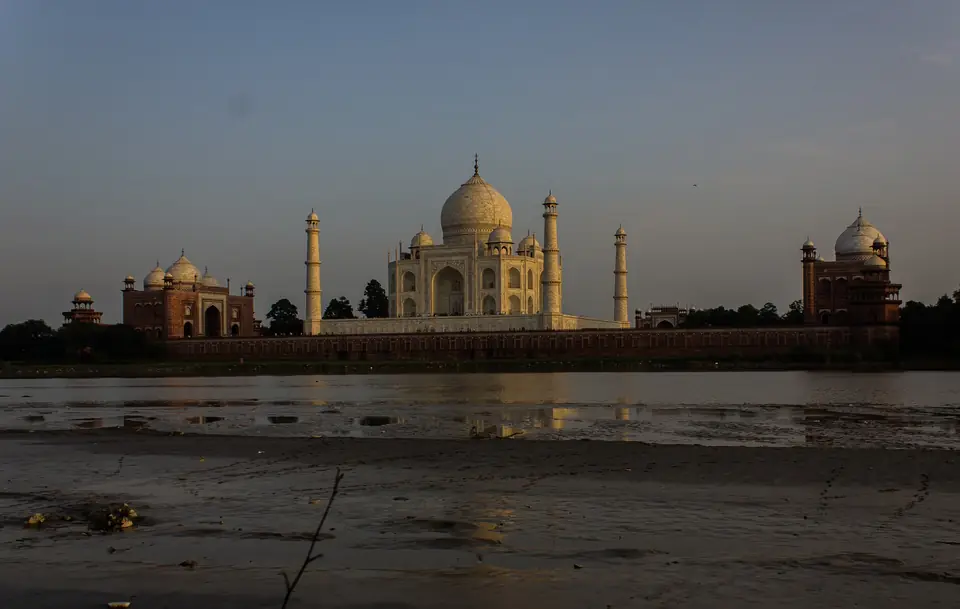
- Front view of the Taj Mahal: on the exact axis of the garden, across the Yamuna
- Octagonal pool: 25 fountains to see the mausoleum reflected in the water
- Southeast red sandstone tower: the only one of the four corners still standing
- Replanted charbagh: some 81 species from Mughal horticulture
- The "black Taj" myth: from Tavernier in 1665 to the excavation of 1994
Across the Yamuna, facing the Taj Mahal, stretches a square about 300 metres on each side that shares its axis and its width with the mausoleum. This is Mehtab Bagh, the “moonlight garden”, the last of the eleven Mughal gardens lined up on the north bank of the river facing the Taj and Agra Fort. Its origin remains in dispute: some sources attribute the original layout to Babur and make it older than the Taj, with Shah Jahan merely aligning it; others maintain that the site was chosen and designed by Shah Jahan himself to look at the mausoleum.
The story of Mehtab Bagh is that of a garden the water erased. In 1652 Aurangzeb already described it as flooded and without charm; the floods and the villagers who carried off bricks did the rest, and in the 1990s it was a mound of sand covered in wild vegetation. The excavation of 1994 and a seven-year study by the Smithsonian and the Archaeological Survey of India gave back its layout. Today it offers a view of the north facade of the Taj without crowds, and the audio guide, documented and checked against historical sources, covers in four stops the garden, the tower, the pool and the bank.
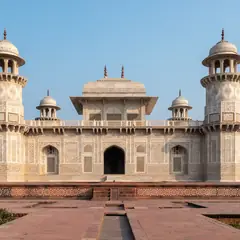
Across the river rises the Taj Mahal, with which it shares its axis, and upriver, on this same bank, the Tomb of Itimad-ud-Daulah is another of the Mughal garden-tombs of the Yamuna.
A garden for looking at the Taj by night
Mehtab Bagh
Summary of this stop
Past the entrance, the visitor finds the quadrants of the charbagh: cross-shaped flower beds with channels and paths, graded from tall trees to flowers. Here Shah Jahan transformed a crescent-shaped grassy plain into a nocturnal pleasure garden, with white plaster paths, open pavilions, fountains, fruit trees and narcissus. In the restoration, the ASI replanted some 81 species from Mughal horticulture, among them guava, maulshri, oleander, hibiscus, citrus, neem, bauhinia, ashoka and jamun.
Among those shrubs a recent episode is also hidden. The Taj is a no-fly zone, and in October 2019 a Chinese tourist crouched in the garden to launch a drone over the mausoleum; a month later five Russian tourists were detained for the same thing next to Mehtab Bagh. How that chase ended, and what happened to the drone’s memory card, is left for the narration in the garden itself.
The only tower the river spared
Southeast sandstone tower
Summary of this stop
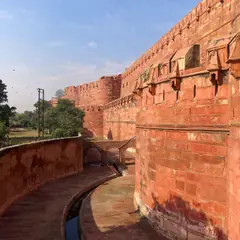
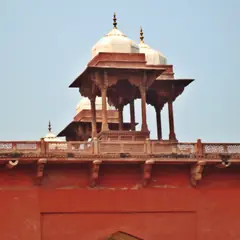
In the southeast corner, beside the river, stands the sole survivor of the four octagonal red sandstone towers that marked the corners of the enclosure. At the other three there is no tower left, only the perimeter: an absence that speaks of the Yamuna’s strength. As early as December 1652, on his return from a campaign, Prince Aurangzeb wrote to Shah Jahan that the garden across the river was completely flooded and had lost its charm.
This tower, known as Mehtab Burj, carried for decades a disputed story: guides and some authors pointed to it, together with the wall that starts from it, as the foundations of the “black Taj”. The art historian R. Nath refuted it by measuring, and comparison with the Taj’s tower across the water is enough to understand why. The exact figures of that comparison are heard in front of the tower.
The black Taj that was a pool
Octagonal pool
Summary of this stop
On the south edge of the garden, toward the river, appear the remains of the great eight-sided pool where the Taj was meant to be reflected. To the north and south it preserves the bases of two structures, probably pavilions, and from the northern one a stepped cascade fed the water. Everything suggests that from this raised pool Shah Jahan contemplated the mausoleum and its reflection at once.
Here the myth is undone. The French traveller Jean-Baptiste Tavernier, who visited Agra in 1665, was the first to speak of a “black Taj” of dark marble that Shah Jahan would have wanted to build for himself opposite his wife’s; in 1871 the British archaeologist A. C. L. Carlleyle found here remains of a pool blackened by moss and lichen and took them for its foundations. Numerous modern archaeologists consider the “black Taj” a myth, and the Sackler-ASI project found no proof of it.
The answer came in 1994, when the Archaeological Survey of India removed some 90,000 m³ of earth and brought to light a pool with 25 fountains and a garden divided into four compartments. There is even a theory, without solid source, that explains the “black Taj” by the dark reflection of the mausoleum in the water; the narration beside the pool tells how each version arose.
The moon the city recovered
Yamuna bank
Summary of this stop
The last stop looks out onto the Yamuna bank facing the Taj, beside the river wall of brick, lime and red sandstone that runs some 289 metres along the river. The water still rules: on 8 September 2025, with the Yamuna above the danger level, some 60 centimetres of water ran through Mehtab Bagh while the river struck the back wall of the Taj, and the garden was closed to visitors indefinitely. What is known of it today comes largely from the seven years of study that culminated in “The Moonlight Garden” (2000), edited by Elizabeth B. Moynihan.
The garden conceived for looking at the Taj by moonlight fills up again each autumn. On Sharad Purnima, the full moon after the monsoon, Agra goes out to see the “chamki”, the sparkle of the stones inlaid in the marble when the moon strikes them; with access to the Taj limited to a few hundred people with tickets, others gather at the viewpoint on this bank. What the whole city shouted when a stone shone, and what that crowded festival was like, is revealed before the water.