Beach and sea history
Cala de l'Olla Audio Guide
A kilometre and a half of pebbles facing an islet that was an anchorage for sailing ships, a bunker of 1937 that never fired and the sea where, every August, Altea lights its firework castle.
- 60 min of audio
- Serra Gelada Natural Park
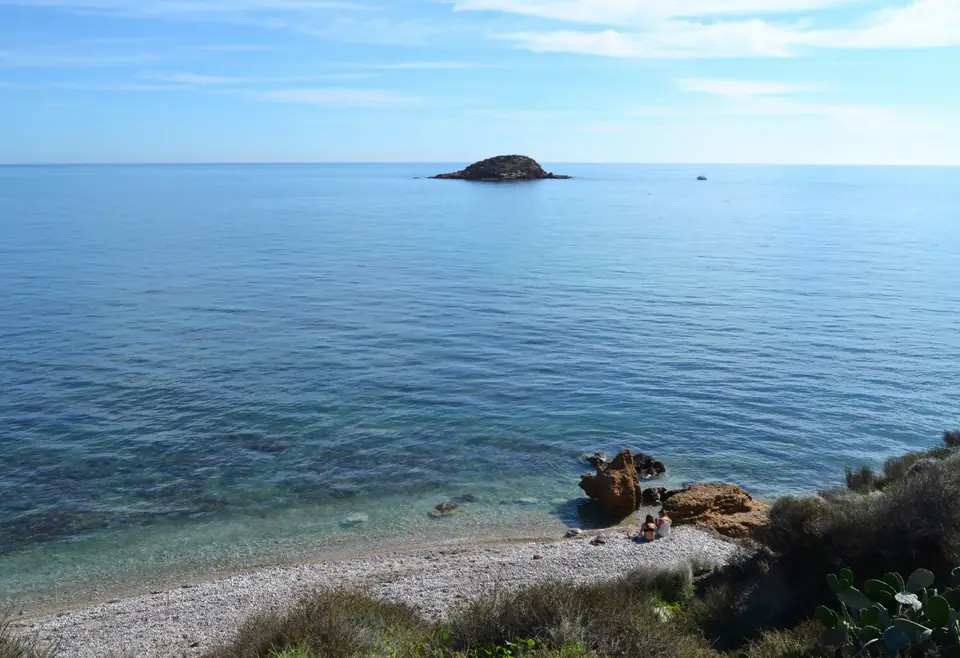
Cala de l'Olla, the platja de l'Olla to the people of Altea, mixes pebbles, rock and patches of sand along a kilometre and a half, facing two islets: l'Illeta, which can be reached by swimming, and l'Illot. For centuries l'Illeta gave sailing ships a safe anchorage against the Levante and Tramontana winds, and the bay of Altea was a place for taking on water, with fresh water from the river Algar, and for trade from Iberian times until the early 20th century. Today els Illots de l'Olla are part of the marine area of the Serra Gelada Natural Park, and l'Illeta is also a marine reserve.
The contrast is almost total: this same calm shore holds a machine-gun nest built in 1937 to stop a naval attack that never came, and is also the setting of the Castell de l'Olla, the firework castle fired from the sea before more than 100,000 people. A neighbourhood pride that, in August 2026, also left a night of injured people on the sand.
Highlights
- L'Illeta de l'Olla — an old anchorage with Roman, late-antique and Andalusi pottery on its west side
- Amphorae on the seabed — 65 pieces recovered in 2019, with amphorae of the 2nd and 5th centuries AD
- Bunker of 1937 — the best-preserved machine-gun nest in the bay, never put to use
- Castell de l'Olla — the firework castle fired from sea platforms every August since 1986
- Cap Negret — the neck of a submarine volcano from when Pangaea was starting to break up, a Natural Monument since 2020
At Cala de l’Olla the sea seems never to have done anything. And yet it has been refuge, road, threat and stage. The history of Cala de l’Olla begins on l’Illeta, the islet that sheltered sailing ships when the Levante and Tramontana blew, in a bay that was a place for taking on water and for trade from Iberian times until the early 20th century. On its west slope remain collapsed structures and Roman, late-antique and Andalusi pottery, inventoried in 2001; off the beach, in 2019, an underwater excavation brought up from the seabed 65 pieces, among them amphorae of the 2nd and 5th centuries AD.
Then came other uses. In 1937 the Republican army studded the bay with concrete machine-gun nests, and the one at l’Olla still stands on the shore. Since 1986, every August, the Castell de l’Olla turns this stretch of coast into Altea’s busiest night of the summer, with tens of thousands of people waiting on the pebbles. What to see at Cala de l’Olla therefore goes far beyond the beach: from the islet to the Portet and the volcanic rocks of Cap Negret, the complete route, documented and checked against historical sources, is best enjoyed walking the shore southwards with the audio guide.
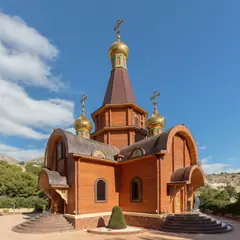
The watch over this coast began much earlier, at the Torre de Bellaguarda, and the seafaring life the cove knew as an anchorage continues today at the Port of Altea. Further north, beside the N-332, stands the Russian Orthodox Church.
Pebbles that crunch facing l’Illeta
Platja de l'Olla
Summary of this stop
The first thing that sets the platja de l’Olla apart is the sound. A kilometre and a half of pebbles, rock and small patches of sand: a texture that separates it from the fine-sand beaches of the Costa Blanca. Opposite, two islets emerge. The nearer, l’Illeta, is within reach of anyone who swims or paddles a kayak; behind it, l’Illot completes the bay’s silhouette.
That islet has more history than it seems. L’Illeta offered sailing ships a safe anchorage, sheltered from the Levante and Tramontana winds, in a bay where water was taken on from the fresh water of the river Algar. On its west side there is a site with remains of collapsed structures, probably dwellings, and pottery spanning centuries: African red slip ware of Roman times, late-antique pieces and green-glazed ceramics of the Almohad period. Who lived on that rock, and why, is the thread the narration pulls on the shore itself.
A machine-gun nest without machine guns
Concrete pillbox of 1937
Summary of this stop
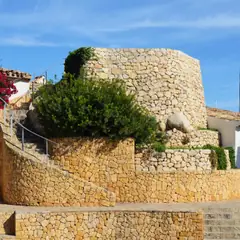
Beside the beach a concrete pillbox emerges, some 5 metres long by 4 wide and 1.85 high, with walls about 70 centimetres thick and loopholes open towards the sea. It is one of up to 8 machine-gun nests that the Republican army built in 1937 between l’Albir and el Mascarat to defend the bay of Altea against a naval attack. The attack never came, and the machine guns were never installed.
The one at l’Olla is the best preserved of them all: it sits on a solid base and its access is closed with a metal gate. Since 2017 the Town Council has promoted its preservation, and international volunteers emptied the sediment that filled its interior. A few metres out to sea, the seabed tells the other side of the same bay: in 2019 the underwater excavation co-directed by the archaeologist Pedro Jaime Zaragozí recovered 65 pieces, from amphorae of the 2nd and 5th centuries AD to modern and contemporary bowls and cups, destined for the MARQ in Alicante. A sea that was a merchants’ route and, centuries later, a frontier to watch.
The empty sea where Sant Llorenç burns
Sea facing l'Illeta
Summary of this stop
Except for one night a year, facing l’Illeta there is nothing on the water. That absence is the stage. Since 1986, on the Saturday closest to Saint Lawrence, 10 August, the Castell de l’Olla has been fired here, born as a tribute to Altea’s pyrotechnician Blas Aznar, “el tio Blai, el coheter”. Some sources place its creation in 1987, the year the Cofradía was constituted, and another version credits the idea to the Sant Llorenç Festivities Committee, which wanted a castle different from the usual ones.
What is recorded is that the castle grew until it no longer fitted on the shore: the firing was moved to floating platforms facing l’Illeta, and that allowed more gunpowder to be used. Between 2000 and 2008 it was pyromusical, with bands such as the Filharmònica Alteanense or the Primitiva de Llíria. On the night of the castle some 50,000 people wait on the coast with the “sopar de cabasset”, the home-made dinner carried in a basket.
More surprising is the origin of the saint. According to local tradition, the festivities of Sant Llorenç were born in the last third of the 19th century in the private chapel of Villa Gadea, the manor house overlooking the beach, whose owner, the jurist Vicente Gadea Orozco, had received from Pope Leo XIII the title of marquis. How a mass in a noble house ended up becoming the festival of a whole coast is one of the revelations of this stop.
The night the fire fell on the sand
South sand of the beach
Summary of this stop
The southern stretch of the beach sums up the scale of the Castell de l’Olla. In August 2025, in its 37th edition, the castle was fired entirely from the sea, from five double platforms 250 metres off the coast and 100 metres apart, before more than 100,000 people, and ended with 250 thunderclaps.
A year later, in the early hours of 9 August 2026, during the 40th anniversary, a shell strayed and fell on the sand of this southern area, where spectators were sitting. There were 27 injured: 14 were taken to hospitals and 13 treated at Altea’s health centre, many of them in the crush afterwards. The mayor spoke of a failure in one phase of the firing from the platform, and the cause of the deviation was left pending investigation.
Behind that grandeur there is, according to the town’s memory, a stubborn man: José Ángel Navarro Montaner, Pepe “Barranquí”, Altea’s official chronicler, publisher, restaurateur and great driving force of the Castell, who in 2006 opened a restaurant under the pines beside this same beach. What he wrote for the 30th anniversary, and the sentence with which his son bade him farewell, give this shore a very personal dimension.
A tiny harbour on top of a volcano
Cala del Soio
Summary of this stop
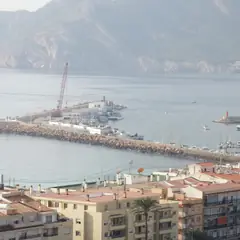
At the end of the beach, beside Cala del Soio, the Portet de l’Olla boasts of being the smallest harbour in the Comunitat Valenciana, with room for some 33 boats. In December 2022 Altea’s council asked unanimously for the early buy-back of its concession, which expired in June 2023, to protect Cala del Soio.
The small sustains the large on land too. The Castell is organised by the Cofradía del Castell de l’Olla, a non-profit body constituted in 1987 by 30 members; in 2017 there were eleven, and it is said that most of the residents of l’Olla hand their donation to the president in person every year, sometimes in the middle of the road. Even the gesture with which that poster was unveiled had something homespun about it.
Beneath it all emerge the dark rocks of Cap Negret: a volcanic outcrop more than 225 million years old, with its fossil beach, declared a Natural Monument in 2020. Those blackish basalts are the neck of a submarine volcano that erupted some 220 million years ago, when Pangaea was starting to break up, and with them the route through the history of Cala de l’Olla closes.