Watchtower
Torre de Bellaguarda Audio Guide
At the highest point of Altea’s old town, a stone viewpoint marks the site of the medieval tower of Bellaguarda: the settlement that failed and ended up giving name and shape to the whole town.
- 25 min of audio
- Historic viewpoint
The history of the Torre de Bellaguarda begins in the 13th or 14th century, when the original tower formed part of the Castellet de Bellaguarda, a bulwark around which a Christian settlement arose, separate from and independent of Altea la Vella. In the 16th century, rectangular in plan and with rubble-masonry walls, it was a coastal lookout point against pirate raids. Today it is listed as an Asset of Cultural Interest.
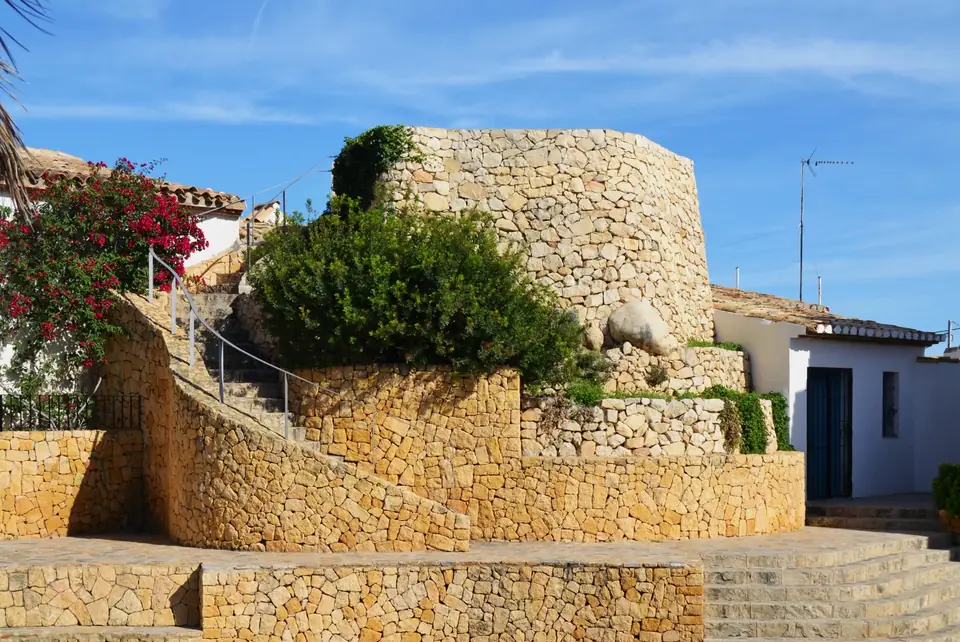
The contrast is stark: the stone seen today is a non-historical reconstruction of 1990, built during the renovation of the Plaça de la Cantereria. The authentic medieval trace is not in its walls, but in the quadrangular outline of the square and of the houses around it, which repeat the old enclosure of the tower and its hamlet.
Highlights
- Viewpoint over the bay of Altea and the Sierra de Bernia
- Plaça de la Cantereria — the layout of the old medieval enclosure
- 16th-century watchtower facing the Barbary corsairs
- Settlement charter of 1617 — the origin of today’s Altea
- Molí de Bellaguarda — a water mill from the 14th to 16th centuries
Few towers on the Costa Blanca hold a paradox like this one. The Torre de Bellaguarda, at the highest point of Altea’s old town, is at once the newest stone and the oldest place in the town: its masonry was laid in 1990, but the site it occupies holds the medieval seed of the whole settlement. Around the Castellet de Bellaguarda there arose, in the 13th or 14th century, a Christian settlement that was depopulated again and again and that, even so, ended up lending its site to the Altea that now descends towards the sea.
Altea’s history is read from up here. It is said that in the early 14th century the admiral Bernat de Sarrià wanted to found a town on this coast and that several brawls prevented him, so that he ended up founding Benidorm. Centuries later, in 1705, in the middle of the War of the Spanish Succession, the bay the tower watched over welcomed the Anglo-Dutch allied fleet of Lord Peterborough, and tradition recalls that the townspeople’s support for the landing earned the town the crown of the double-headed eagle on its coat of arms. The tower’s silhouette is still an emblem: in 2024 it framed the Moors and Christians poster by Salvador Gomis, as lookout and origin of Altea.
The narration, documented and checked against historical sources, covers the square, the viewpoint and the slope that goes down to the church, and takes on its full meaning right there, with the bay in front.
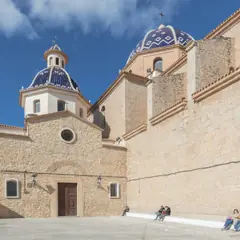
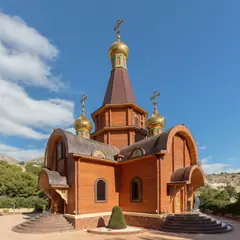
A few steps away, the domes of the Our Lady of Consolation Church occupy the same height that was fortified against the corsairs, and the defence of the bay has its 20th-century chapter in the Republican bunker at Cala de l’Olla.
The square that outlines a vanished castle
Plaça de la Cantereria
Summary of this stop
The route starts in the middle of the Plaça de la Cantereria, where stands the stone volume that everyone identifies as the Torre de Bellaguarda. Its rough masonry is deceptive: the tower was in service until the 16th century, and what is seen today is a non-historical reconstruction built in 1990, during a deep renovation of the square. Some tourist guides still present it as the preserved watchtower, and the sources do not fully agree on the chronology of its origin either.
The true medieval trace is in the ground. The original tower, from the 13th or 14th century, was part of the Castellet de Bellaguarda and, together with its hamlet, occupied a quadrangular space that coincides with the present square and the houses around it. Linked to that complex was the Molí de Bellaguarda, also called Aljub, a water mill on the Costera del Mestre Música that was used between the 14th and 16th centuries. Nothing of the bulwark remains in view; according to tradition, the name of the place comes from the “bella guarda”, the fair guard, that protected the surrounding houses.
Today the tower is listed as an Asset of Cultural Interest, and an open question hangs over it: two versions dispute whom the first tower protected, whether the settlement that is today Altea la Vella or a rival settlement that would end up keeping the name of Altea. The answer to that enigma is better understood standing in the middle of the square.
An open horizon for spotting corsair sails
Tower viewpoint
Summary of this stop
The stairs lead to the top of the viewpoint, and from there it is understood at once what the tower was for. In the 16th century, rectangular in plan and made of rubble masonry, it was a coastal lookout point within the system that warned of pirate raids. At the other end of the municipality, at Punta Galera, its counterpart was built in the middle of that century, the Torre Galera, circular in plan and wider at the base than at the top, today inside a private home.
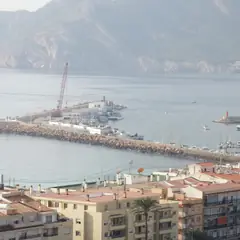
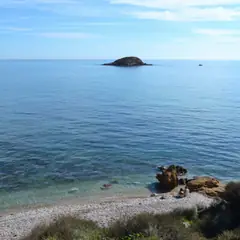
The horizon takes in the bay of Altea and the Sierra de Bernia, and at the foot of the sierra lies Altea la Vella, the settlement from which Bellaguarda was born separate and independent. It is the same landscape the lookouts scanned, and it was not always enough: according to the town’s chronicles, in 1526 Altea was sacked by Barbary corsairs, and in 1529, 1546 and 1584 there were further landings and raids in the surrounding area, although without ever occupying the fortress on the hill.
Only in 1597 did a modern wall manage to deter further raids. What that waiting before the sea meant, decade after decade, is what the narration reconstructs up there, with the same waters in view.
The town that came down from the hill like a pine cone
Old town on the slope
Summary of this stop
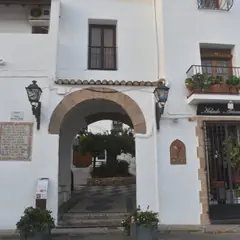
At the start of the slope towards the church, the white houses spill down the hillside. Bellaguarda had been a medieval repopulation project of little success, with several depopulations through the 14th and 15th centuries, but its fate changed with the Palafox family. The Valencian Cortes of 1604 record that the lord of the barony, Francisco de Palafox, had made a walled town called Altea that took in the castle formerly called Bellaguarda.
On 11 January 1617, Martín de Àlava y Palafox, procurator of Jaume Palafox, signed with Francisco Alvado, Juan Barber and other settlers the settlement charter of present-day Altea. The new town was set on the slope of a small hill with a layout described as “like a pine cone”, the same old town that today descends from Bellaguarda; how many families originally settled it is a point on which the sources do not agree.
Peace proved more destructive than the pirates: through the 18th century, with the corsair danger receding, the castle on the hill was pulled down, and in the 19th century official and commercial life moved down to the settlement growing beside the sea. The neighbourhood, however, did not leave: every June Bellaguarda celebrates its festivities in honour of the Holy Trinity. How the last piece of this story fits is the ending the narration reserves for the slope.