Fishing port
Port of Altea Audio Guide (Puerto de Altea)
Trammel-net boats, a fish market with a solar roof and the sailboats of a yacht club share the same basin at the foot of white Altea, on a shore that for centuries was a shipyard, a customs house and a smugglers’ hideout.
- 40 min of audio
- Seafaring tradition
The history of the Port of Altea begins before there were quays. For centuries the boats were hauled up onto the beach of the Raval Mariner, the fishermen’s quarter that more than three hundred years ago already had a customs house, a guardhouse, trade agents and consulates of several countries. In the mid-19th century, llaüts, xebecs, small boats and luggers of up to 25 tonnes loaded here each year some 1,300 tonnes of carob, 140 of raisins, 85 of almonds and 80 of dried figs bound for Barcelona, Mataró, Málaga, Mahón, Cádiz or Ceuta.
Alongside the trade figures runs another story, that of the words that could not be said on board. On Altea’s boats a vessel never sank and a sailor never drowned: they “were lost”. When counting nets, the number thirteen was skipped, nobody went out to fish on All Saints’ Day because, according to belief, the sea returned only “skulls and crosses”, and against bad luck one touched iron, not wood. That “toca ferro” can still be heard in the Marina.
Highlights
- Raval Mariner — customs house, consulates and boats hauled up on fig-wood logs
- Fish market — the fish auction and 218 solar modules on the roof
- Club Náutico de Altea — 360 berths and almost half of the port
- Enfilacions — the Consuelo bell tower as the skippers’ secret sign
- Dique de Levante — a breakwater repaired in 2021 after the storms of 2020
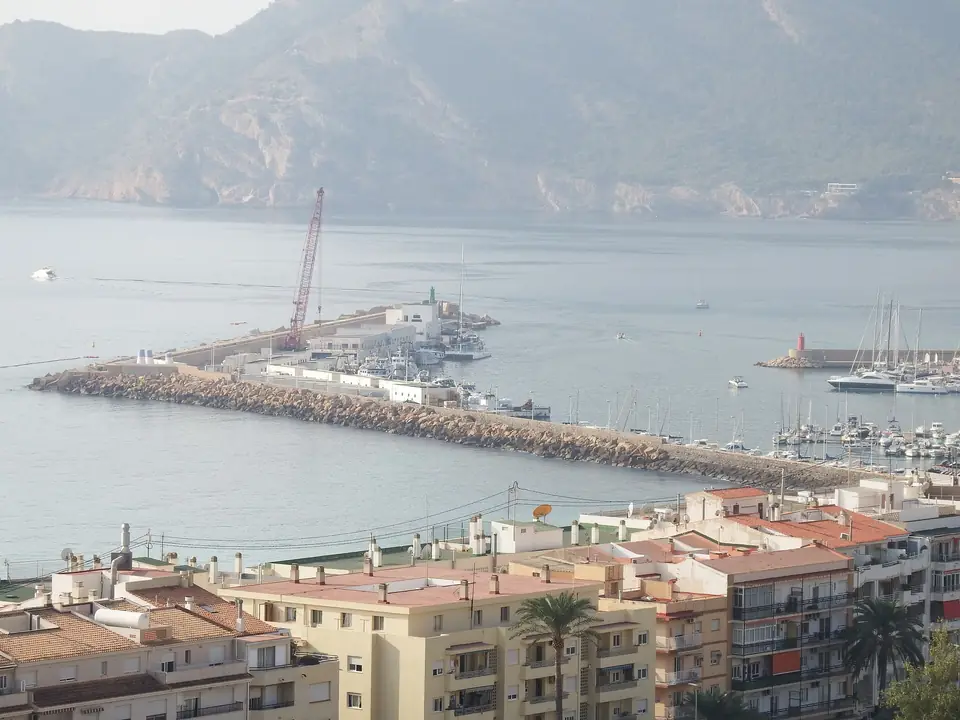
From the quay, the Port of Altea looks like a Mediterranean port like many others: fishing boats, yachts, a fish market and a breakwater of blocks. But the history of the Port of Altea is that of a shore that always lived from the sea and that kept changing shape without changing trade. First it was a beach for hauling boats up, with boats dragged over fig branches; then a commercial frontier with a customs house and consulates; since the 1950s, a basin to which boatbuilding, the unloading of fish and the mending of nets moved. In 1956 the last ship loaded with almonds docked and the Casa Aduana closed. Today the fish market sports solar panels and almost half of the berths belong to the Club Náutico.
On that shore stories also pile up. The sailors of the late 19th century told of the “Viaje prodigiós”, the legend of a llaüt that dawned wet without having sailed, of spectral crews and of a branch with coffee beans brought, according to the tale, from Cuba. And every July, at the seafarers’ festival of Sant Pere and the Mare de Déu del Carme, the images go down in procession to the port and the bay is covered with wreaths of flowers for the sailors who did not return. Walked from end to end, from the seafront promenade to the head of the Levante breakwater, the port is understood in a different way with the audio guide, documented and checked against historical sources.
Up the bay, Cala de l’Olla was the old anchorage of the Altea coast, and at the top of the old town, the Schlotter Foundation recalls the German engraver who arrived drawn by this same light.
A beach that was a port without quays
Start of the seafront promenade
Summary of this stop
At the start of the seafront promenade, where today people stroll in front of the old Raval Mariner, there were for centuries neither quays nor breakwaters. Boats were hauled up on the sand by dragging them over the “parats”, fig logs and branches laid like sleepers that the sailors’ children greased; hence the expression “enseuar els parats”. And yet it was a port in every sense: more than three hundred years ago the fishermen’s quarter had a customs house, a guardhouse, trade agents and consulates of different countries.
Where there is a customs house there is smuggling. In 1790 the Genoese captain Andrea Fenochio travelled through several villages of the region buying goods to ship from Altea and ended up accused of smuggling. Genoese too was, according to a story that the town takes as true, the skipper of the boat that one morning appeared on the beach fleeing the royal schooner, with a stash that the neighbours agreed to hide in their homes.
How that episode ended is summed up by an expression that is still alive in Altea’s speech, “barqueta de genovesos”. What the phrase means, and what the ghosts and goblins told of this shore were really for, is revealed by listening to the narration at the very place where the boats were hauled up.
Three trammel nets and a market with a solar roof
Fish market
Summary of this stop
In front of the fish market, the fishing quay keeps the pulse of the work: the fish auction when the boats return, the sheds where nets and tackle are kept and the ice factory. Since 2026 the roof of the market and of the sheds supports a 119.9 kWp photovoltaic plant with 218 modules. Before this quay, the sailors’ associations built on the shore the Caldera, for dyeing nets, and the Prado, for unloading and auctioning fish; both buildings have disappeared without a visible trace.
The trade, meanwhile, has narrowed. In December 2019 only three small-scale trammel-net fishing boats were left in the port, and a four-year agreement between the Town Council and the Cofradía assigned them 2,000 euros in exchange for reporting sightings of cetaceans and turtles to the Serra Gelada Natural Park. In 2024 the Cofradía’s head skipper, Antonio Ferrer, put the fall in business over the last five to ten years at more than 30 %, with the white prawn as the only catch holding up. The real size of the fleet varies according to the source and what is counted, because trawling is not the same as small-scale gear.
In the old fishermen’s quarter the return of the boats did not only fill the market: it also decided the shops’ accounts. Since the sailors were paid by share, goods were bought on credit, and it is said that tía Teresa Carreta, with her grocery store on Calle de la Acequia, waited each afternoon at the door for the crews with a single question. That question, and the ledger she opened afterwards, are part of this stop’s story.
Half a basin for the club’s sailboats
Pontoons of the Club Náutico de Altea
Summary of this stop
Before the pontoons of the Club Náutico de Altea, the sail seen is for leisure. But the town had a long tradition of sail coasting trade with Cádiz, Santander, Genoa or Marseille, and the last ship loaded with almonds did not dock here until 1956, the same year the Casa Aduana closed. Today the club manages practically half the port, with 360 leisure berths, a 5-metre-deep entrance and the renovated P-I pontoon; the port has flown the Blue Flag since 1988.
That division of the basin was made with official paperwork. In 1980 the authorities granted the club a concession to build and operate a nautical-sports facility inside the port, which expired in 2000. There followed 26 years of temporary authorisations, from September 2000, until the Generalitat Valenciana extended the concession to 22 September 2030. The sources do not agree on the chronology of the sports side: some place the club’s founding in 1977 and others speak of a remodelling in 1985 to include a marina.
Between the slipway where boats are hoisted and the yachts moored next to the fishing boats, the architecture of the Port of Altea tells of a change of use that the narration follows step by step.
Reading the town from the end of the breakwater
Head of the Levante breakwater
Summary of this stop
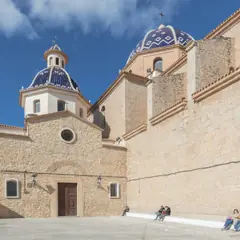
At the end of the Levante breakwater, the rubble mound that closes the port on the open-sea side, the town appears whole: the whitewashed old town and, at the top, the bell tower and blue dome of the Consuelo church. For Altea’s skippers that silhouette was a navigation instrument. They fixed their position in the bay with the “enfilacions”, secret alignments of landmarks that included the Consuelo bell tower itself and the house of the Canonge.
That house, the large mansion on the tossal de les Quintanes that belonged to the canon of Zaragoza cathedral José Lloret Tecles, had a problem on board: on Altea’s boats it was forbidden to name any clergyman, whom they called “those in the robe”. According to tradition, the sailors solved the taboo by changing two letters of the name, and the result was a house christened with an object it never had on its façade.
The breakwater also has its recent history. After the storms of 2020, the Generalitat allocated in 2021 1,681,679 euros to repair its trunk and head, and since the head was out of reach of cranes from the quay, it was reinforced with blocks by sea. With the swell hitting the rubble mound, the end of the route turns the gaze back to the town as the skippers read it.