Renaissance wall
Portal Vell Audio Guide
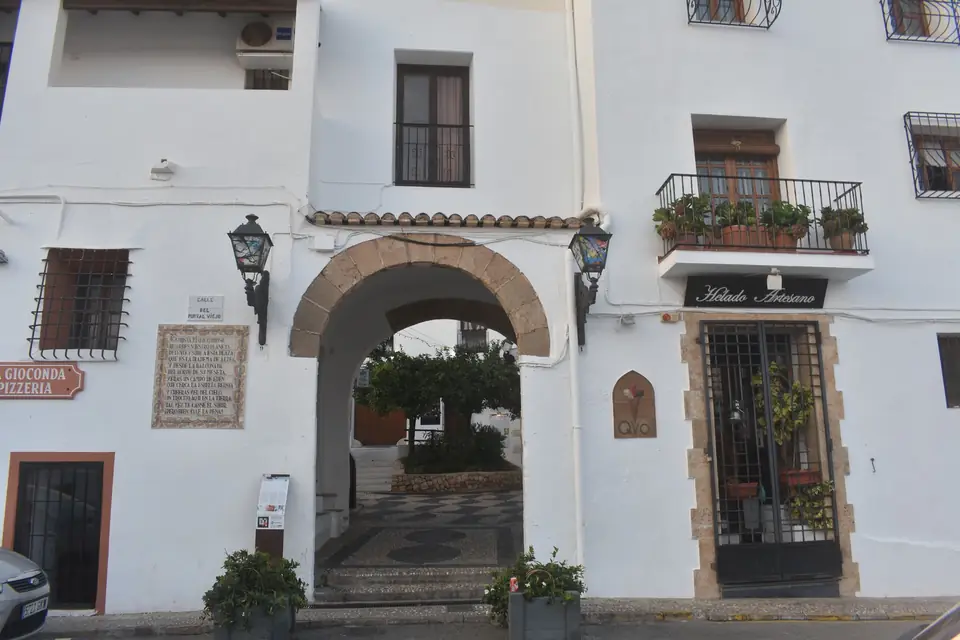
The north gate of walled Altea, the Valencia Gate that opened the town onto the royal road, is the gate of the enclosure that the 2013 decree described as in perfect condition. Through it the old town is entered, and through it its Christ leaves and returns.
- 25 min of audio
- Historic Ensemble (BIC)
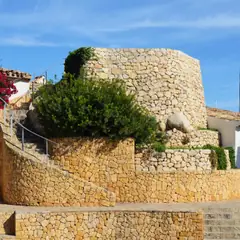
The Portal Vell was one of the two original gates of Altea’s wall: it opened in the north stretch, towards the royal road, while the other, the Portal del Castell or de Polop, faced west. As early as 1604 the Corts Valencianas recorded that the lord of the barony, Francisco de Palafox, had made a town called Altea and enclosed it. It is the gate that Decree 69/2013, in declaring the Bulwark and Renaissance Enclosure of the Town of Altea an Asset of Cultural Interest, described as in perfect condition.
The story of this gate is also read in what is missing: the houses that stood in front of it were pulled down and are now a garden, and the small square tower that guarded it at the corner vanished without leaving anything standing. Behind the arch, by contrast, Calle Mayor preserves intact the layout of parallel streets from which the whole enclosure starts.
Highlights
- Valencia Gate — one of the two original gates of the wall, open to the royal road
- Perfect condition — how the 2013 Asset of Cultural Interest decree described it
- Garden in front of the gate — on the site of demolished houses, one of only two alterations to the founding layout
- Calle Mayor — the straight, original axis that climbs to the Plaza de la Iglesia
- Christ of the Sagrario — in Lent it leaves the enclosure and re-enters through this arch
Altea did not grow around a gate: it was laid out from one. The Portal Vell, also called the Valencia Gate, opened in the north stretch of the wall towards the royal road, and from its arch starts Calle Mayor, the axis from which all the enclosure’s parallel streets branch. The history of the Portal Vell is that of a purpose-built town: in 1604 the Corts Valencianas recorded that Francisco de Palafox, lord of the barony, had made a town called Altea and enclosed it, and on 11 January 1617 its settlement charter was agreed with Francisco Alvado, Juan Barber and other settlers.
The exact date of the wall is still debated: some sources take it back to the Christian conquest of 1244 and others to 1597, while the 2013 decree speaks of a newly built Renaissance enclosure. What is not disputed is its reason, a coast plundered by Barbary corsairs throughout the 16th century. In 2013, Decree 69/2013 of the Consell declared the Bulwark and Renaissance Enclosure of the Town of Altea an Asset of Cultural Interest, as a Historic Ensemble, and the Portal Vell was its gate in perfect condition. Its full story, documented and checked against historical sources, is best enjoyed by crossing the arch with the audio guide.
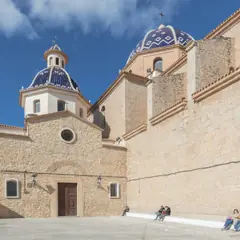
Up Calle Mayor, the climb ends before the Our Lady of Consolation Church and its blue domes, and facing that same climb, a 17th-century house holds the Schlotter Foundation.
A garden where houses once stood: what is missing before the gate
Portal Vell
Summary of this stop
Before the arch, the visitor finds an open space that was not in the original plan. In front of the Portal Vell stood houses that were pulled down, and their site became an urban garden: together with the one in the Plaza de la Iglesia, it is one of only two alterations to the founding layout of the enclosure. That absence now opens the view onto the entrance and allows the gate to be read as it was seen by those arriving along the royal road.
At the corner beside the gate there was also a small square-plan tower, one of the four complementary defensive elements of the wall. Nothing of it remains standing, and its site is an archaeological precaution area under Decree 69/2013. Right opposite the climb, at the corner of the streets Santa Teresa and Calvari, a 17th-century house has housed since 1995 the foundation of the German engraver Eberhard Schlotter.
This corner has its own festival too. Every Saint John’s Day, at the Plantà de l’Arbret, the young people of Altea carry on their shoulders a poplar that can exceed twenty metres, and their route passes along Calle Calvari, the one that opens in front of the climb to the gate, while people throw water on them from houses and balconies to ease the heat. The custom is credited with a possibly Celtic origin; what happens to the tree when it reaches the top of the town is left for the narration.
The Valencia Gate and its travelling Christ
Arch of the Portal Vell
Summary of this stop
Under the arch the passage from outside to inside is felt, and with it the reason for the wall’s existence. In 1526 Barbary corsairs sacked Altea, and in 1529, 1546 and 1584 there were further landings and raids in the surrounding area. The architecture of the Portal Vell answers that fear with an enclosure financed by the lord of Altea and not by the king: thinner walls, built as a casamuro, folding into a rhomboid shape with ashlar bastions at the corners.
The old gate has a younger sister. In the mid-18th century, with demographic pressure and the weight of the Sant Pere suburb, the Portal Nou was opened in the east stretch. In 2013 the contrast between the two was clear: the Portal Nou was heavily altered by stalled works, and the Portal Vell remained the gate of the enclosure in perfect condition.
The arch is not just a passage for residents. In Lent 2025 the Santísimo Cristo del Sagrario left the parish church in a procession, went down the Carrer Major and crossed the Portal Vell on its way to the church of San Francisco, where it stayed for a week; it then re-entered through the same gate and climbed the street back to the Plaza de la Iglesia. According to tradition, the image came to Altea from Algiers thanks to a sailor of the Ronda family, and legend says that a set of scales had much to do with its rescue.
A town shaped like a pine cone: Calle Mayor
Calle Mayor
Summary of this stop
Behind the arch begins Calle Mayor, which joins the Portal Vell with the Plaza de la Iglesia. The new-settlement deed of 1617 granted the beneficial ownership in emphyteusis to 48 families, although other sources speak of 60, and describes the town as set on the slope of a small hill “like a pine cone”. From this street branch the enclosure’s parallel streets, running north-east to south-west, with a layout that has been preserved unaltered: only the names have changed, Carrer Major, d’Enmig, de Baix or Fondo, del Forn.
That regular order contradicts the tourist image of twisting streets designed to confuse invaders, although both versions keep circulating. The wall, moreover, has become façade: originally it reached the height of the guard walkway, and during the 18th century the houses that rest their backs on the wall grew over that walkway, fragments of which remain in the north and east stretches.
In Holy Week, this axis becomes a route out. The Way of the Cross goes down the Carrer Major and leaves the enclosure along Calle Portal Vell to continue along Calle Calvari, and the Good Friday Holy Burial procession also passes through here before returning to the Plaza de la Iglesia. On Palm Sunday the pilgrimage makes the opposite journey and enters through the old Valencia Gate towards the top of the town.