The dome of the Mediterranean
Our Lady of Consolation Church Audio Guide (Iglesia de Nuestra Señora del Consuelo)
The blue domes seen from the sea crown the highest point of Altea, right where a castle and a fortress-church once stood. Beneath them, a Virgin who replaces a lost one and a Christ who, according to tradition, was bought for a handful of coins.
- 40 min of audio
- Blue ceramic domes
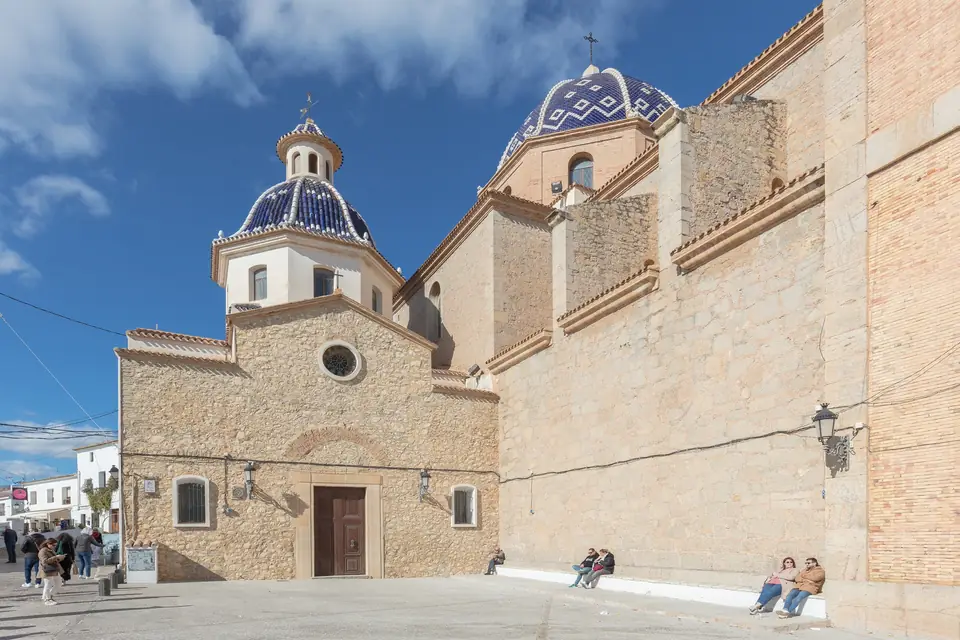
The Church of Our Lady of Consolation, the “Upper Church” to many locals, occupies the summit of Altea’s old town. It began as an austere, defensive church started in 1607 inside the walled town, to a design by Pere and Damià de la Càmara, and finished in 1617. The present neo-Baroque building went up between 1901 and 1910 on the initiative of the parish priest Juan Bautista Cremades Peiró, to a design by the brothers Adrián and Julio Vela Gadea, reusing pieces of the earlier church.
Altea’s most famous image is the result of a decision with a name attached: Cremades Peiró had the façade set back and a second, smaller dome added, clad in cobalt-blue modernist tiles. Those two ceramic domes, visible from the seafront and the beaches, ended up giving the town its nickname: “the dome of the Mediterranean”. And among their tiles peek out dragon-shaped figures that only reveal themselves to a slow look.
Highlights
- Two glazed-tile domes — blue with white courses, visible from the seafront and the beaches
- Dragons and a white spine — details hidden in the tiles of the dome
- Classicist façade — rose window, niche for the Virgin and two bell towers, the left one taller
- Our Lady of Consolation — polychrome carving of 1941 from the workshop of José Rabasa Pérez
- Communion Chapel — a former freestanding chapel of 1854-1856 holding the Christ of the Sagrario
From the beach they seem to float above the white houses: two domes of blue and white tile that have become Altea’s signature. The history of the Church of Our Lady of Consolation, however, begins long before that postcard. In 1607, three years after the fortified town of 1604 was completed, work started inside its walls on a church that was not in the original plan, defensive and austere, built by the architects Pere and Damià de la Càmara. It was finished in 1617, the same year as the founding charter of the new Altea, and in 1640 it was granted parish status. The dedication to Consolation most probably arrived with Augustinian friars who held important ecclesiastical posts in the region during the 17th century.
The church visited today is a different one: neo-Baroque, built between 1901 and 1910 and consecrated on 18 September 1910. The sources do not always agree on the dating of its origins and of the present building, nor do all descriptions count the same domes, small disagreements that are part of its story. Restored between 1980 and 1989, it was declared an Asset of Local Relevance in 2007 and since 2013 it lies within the Asset of Cultural Interest “Baluard i Nucli històric renaixentista d’Altea”. What to see at Our Lady of Consolation Church goes far beyond the façade: the square where a castle stood, the architecture of its domes, a post-war Virgin and a Christ with a legend. All of it is understood best by walking it with the audio guide, stop by stop, on top of the hill.
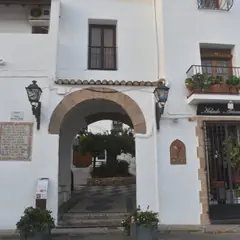
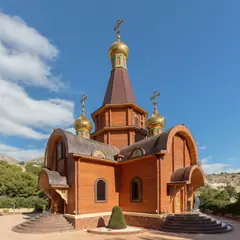
From the viewpoint beside the church, the site of the Torre de Bellaguarda recalls the fortified core from which the town was born, and down Calle Mayor waits the Portal Vell, the north gate of the walled town. The blue domes also have an unexpected counterpart on the outskirts: the five golden domes of the Russian Orthodox Church.
A square born from a demolished castle
Cronistas de España viewpoint
Summary of this stop
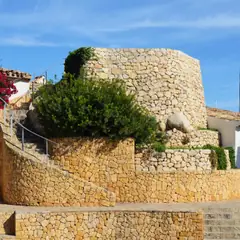
The climb up the old town’s slopes ends at the Plaza de la Iglesia and, a few metres on, at a viewpoint open over the bay. That openness has a trick behind it. In the second half of the 19th century the bastions and the castle that surrounded the church were demolished; today they are known from descriptions such as Pascual Madoz’s Diccionario of 1845-1850 and from drawings of the period. The disappearance of those structures allowed the square to be enlarged in the early 20th century, at the highest part of the town.
What is missing here is as eloquent as what can be seen: the square occupies the site of the old fortress that protected the church of 1607. And every September that past returns as a festival. During the Fiestas Mayores, the Moors and Christians troops, who have paraded in Altea since 1979, climb from the Plaza de la Cruz to the Christian Embassy set up in this very square, amid battle cries, declaimed embassies and the Moorish surrender, while gunpowder bursts from a castle built expressly for the occasion.
A real castle that was pulled down and another, take-it-apart-and-put-it-up castle assembled every year on the same spot: the viewpoint holds more layers than it seems, and the narration on site uncovers them one by one.
Altea’s postcard has an author
Façade and bell towers
Summary of this stop
In front of the main façade appears the classicist face of the church: a round-arched doorway, a niche with the image of the Virgin, a rose window, a plain pediment and two bell towers, the left one taller. That façade is not where it used to be. During the works of 1901-1910, the parish priest Juan Bautista Cremades Peiró had it set back and a second, smaller dome added, clad in cobalt-blue modernist tiles. The design was by the brothers Adrián and Julio Vela Gadea, who reused elements of the earlier church.
From that decision came the image that identifies the town today. The two blue ceramic domes, visible from the seafront and the beaches, gave Altea the nickname “the dome of the Mediterranean”. It is also said that during the works the townspeople carried the materials up by hand, stone by stone, to the top of the hill.
The architecture of Our Lady of Consolation Church also hides a game for those who look slowly: dragon-shaped figures and a row of white tiles running along the dome like a spine. Finding them requires knowing where to look.
White, gold and a Virgin who replaces another
Image of Our Lady of Consolation
Summary of this stop
Inside, the church opens out on a Latin-cross plan, with chapels between buttresses, a barrel vault and a polygonal apse with a balcony and ambulatory. The decoration of golden floral motifs on a white background gives the nave a luminosity that contrasts with the defensive sobriety of its predecessor. It is the interior that José Beneyto y Beneyto consecrated on 18 September 1910.
At the far end, the titular image holds an absence. The original carving of Our Lady of Consolation was destroyed at the start of the Civil War, in 1936; the one venerated today dates from 1941, a polychrome wood carving commissioned from the workshop of José Rabasa Pérez in Valencia. Its dedication, by all indications, reached Altea with the Augustinians of the 17th century.
The town’s bond with its Virgin is still being written. In 2013, the first year a Comisión de Quintos organised the Fiestas del Cristo, the offering on Sunday 15 September replaced flowers with milk, nappies and oil for Cáritas. What that gesture says about Altea is better told in front of the altar.
The scales of the Christ of the Sagrario
Communion Chapel
Summary of this stop
The Communion Chapel began as something else: a freestanding chapel dedicated to the Holy Christ, built between 1854 and 1856 beside the church, which the works of the early 20th century ended up joining to the building. Inside is kept the polychrome carving of the Santísimo Cristo del Sagrario, Altea’s best-loved image.
Its arrival in the town is a matter of legend. Altea tradition tells that a sailor of the Ronda family, a prisoner in Algiers or, according to other versions, a liberator of captives, was offered the image in exchange for its weight in gold and silver, and that the scales miraculously balanced with very few coins. Several accounts of its origin have circulated for some two hundred years, and local historiography does not consider them faithful to what happened; even so, the name Christ of the Sagrario is attributed to the place where it was set, behind the parish church’s Sagrario.
The legend lives on in the calendar. The Fiestas Mayores in honour of the Santísimo Cristo del Sagrario and San Blas, born in the 18th century and held in February, were moved to September in 1987 because of the cold, and today include the floral offering to the Virgin of Consolation and the re-enactment of the Christ’s arrival in Altea. Where memory ends and the miracle begins is the question that closes the route.