Russian wooden church
Russian Orthodox Church Audio Guide (Iglesia Ortodoxa Rusa de San Miguel Arcángel)
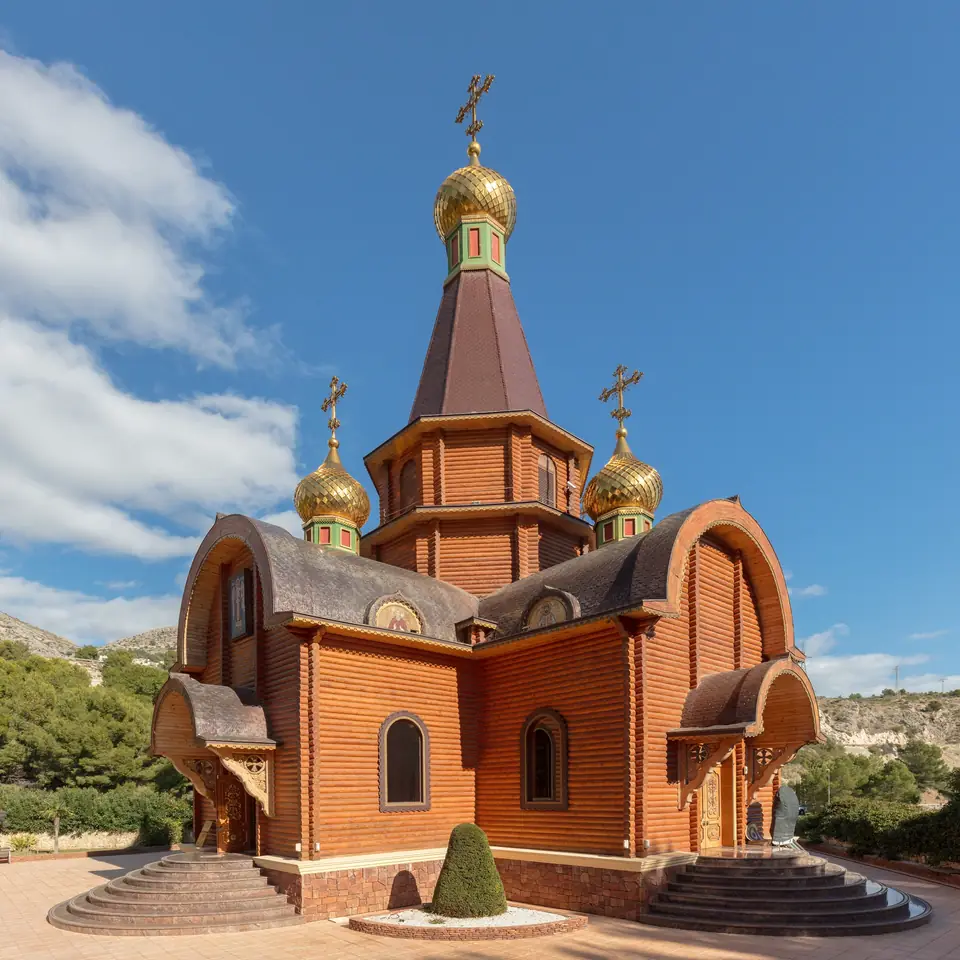
Five golden domes peek out among the pines beside the N-332: a log church copied from a 17th-century temple in northern Russia, the first church the Russian Orthodox Church built in Spain.
- 40 min of audio
- Russian wooden architecture
The Russian Orthodox Church of Saint Michael the Archangel in Altea reproduces a 17th-century wooden church from the Arkhangelsk region in northern Russia: cross-shaped plan, five onion domes and an octagonal bell tower. Its story begins in 1996, when the Botsko family, from Rostov-on-Don, bought a plot to build it; the first stone was laid in 2002 and it was consecrated in 2007 by Metropolitan Kirill, who two years later would become Patriarch of Moscow.
It is a church assembled from pieces of half of Russia: the log frame came from the Kirov region, the domes and crosses from Volgodonsk, the mosaic from Moscow hands and the icons from Sergiev Posad. Many swear that the wood came from the Urals and that a millionaire had it built for his mother; the parish’s chronology tells a different story, made of emigrants, paperwork and a famous cellist.
Highlights
- The five golden domes — onion domes with crosses made in Volgodonsk, visible from the N-332 among the pines
- The log frame — walls assembled in 2003 by workers from Kirov using the technique of northern Russian churches
- The iconostasis — a screen of icons painted in Sergiev Posad that separates the altar from the nave
- The icon of the Archangel Michael — the one that belonged to Tsar Nicholas II
- The consecration of 2007 — the future Patriarch Kirill, the choir of the Danilov Monastery and more than 2,000 attendees
Anyone driving along the N-332 at Altea comes across, among Mediterranean pines, an image that seems out of place: five golden onion domes on a body of dark logs. It is the Russian Orthodox Church of Saint Michael the Archangel, the first church the Russian Orthodox Church built in Spain and the first in the country built in Russian wooden architecture. It is not, as is sometimes read, the first Orthodox church on the Peninsula: the Greek cathedral of Saint Andrew and Saint Demetrius in Madrid opened in 1973, and the Russian embassy already had a chapel in 1761.
The history of the Russian Orthodox Church in Altea is not that of a 1990s church either, as some catalogues repeat. In that decade only the land was bought (1996) and the community of emigrants from Russia, Ukraine, Belarus and Moldova was formed. The first service was held on 7 January 2000, Orthodox Christmas, in a rented premises; the first stone came on 21 November 2002, the feast of the Archangel Michael, and the first Easter inside the church, still unfinished, on 30 April 2005. The consecration, in 2007, closed five years of works.
Between patrons, dealings with two patriarchates and coastal legends, understanding what to see at the Russian Orthodox Church in Altea calls for walking it outside and inside. It is the four-stop itinerary that the EarGuide audio guide follows, documented and checked against historical sources.
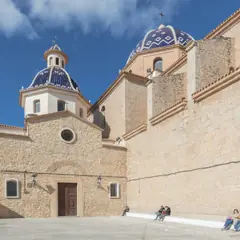
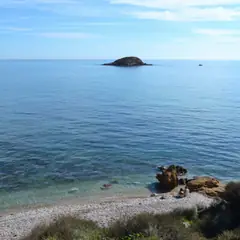
Its golden domes converse from a distance with the blue ones of the Our Lady of Consolation Church, at the top of the old town, and on the way towards the town lies Cala de l’Olla.
A piece of northern Russia by the roadside
Russian Orthodox Church of Saint Michael the Archangel
Summary of this stop
In front of the entrance to the grounds the essentials of the architecture of the Russian Orthodox Church in Altea are understood: it is not a free invention, but the copy of a 17th-century wooden church from the Arkhangelsk region in northern Russia. From it it takes the cross-shaped plan, the five domes and the octagonal bell tower. The domes, which many read as Christ and the four evangelists, were made with their crosses in Volgodonsk in 2004.
The rest also came in pieces: the log frame was made in the Kirov region and assembled in 2003 by workers from that city; the mosaic is the work of Moscow masters and the icons were painted in Sergiev Posad. In 2007, with the works still under way, a good part of the carpenters were Siberians used to 50 degrees below zero, who worked in T-shirts when in Altea the thermometer dropped to 5. A Ukrainian dancer, Inna Gurishkina, a star of the Benidorm Palace, cooked Russian dishes for them as a volunteer.
It is often repeated that the wood came from the Urals, or even from Siberia, and that the model was a church from the Urals. The history of the building points to another map, and the difference between what is told and what happened is left for the narration, in front of the logs themselves.
The church that had to leave the town centre
Octagonal bell tower and cross-shaped plan
Summary of this stop
Walking round the church, its cross-shaped plan appears clearly, the same layout that the patronal festival procession follows, and the octagonal bell tower inherited from the northern model can be made out. That outer circuit also tells why the church is where it is: the permit and the location were negotiated for years with the local authorities and ended up being unblocked thanks to the cellist Mstislav Rostropovich, on one condition: build outside Altea’s town centre.
Behind the building there is a promoter with a name. In 1996 the Botsko family, from Rostov-on-Don, bought the land and commissioned a first project for a stone church, although a 2007 report claimed that the plot had been donated by the Town Council. The church was built with funds from the company Vera Bosco and does not belong to the Patriarchate of Moscow but to its promoter; Mikhail Botsko, founder and patron of the church, received the Order of Saint Sergius of Radonezh in 2007.
On the coast another, more novelistic version circulates: that of a Russian millionaire who supposedly built the church for his mother, or who built it because she set an Orthodox church as a condition for moving to Spain. Whether it was a whim, a family promise or the faith of a whole community is one of the questions the audio guide leaves open at this point.
The consecration that brought together a patriarch, a bishop and a grand duchess
Iconostasis
Summary of this stop
Inside, the nave gathers into a half-light of wood, gold and candles, closed at the far end by the iconostasis: the screen of icons with a larger central door and two side ones that separates the altar from the faithful. Before it, on 11 November 2007, the great consecration of the church was celebrated, presided over by Metropolitan Kirill of Smolensk and Kaliningrad, then head of External Relations of the Patriarchate of Moscow and patriarch since 2009, with the choir of the Danilov Monastery of Moscow and more than 2,000 faithful and guests.
The list of attendees could only be given here: the Catholic bishop of Orihuela-Alicante, Rafael Palmero; the mayor of Altea, Andrés Ripoll; and Grand Duchess Maria Vladimirovna Romanova, head of the Russian imperial house in exile.
During the rite, Kirill placed at the base of the altar particles of saints’ relics sealed with a special wax paste, the gesture that marks a church as finished and “indestructible”. What that seal means for the Orthodox liturgy, and what was left hidden beneath the altar, is told calmly in the narration.
An imperial icon and a community that prays together
Icon of the Archangel Michael
Summary of this stop
The church keeps an icon of the Archangel Michael, its titular saint, which belonged to Tsar Nicholas II. Before it the praise service of the patronal festival is celebrated, and at that of 21 November 2025 the rector Yaroslav Pirkovsky gave copies of the icon to the bishops after the procession around the church.
The community that venerates it has its own story of borders. In 1997 it asked the Patriarchate of Moscow to register the parish without obtaining a positive reply; at the end of 1999 it was entered in the Exarchate of Russian tradition of the Patriarchate of Constantinople, and only on 24 December 2004 did the Holy Synod of Moscow admit it into its Korsun diocese. By 2007 it was said that here Ukrainians, Georgians, Lithuanians and Belarusians formed a single family, united by language and faith.
Fifteen years later, with the Russian invasion of Ukraine, the church was still bringing together Ukrainians and Russians alongside Romanians, Greeks and Spaniards. In those first weeks of 2022, a priest received visitors at the door with two ribbons round his neck, one with the Russian flag and the other in the Ukrainian colours. What those ribbons said, and what the parish preferred to keep silent, is the close of the visit.