Cathedral basilica
Arequipa Cathedral Audio Guide (Basílica Catedral de Arequipa)
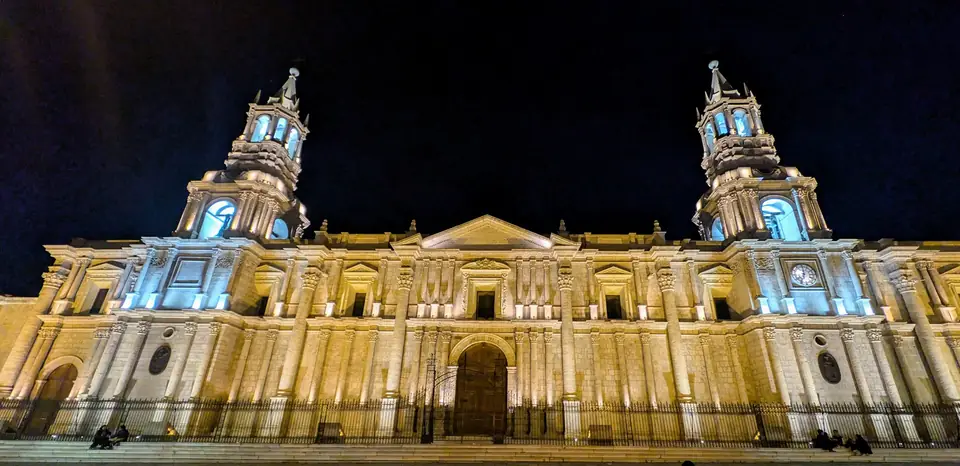
A white ashlar façade that takes up a whole side of the Plaza de Armas and that Arequipa has had to raise again after a volcano, a fire and several earthquakes. Every stone you see has survived something.
- 45 min of audio
- Ashlar architecture
Arequipa's main church began to be built on 15 August 1540, the same day the city was founded, on the plot that the founding charter marked with a cross. Since then the temple has been lost and rebuilt several times: the eruption of Huaynaputina in 1600, the earthquake of 1604, the fire of 1844, the quake of 1868 and that of 2001. The present cathedral is above all the work of the Arequipa stonemason Lucas Poblete, who rebuilt it in the nineteenth century in the white volcanic ashlar that gives the whole city its character.
Behind that solemn façade, unexpected details appear. At the foot of the pulpit, carved in Lille and installed in 1879, stands a figure of El Diablo, something unusual in a basilica. And on the face of the right-hand tower clock, next to the number IX, the hole of a bullet is still visible, which local memory attributes to the rebellion of June 1950, when students and residents barricaded themselves in the towers.
Highlights
- Ashlar façade — about 100 metres wide, seventy Corinthian columns and two 28-metre towers
- Right-hand tower clock — the four written IIII and the 1950 bullet hole next to the IX
- Oak pulpit carved in Lille (1879) — with the figure of El Diablo at its feet
- Loret organ — 12 metres high and about 1,500 pipes, crowned by King David
- Italian marble high altar — beside the Vatican flag that marks the basilica
The Basilica Cathedral of Arequipa does not look out onto the Plaza de Armas: it closes it off entirely on the north. Its history starts on 15 August 1540, when Garci Manuel de Carbajal founded the city and the charter marked with a cross the plot reserved for the main church. What stands there today is the result of almost five centuries of destruction and rebuilding: the temple that Gaspar Báez had been remaking since 1590 fell with the eruption of Huaynaputina in 1600 and the earthquake of 1604; the colonial cathedral of Andrés de Espinoza, finished in 1656, burned in 1844; the towers collapsed in 1868 and suffered again in 2001.
The history of Arequipa Cathedral is, for that reason, that of a city that refuses to lose its temple. The protagonist of the present building is Lucas Poblete, a local stonemason whom a newspaper once accused of barely knowing how to sign his name and who nevertheless left the ashlar façade that defines the square. Inside await an organ that came from Belgium, a French pulpit with a demon at its feet and an Italian marble altar. The audio guide walks through the temple in five stops, with narration that is documented and checked against historical sources, to be heard in front of each stone.
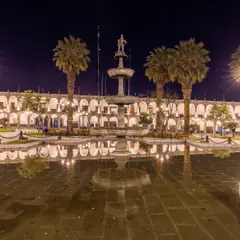
In front opens the Plaza de Armas, and on its corner the Church of the Company of Jesus tells the same story of ashlar rebuilt after every quake; the earthquake of 1868 that toppled the cathedral’s towers also left in ruins the church on whose site the San Camilo Market now stands.
Seventy columns for a whole side of the square
Plaza de Armas of Arequipa
Summary of this stop
From the gardens of the Plaza de Armas the cathedral reads as a single front of white ashlar some 100 metres long, taking up the whole north side. Seventy columns with Corinthian capitals order the façade, with three portals, a central pediment and two large side arches, and two 28-metre towers crown it. The feeling is that the temple is not in the square but part of it: no wonder, since it occupies the plot the city reserved for it on the very day it was born.
That clear view did not always exist. Before the reform of 1868, 36 kiosks crowded in front of the temple, which the clergy rented out as a source of income; the people of Arequipa, according to documented tradition, called them «los cajoncitos» for their shape and size. Their removal widened the atrium and left the façade in view from the whole square. What is surprising is when and why that decision was taken, a detail the narration reveals at this very spot.
Ash on the steps, a bullet in the clock
Atrium steps
Summary of this stop
The atrium steps, beneath the right-hand tower, keep the memory of one of the city’s most dramatic episodes. In February 1600, with the Huaynaputina volcano shaking the ground and ash falling on Arequipa, the old Main Church was partly destroyed when it was almost finished. A witness of the time left the scene written down: a whole city gathered before its steps, covered in ash, convinced it was witnessing the end of the world.
The towers that rise above are not the original ones either. The earthquake of 13 August 1868 brought down the pediment, the arches and the towers, and Lucas Poblete rebuilt them taller and more slender, with two allegorical medallions of Peru and Arequipa on their first level. The magnitude 8.3 quake of 23 June 2001 struck them again: the left tower partly fell (some sources speak of complete collapse) and the right one was left in unstable balance. The restoration, with reinforced concrete in one and carbon fibre hidden under carved stone in the other, was completed on 15 August 2002, and from outside the reinforcement cannot be seen.
On the face of the right-hand tower clock, which writes the four as IIII, there is a hole beside the IX. Local memory attributes it to the days of 12 to 16 June 1950, when schoolchildren, university students and residents risen up against General Manuel A. Odría barricaded themselves in the towers. Who fired remains unproven, and around that bullet circulates a testimony best told at the foot of the tower.
The nave that fire forced to grow longer
Loret organ
Summary of this stop
On 1 December 1844 a fire destroyed several vaults and pillars, along with many paintings, sculptures and furnishings. Two weeks later, on 15 December, reconstruction began under the direction of Bishop José Sebastián de Goyeneche and his brother Juan Mariano. Lucas Poblete pulled down the two charred vaults and lengthened the building at both ends to house the high altar and the choir, taking up part of the site of the old church of San Juan, destroyed in 1784. The nave walked today is therefore longer than the one that burned.
At the far end of that nave rises the organ by the Belgian François-Bernard Loret: a case 12 metres tall, with about 1,500 pipes and three bellows, crowned by King David and two carved angels. The most cited date places its construction in 1854 and its installation three years later, although another source takes it to 1870, and there is no agreement either on its rank among South America’s organs. It is still played several afternoons a week as maintenance, and its history has a twist that the narration keeps for this point.
The devil at the preacher’s feet
Buisine-Rigot pulpit
Summary of this stop
The neo-Gothic oak pulpit, carved in the Buisine-Rigot workshop in Lille and installed in 1879 through the efforts of the Count of Guaqui, is the most talked-about detail of the temple. At its feet appears a figure of El Diablo, accompanied by an inscription naming the donor, Xaviera Lizárraga de Álvarez Comparet. It is said that in her will she ordered the sale of her house to pay for a new pulpit brought from France.
Popular legend says that a demon wanted to destroy the cathedral and was trapped in the pulpit, crushed beneath the place from which preaching is done: every sermon treads on him again. The presence of Satan in plain view of the faithful in a basilica is still told as a small mystery. There is also an open doubt: a text of local memory speaks of a «replica» linked to the Arequipa image-maker Pablo Calle, which leaves in the air whether the present figure is the original from Lille or a copy. The audio guide sets out both versions in front of the carving.
Italian marble for the Lord of Great Power
Marble high altar
Summary of this stop
Before the high altar gather the signs of the cathedral’s rank. The altar, of Italian marble, was a gift from Bishop Goyeneche’s nephews and was installed by an Italian architect surnamed Guido; its marble columns are associated with the twelve apostles. To its right hangs the Vatican flag that distinguishes basilicas, a privilege whose rarity is put in different ways depending on the source, and in front hangs a large metal lamp of Sevillian origin.
In a side chapel, much frequented by the people of Arequipa, the Lord of Great Power is venerated. According to documented tradition, the city’s Holy Week starts here: on Palm Sunday, at five in the afternoon, the procession of the Lord of Great Power leaves the cathedral and winds through the streets near the Plaza de Armas. In other times the temple also played a role on Holy Thursday, with a ritual around twelve poor people of the city that the narration reconstructs to close the visit.