Founding square
Plaza de Armas Audio Guide (Plaza de Armas de Arequipa)
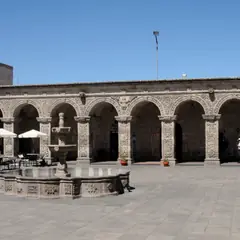
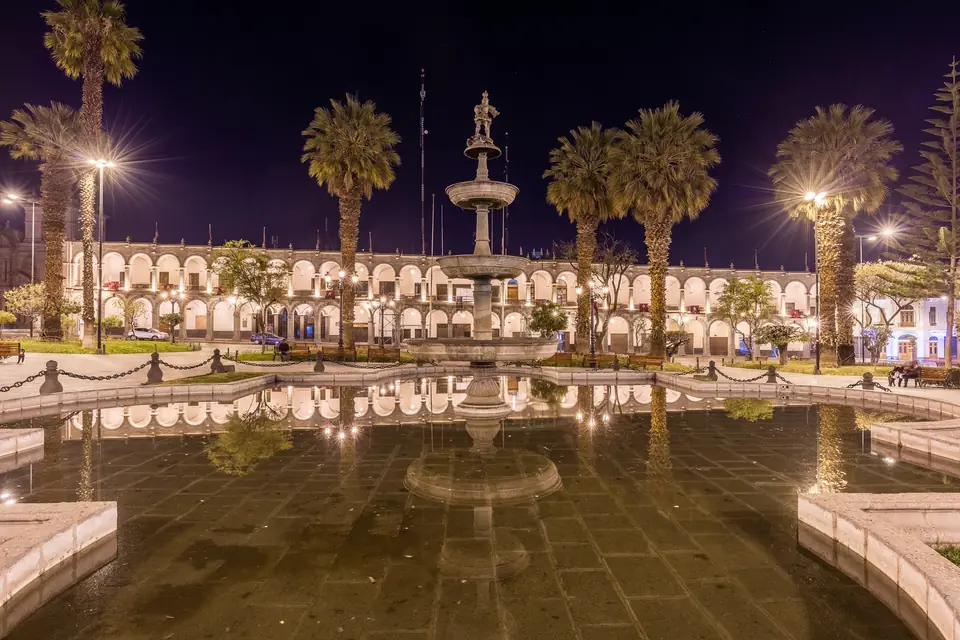
The square from which the White City was measured out in 1540 now feels like a serene lounge of palm trees and ashlar stone. Beneath its three double-arcaded portals there were once a market, a pillory, firing squads and revolutions, and from the fountain a little bronze man with a trumpet has seen almost all of it.
- 30 min of audio
- History and colonial architecture
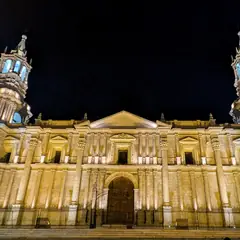
Garci Manuel de Carbajal founded the town on 15 August 1540 in the valley of the Chili River, handed out plots and laid out the grid around this main square, with blocks 400 Castilian feet on a side. Three sides are closed by the portals of San Agustín, the Municipalidad and Flores; the fourth is taken up entirely by the neoclassical ashlar façade of the cathedral, with its seventy Corinthian columns and two towers.
The upper gallery of arches that looks like it has always been there is barely sixty years old: until the earthquake of 1958, there were rooms with windows above the portals. And under one of them, a plaque reproduces the letter that a president of Peru wrote to his wife on the eve of being shot in this very square.
Highlights
- Three double-arcaded portals, with 31 arches per floor in each
- Upper gallery of ashlar arches, built from 1960-61
- Plaque with Salaverry's farewell letter to his wife Juana
- Bronze fountain of 1735 crowned by the Tuturutu
- Neoclassical ashlar cathedral along the whole north side
The history of the Plaza de Armas of Arequipa begins on the same day as the city: 15 August 1540, when Garci Manuel de Carbajal founded the Villa de la Asunción de Nuestra Señora del Valle Hermoso de Arequipa and laid it out on a grid around this space. A year later, by royal decree of 22 September 1541, the town became a city. Since then the square has been a market, a court, a bullring, a parade ground and a stage for protest. Its name comes from civic and military parades, but what it has seen most is the whole city gathered to rebel or to celebrate.
What can be seen today is a luminous square of palm trees and flowerbeds, closed on three sides by double-arcaded portals and on the fourth by the ashlar cathedral. Few things here are as old as they look. The earthquake of 13 August 1868 destroyed the cathedral’s three-tier towers and damaged two of the portals, and the city took between ten and fifteen years to rebuild. The one of 1958 left the San Agustín Portal leaning. The audio guide walks the square in four stops, from the portals to the fountain, and explains what remains from each era and what changed after each quake.
The whole north side is taken up by the Arequipa Cathedral, and a few blocks to the southeast the San Camilo Market keeps the role of the city’s pantry that the square had in its first centuries.
The square from which the city was measured
San Agustín Portal
Summary of this stop
Beneath the San Agustín Portal, the square stops looking like a space that grew over time. It is the point from which Arequipa was laid out: blocks 400 Castilian feet on a side, about 111 metres, separated by streets of 37 feet, a little over ten metres. The streets of the historic centre start from here in a straight line, and the grid of 1540 can still be read on the map.
The portal takes its name from the National University of San Agustín, founded on 11 November 1828, although it was earlier called de las Delicias after the market women, pastry sellers and sweet vendors who set up under its arches. In viceregal times the square brought together the jail and the Royal Treasury, the Indigenous market or ccatu under awnings, the proclamation of ordinances, bullfights and processions. In front of the town council stood the rollo, a stone pillar where convicts were executed. At this first stop the narration puts each of those scenes back in its place, over paving stones that now look very peaceful.
A gallery of arches where there were windows
Municipalidad Portal
Summary of this stop
In front of the Municipalidad Portal, where the town council sat from colonial times, the double arcade changes meaning. In the nineteenth century the portals had a single storey and the food market took up the square itself; it was later moved to Duhamel Park and then to the former convent of San Camilo, where it opened on 6 January 1881. The earthquake of 1958 brought down second-floor rooms at San Agustín, and between late 1960 and early 1961 this portal was rebuilt on an idea by the architect Alejandro Alva Manfredi: to replace the old rooms with windows by a gallery of arches. The solution was later extended to the other two portals.
Each portal adds up to 31 arches on the ground floor and 31 on the upper one, counting those facing the side streets. The lower ones are of stone and concrete; the upper ones, of veneered ashlar. The work did not convince everyone: the press of 1961 reported that it was advancing «despite hostile criticism», while a local historian who knew the square before and after considers it an improvement. Sources do not fully agree on the material and chronology of the portals either.
Under these arches there also survives a trade with a pedigree. Here worked the quelqueres, scribes who drafted documents for the public, and when they moved to other offices a group of students took their place with typewriters. That is how the square’s tipeadores were born, who share the space with photographers using improvised cameras and with sellers of corn for the pigeons who divided the square among themselves by zones. At this stop the narration tells where each of these characters comes from.
Salaverry’s last letter to Juana
Plaque with Salaverry's letter
Summary of this stop
On the same Municipalidad Portal, a plaque reproduces a few intimate lines: the farewell letter that General Felipe Santiago Salaverry wrote to his wife Juana on 17 February 1836. Defeated by Andrés de Santa Cruz at the Battle of Socabaya, the young supreme chief was shot in this square along with his officers; most sources date the execution to 18 February, although some give the 19th. In 1854 the Venezuelan general Trinidad Morán met the same fate in the same place, on the orders of Domingo Elías.
The square as political punishment has its reverse too: that of a city that rebelled. According to documented tradition, on 11 September 1867 the people of Arequipa refused to swear allegiance to the new liberal Constitution, promulgated under the government of Mariano Ignacio Prado, and burned it right here in defence of that of 1860. It was the beginning of a revolution led by the Arequipa-born general Pedro Diez Canseco that ended with the president of Peru besieging Arequipa in person. What happened in the second assault, in December of that year, is told in the audio guide in front of the plaque.
The Tuturutu, the square’s bronze lookout
Tuturutu fountain
Summary of this stop
At the centre of the square, the bronze fountain of 1735 is topped by a little figure playing the trumpet: the Tuturutu. It has undergone successive modifications; the first added the larger basin and changed its outline and size, and in 2002 vertical jets and coloured floodlights were installed, which the National Institute of Culture asked to have removed. The 2018 restoration brought a surprise: beneath layers of paint, the basins were of bronze and hid high reliefs, a national coat of arms and lion heads on the lower basin. For one historian, that coat of arms points to a republican origin for that part of the ensemble, later than the date of the fountain.
Who the trumpeter is is not clear either. The oldest description speaks of an angel above the basin, and the figure is said to have lost a pair of wings; other versions see him as a soldier. Legend has it that he was a trusted messenger of the Inca Mayta Cápac, of very short stature, who announced the arrival of the chasquis with his horn until the cold of the Andes turned him to stone, and that at the start of the twentieth century he spent a spell in an unexpected place.
Around the fountain the square keeps filling up: here gathered the Arequipazo protests against the privatisation of Egasa and the crowds that celebrated the 2003 Copa Sudamericana final and Melgar’s title in 2015. The last stop of the audio guide ends beside the Tuturutu and reveals where the little trumpeter spent that spell.