Cloistered citadel
Santa Catalina Monastery Audio Guide (Monasterio de Santa Catalina)
A city of nuns hidden behind an ashlar wall: streets, little squares and small houses painted indigo and ochre that lived almost four centuries with their back to Arequipa, until in 1970 they opened their only door.
- 120 min of audio
- Ashlar architecture
Founded in 1579 with the licence of Viceroy Francisco de Toledo, the Dominican monastery of Santa Catalina de Siena began with a wall: a high wall that enclosed 20,000 m² with a single door. Inside grew a citadel of 20,426 m², with streets, cloisters and cells of ashlar raised by the nuns themselves, which is still inhabited today by a cloistered community.
Behind the charm of its little streets there were money, servants and rivalries: each nun paid for her dowry and her house, around 1795 more than two hundred women lived here and, according to tradition, an austere prioress even suffered an attempted poisoning. After the earthquakes of 1958 and 1960 some proposed splitting it in two or turning it into a shopping centre.
Highlights
- Citadel of 20,426 m² — streets, squares and cells behind a wall of about 4 metres
- Cell-houses — no two alike, because each nun paid for her own
- Parlour and turnstile — the only border with the city for almost four centuries
- Cell of Sister Ana de los Ángeles — the death portrait of the blessed
- Laundry of 1770 — 20 half clay jars and a central channel
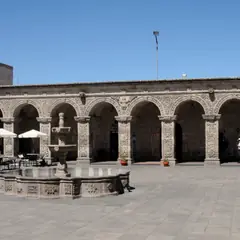
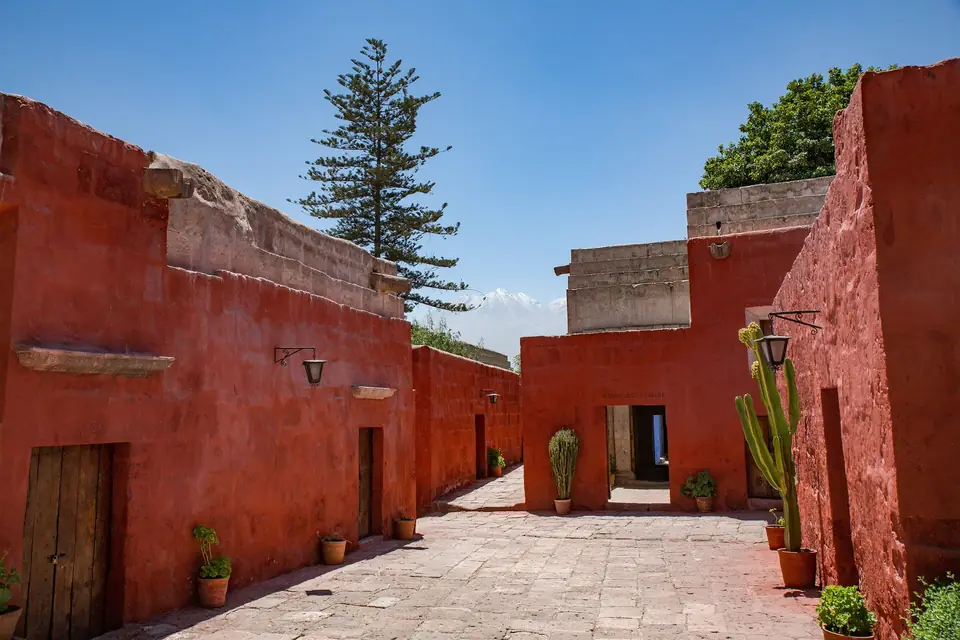
In the very centre of Arequipa, an entire block lies hidden behind a white ashlar wall. On the other side there is no ordinary convent but a town: streets named after Spanish cities, little squares with fountains, cloisters with orange trees and small houses painted indigo blue, red ochre and yellow ochre. The history of the Santa Catalina Monastery begins on 10 September 1579, when the Cabildo of Arequipa and the bishopric of Cusco signed its founding memorandum and named María de Guzmán, widow of Diego Hernández de Mendoza, «first settler and prioress».
For almost four centuries, the city could barely glimpse what lay behind its single door. The nuns lived in houses of their own, with a kitchen, a clay oven and servants; they followed a prayer timetable that began at 4:30 in the morning with the sound of the rattle, and spoke with their families through grilles and lattices. Flora Tristán, the future grandmother of Paul Gauguin, spent a week here and told of it with acid remarks in «Peregrinations of a Pariah» (1838). Only after the earthquakes of 1958 and 1960, and a long negotiation, did the monastery open to the public on 15 August 1970. The community, some 20 professed nuns, remains cloistered in a modern building separate from the visitable area.
What to see at the Santa Catalina Monastery: the gateway, the parlour, the cell of the blessed Sister Ana de los Ángeles, Córdoba Street and the laundry of clay jars. The tour with the audio guide, documented and checked against historical sources, unpacks what each corner hides: dowries, legends, conspiracies and the tenacity that saved this place from disappearing.
The other face of viceregal religious life is a few blocks to the south, at the Church of the Company of Jesus and its former Jesuit college, and a short walk away waits the centre’s other long visit, the Andean Sanctuaries Museum.
A single door in four metres of ashlar
Santa Catalina Monastery
Summary of this stop
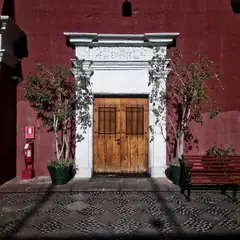
The visit starts in front of a sober gateway, carved into the ashlar wall that surrounds the whole block, with the relief of Saint Catherine of Siena. Its white contrasts with the burst of colour waiting inside. And that wall is no detail: it was the first thing built. Before cells or church, a wall was raised that enclosed the 20,000 m² of the plot with a single door for entry and exit.
Today the enclosure measures 20,426 m² and the wall reaches about 4 metres in height: a citadel embedded in the city and, at the same time, isolated from it. The foundation of 1579, with the licence of Viceroy Francisco de Toledo, turned this block into a sealed world. What it meant to live on this side of the wall is gradually revealed in the narration, at the foot of the gateway.
Speaking to the world through a turnstile
Parlour and turnstile
Summary of this stop
Beside the porter’s lodge appear the narrow rooms of the parlour: grilles, lattices and a revolving turnstile through which writings and objects passed without anyone seeing the face on the other side. It was the only border between the nuns and the city. Through those same partitions the opening of the monastery was negotiated centuries later: in 1968 the bishop promoted the arrival of new Spanish nuns, more open to the world, to overcome the community’s resistance.
The result was the opening of 15 August 1970, after a restoration directed by the engineer Eduardo Bedoya Forga and the architect Gonzalo Olivares Rey de Castro. But the parlour also keeps a tradition of the convent: that of Mother Ana de los Ángeles Monteagudo, who from behind these grilles is said to have asked the Cabildo to postpone the funeral of a bishop believed dead in a shipwreck. How that story ends is left for the audio guide.
The portrait that cured its painter
Cell of Sister Ana de los Ángeles
Summary of this stop
The cell of Sister Ana de los Ángeles is a little house like many others, but its owner was no ordinary nun. She lived almost all her life within these walls: she entered as a child pupil and later became a nun and prioress. She died in 1686, and John Paul II beatified her in Arequipa on 2 February 1985.
In the cell her death portrait is preserved, painted at her death, and around it turns one of the convent’s most curious traditions: it is said that the painter, afflicted by severe pains, was healed on finishing the canvas. The story has a second part, much more recent, that links that painting with forensic science; the narration tells it in front of the portrait.
Bought houses, maids and a hated prioress
Córdoba Street
Summary of this stop
On Córdoba Street, with its white walls, open the dwellings of nuns and servants. No cell is like another, and the reason is economic: as a «private» monastery, each nun could choose the shared dormitory or buy a piece of land within the cloister and build her own house. Some had several rooms, a kitchen with a hearth, a clay oven and even a pen for raising guinea pigs.
Taking vows was costly: a dowry of between 500 and 1,000 silver pesos in the early days, and between 1,000 and 2,400 silver coins from the end of the seventeenth century; for the «poor nuns» the townspeople paid it through collections. Around 1795 there lived here 53 black-veil nuns, 28 white-veil nuns, 12 donated sisters, 62 lay women in the convent’s service and another 70 women, including enslaved women, in the private service of the nuns.
In that world of private houses, Prioress Sister Ana de los Ángeles imposed austerity and the habit without ornament. According to tradition, the discontent ended in attempted rebellions and in some plot to get rid of her, including an attempt to poison her. The details of that tension are heard in the street itself.
Twenty jars and a convent almost split in two
Laundry of the clay jars
Summary of this stop
At the end of Toledo Street, painted intense red, appears the laundry of 1770, built beside the irrigation channel that brought the water. Twenty half clay jars served as washing basins: water from a central channel was diverted to each with a stone and left through a plug into an underground channel that carried it to the river. A simple system of surprising ingenuity.
The colour that wraps the whole route has a history too. The ashlar walls are limewashed in a reduced palette, indigo blue, yellow ochre, red ochre, orange ochre and white, with a technique kept for more than 400 years; in 2023, test cuts in the walls documented the superimposed layers of colour hidden beneath.
None of this was guaranteed. The earthquakes of 1958 and 1960 badly damaged the convent, which was left out of the restoration plan of the Arequipa Rehabilitation and Development Board, and among the proposals considered were splitting it in two to recover the urban grid or turning it into a shopping centre. How it was saved is the close of the route in the audio guide.