Mestizo Baroque
Church of the Company of Jesus Audio Guide (Iglesia de la Compañía de Jesús)
A façade that looks European and an Andean weave in every relief. The white ashlar Jesuit church beside the Plaza de Armas was raised three times between earthquakes and keeps a painted jungle in its former sacristy.
- 40 min of audio
- Mestizo ashlar Baroque
Arequipa and the Society of Jesus were born in the same year, 1540, and the city's Jesuit church has carried ever since a history of collapses and rebuilding. The first building, begun in 1578, fell in the earthquake of 1582; the one seen today completed its reconstruction in 1698, a date carved on the main portal, the model for the mestizo Baroque of the southern Andes, copied in Cayma, Yanahuara, Puno, Juli and even Potosí.
Sillar, Arequipa's white volcanic rock, is easy to work but too porous for deep carving. From that limitation was born a flat relief that spills over the portal like a stone tapestry, where bunches of grapes and scallop shells live alongside ears of maize, cantuta flowers and a cat-tiger from Altiplano mythology.
Highlights
- Main portal of 1698 — the model of the mestizo Baroque of southern Peru
- Side portal of 1654 with Santiago Matamoros and two winged sirens
- Gilded high altarpiece by Juan de Salas, assembled from 447 pieces of wood
- Chapel of San Ignacio — a rainforest painted beneath the dome
- Cloisters of the former Jesuit college, with pilasters of fruit, shells and pumas
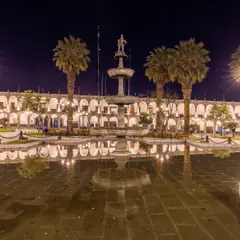
On the corner of the Plaza de Armas, facing it diagonally, stands the Church of the Company of Jesus, the Jesuit church of Arequipa. City and order share a birth year: Garci Manuel de Carbajal founded the town on 15 August 1540, and Ignatius of Loyola obtained papal approval of the Society in Rome six weeks later. What followed was a race against earthquakes. The first church, begun in 1578, came down in 1582; in 1590 a second construction began with the same plans, and the quake of 1687 forced a new reconstruction that concluded in 1698. Sources do not fully agree on that chronology or on the authorship of the plans, which some attribute to Gaspar Báez and others share with the Jesuit Diego Felipe or reduce to «Brother Felipe», but the date on the portal marks the end of the reconstruction, not the origin. The tower is not the first either: it fell in 1868, its replacement collapsed in 1960 and the present one is the third.
The history of the Church of the Company of Jesus is read above all in its architecture. Its portal set a style that spread across southern Peru and the Altiplano, the so-called mestizo Baroque, and its interior and cloisters sum up three centuries of the city’s life: a college, an orphans’ hospice, an auction in lots and a restoration. Knowing what to look at in each relief changes the visit, and the audio guide, documented and checked against historical sources, walks it in five stops from the street to the main cloister.
It shares the square with the Arequipa Cathedral; across the Chili River, the portal of San Juan Bautista, beside the Yanahuara Viewpoint, follows the same mestizo Baroque, and a few blocks to the north the cloister of the Santa Catalina Monastery shows how the nuns of the same viceregal city lived.
The oldest portal and its sirens
Santiago Matamoros side portal
Summary of this stop
On General Morán Street, the side portal is the oldest face of the complex: the stonemason Simón de Barrientos carved it in 1654, before the main one, on a plot where the first church had already collapsed in the earthquake of 1582. In its tympanum, beneath a great scallop shell, the apostle Santiago, patron of the church, rides with sword raised while his horse tramples the heads of Moors and a crescent moon. Around it appear zigzag columns, the lion of Saint Mark and the bull of Saint Luke.
Lower down, a corbel rests on two sirens with angel wings who raise a hand and look toward the saint, as if greeting him. A legend is associated with them that links them to the transfer of the apostle’s body from Palestine to Galicia, although in the medieval accounts of that voyage the boat is guided by the hand of God and by angels, with no trace of sirens. Perhaps the story arose from a later reading of this very portal, and the stop leaves the question open in front of the stone.
A dated ashlar weave
Church of the Company of Jesus
Summary of this stop
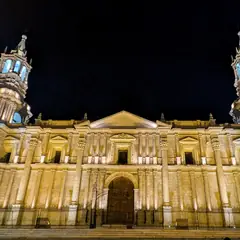
The main portal is organised in two tiers with paired columns on black-stone pedestals, a cedar door with big nails and, high up, the archangel Saint Michael in a niche with a scallop shell, between Habsburg double-headed eagles and beneath a trilobed pediment. Between the columns of the first tier, two cartouches with cherubs read «EL AÑO» and «DE 1698»: they mark not the origin of the temple but the end of the reconstruction after the earthquake of 1687.
The sillar explains the look of the whole frontispiece. Easy to carve but too porous for deep cutting, it forced a flat relief that spills over the portal and covers the wall like a tapestry. In it live together bunches of grapes, pomegranates, Compostela scallop shells and Renaissance mascarons with masks of Nazca tradition, ears of maize, cantuta flowers and a cat-tiger with a myriapod body from Altiplano mythology. Documented tradition holds that the Spanish masters commissioned the fine carving to Indigenous Collagua assistants, with a sensibility trained in weaving, and the historian Antonio San Cristóbal ended up calling this architecture «textile».
That model was copied in the churches of Cayma, Yanahuara, Paucarpata and Characato and travelled across the Altiplano to the cathedral of Puno, Santa Cruz de Juli and Potosí. Half an hour from the centre, in the Añashuayco ravine, the portal even has a twin carved at double scale on the wall of an ashlar quarry, proof that the craft is still alive.
The altarpiece gold and the Holy Tuesday image
Image of the Just Judge and high altarpiece
Summary of this stop
Inside, the nave shows bare sillar and, at the far end, the glow of the high altarpiece covered in gold leaf. Master Juan de Salas assembled it from 447 pieces of cedar, oak and alder and some 21 poles of willow and lloque; the repoussé silver tabernacle is by Pedro Gutiérrez, and at the centre stands a Virgin and Child by Bernardo Bitti. In the right aisle are added the altarpiece of the Founders and a pulpit carved in gold leaf.
By the entrance the Lord Just Judge is venerated, protagonist of a living ritual. Every Holy Tuesday, around half past five in the afternoon, he goes out in procession with Jesús Cautivo, a carving of more than two metres from 1960-1961, and the Virgin of La Macarena. In front of the image walk two barefoot hooded men carrying a cross of rough poles as a penance of thanksgiving, a scene the city has repeated for generations before returning to the church, which the Jesuits still look after.
The chapel of San Ignacio, a jungle beneath the dome
Chapel of San Ignacio
Summary of this stop
To the left of the altar, the former sacristy is now the chapel of San Ignacio. Its half-orange dome with lantern and its walls are covered in vines, exotic flowers, fruit, colourful birds, warriors and angels: a painted tropical forest that recalls the Arequipa Jesuits’ link with their Amazonian missions. On the cornice, eight paintings of saints accompany their relics.
The ensemble, the work of anonymous Indigenous artists, is popularly known as the «Sistine Chapel of Arequipa», a nickname that measures astonishment more than resemblance. And it holds a clue about the whole church: all its interior surfaces were once polychrome, and this chapel is the only one that keeps that colour.
From Jesuit college to cloister shops
Cloisters of the Company
Summary of this stop
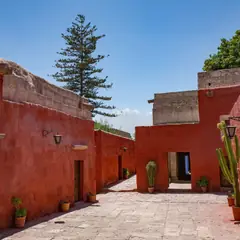
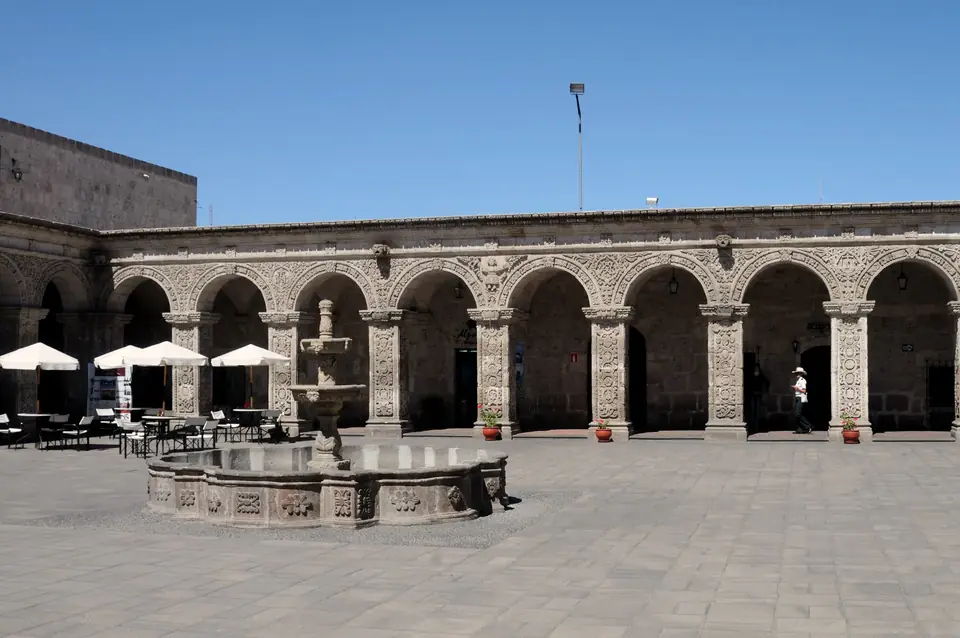
Beside the church, the cloisters of the former College of Santiago were begun in 1677 under Lorenzo de Pantigoso, with sillar from the Chilina quarries worked by Indians, Black slaves and Spaniards. The pilasters of the main cloister, now white and originally painted in several colours, are carved on all four faces with bunches of fruit, papayas, shells, roses, cherubs and small figures of Saint Ignatius and Saint Francis Xavier, and high up peer gargoyles shaped like stylised pumas. At the centre, a fountain brought from Lima receives visitors’ coins, and from the courtyards one can see the sequence of vaults and buttresses of the church that the street does not let one see.
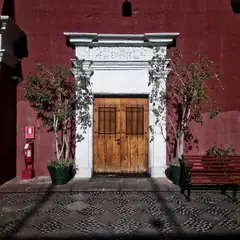
The history of the place takes several turns. The college operated until the expulsion of the Jesuits in 1767, although one source extends it to 1773, and the cloisters passed to the Oratorians of San Felipe Neri; in 1788 part became a hospice for orphans and foundlings, in 1921 the complex was auctioned in eight lots and in 1971 the Banco Central Hipotecario bought and restored it. Today it houses craft shops and restaurants, and the entrance arch no longer shows the completion date it bore until 1973. Beside a closed door of the façade there remain almost faded red inscriptions of old graduations, one of the details the narration recovers on the spot.